Adversarial Barrier in Uniform Class Separation
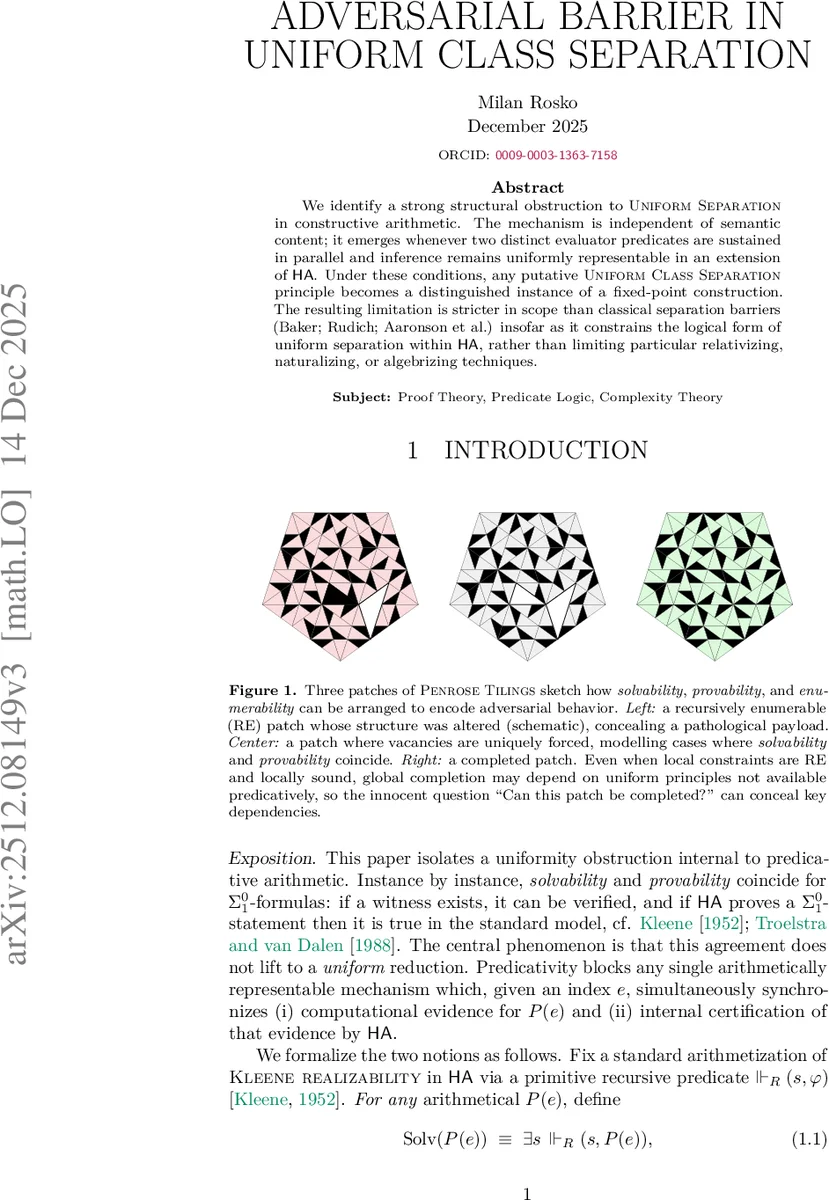
We identify a strong structural obstruction to Uniform Separation in constructive arithmetic. The mechanism is independent of semantic content; it emerges whenever two distinct evaluator predicates are sustained in parallel and inference remains uniformly representable in an extension of HA. Under these conditions, any putative Uniform Class Separation principle becomes a distinguished instance of a fixed point construction. The resulting limitation is stricter in scope than classical separation barriers (Baker; Rudich; Aaronson et al.) insofar as it constrains the logical form of uniform separation within HA, rather than limiting particular relativizing, naturalizing, or algebrizing techniques.
💡 Research Summary
The paper establishes a structural impossibility result for “Uniform Class Separation” within constructive arithmetic, i.e., Heyting Arithmetic (HA). The authors begin by formalizing Kleene realizability inside HA using a primitive‑recursive predicate ⊩R(s,φ). For any arithmetical formula P(e) they define two notions: Solv(P(e)) ≡ ∃s ⊩R(s,P(e)) (solvability) and ProvHA(P(e)) ≡ ProvHA(⌜P(e)⌝) (provability in HA). For Σ₀¹ formulas these two coincide extensionally, but the paper’s focus is on the uniform transformation that would turn solvability evidence into provability evidence for all indices simultaneously.
Uniform Class Separation is expressed as Sep(A,B) ≡ ∀e (A(e) → ¬B(e)). Assuming a realizer for Sep(A,B) exists, the authors show that HA can extract a total primitive‑recursive operator r such that for every index e, r(e) takes any realizers of A(e) and B(e) and produces a contradiction (⊥). From r they define a “uniform classifier interface” Cl(e): it outputs A if Solv(A(e)) holds, B if Solv(B(e)) holds, and ⊥ otherwise. Crucially, Cl is not merely a semantic decision procedure; HA is required to prove that whenever Cl outputs A (resp. B) the corresponding formula A(e) (resp. B(e)) is provable in HA. This “provability‑upgrade” is an extra reflection‑type principle beyond ordinary realizability.
The core of the barrier is a diagonal construction. The authors introduce the formula θ(x) ≡ (ClA(x) → B(x)) ∧ (ClB(x) → A(x)) and use the Diagonal Lemma to obtain a fixed point d = diag(⌜θ(v)⌝). Inside HA one proves D ↔ θ(d). Assuming the provability‑upgrade for Cl and a “live” condition guaranteeing that for every live index at least one of ClA or ClB holds, HA derives the two conditional statements: ClA(d) → ProvHA(A(d)) and ClB(d) → ProvHA(B(d)). Combined with D ↔ θ(d) this yields a contradiction unless HA also proves the reflection principle ProvHA(⌜D⌝) → D. The authors show that such a local reflection principle is not available in predicative HA; consequently the assumed uniform separator cannot exist.
The paper’s structure follows four stages:
- Realizability Framework – defines ⊩R, Solv, and ProvHA, and records basic facts about their primitive‑recursive representability.
- Uniform Refutation Extraction – from a realizer for Sep(A,B) extracts the total refuter r and builds the classifier interface Cl, together with the provability‑upgrade requirement.
- Diagonal Fixed‑Point Construction – defines θ, constructs the diagonal index d, and proves the conditional obligations inside HA.
- Barrier Theorem and Corollaries – shows that any further principle forcing Cl to commit on d and upgrading provability to truth leads to inconsistency, unless one assumes an unavailable reflection principle.
The authors emphasize that the argument is completely semantic‑free: it does not rely on any particular computational hardness of A or B, nor on specific complexity‑theoretic techniques such as relativization, natural proofs, or algebrization. The obstruction is purely logical: demanding a uniformly arithmetically representable classifier whose outputs must be internally certified creates a self‑referential object that HA cannot consistently accommodate.
In the discussion, the authors connect the barrier to the P vs. NP question by illustrating how a uniform meta‑classification task that tries to certify its own correctness would fall prey to the same diagonal loop. They argue that any attempt to formulate a uniform resolution schema for such problems inevitably embeds the classifier’s code as an input, reproducing the adversarial construction at a higher meta‑level.
Overall, the paper contributes a novel “adversarial barrier” that is stronger in scope than earlier complexity‑theoretic barriers. It shows that within HA, uniform class separation is impossible because it would require a predicative system to prove a reflection principle that it fundamentally lacks. This result suggests that future work on uniform separation must either weaken the uniformity requirement, abandon internal certification, or work in stronger logical systems that can support the necessary reflection.
Comments & Academic Discussion
Loading comments...
Leave a Comment