Lyapunov maximizing measures for balanced pairs of matrices
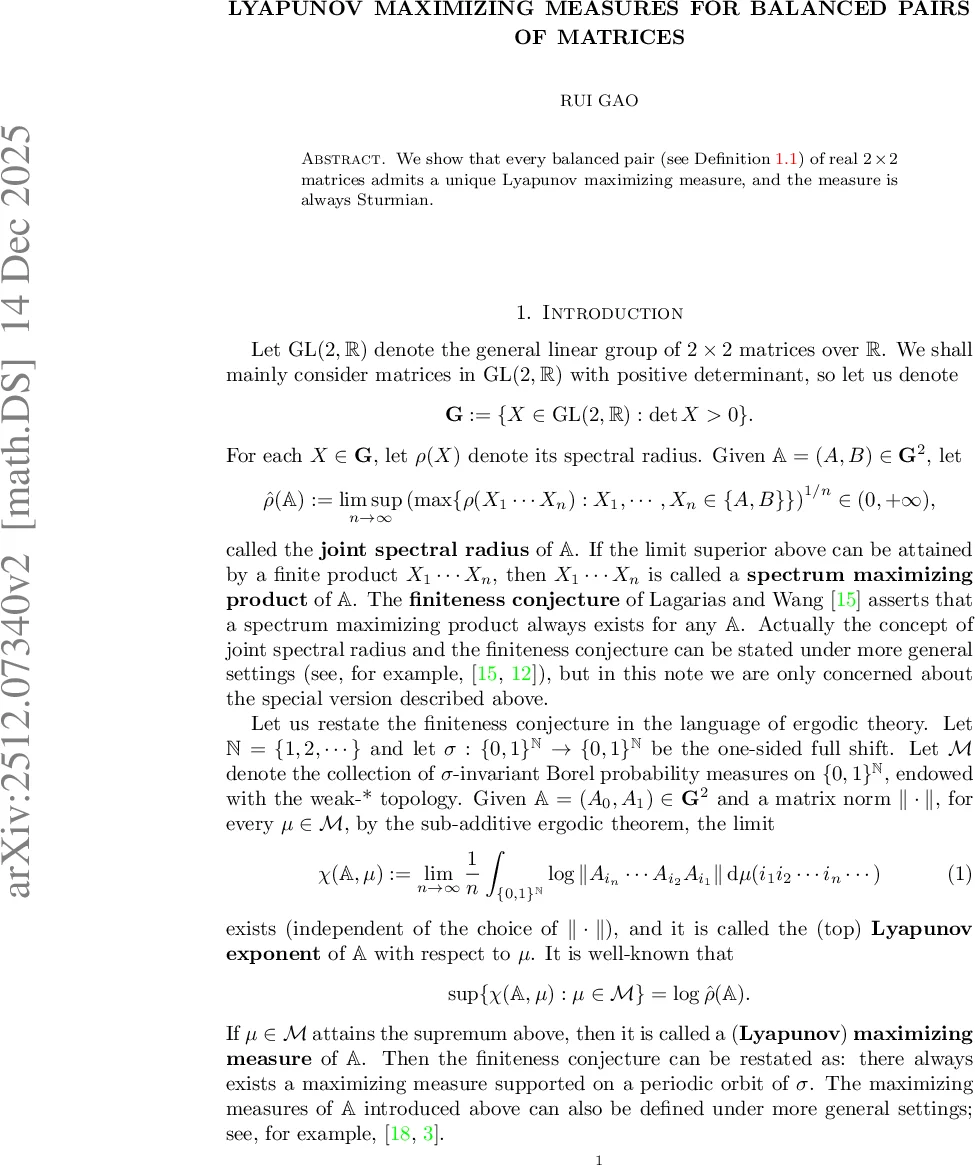
We show that every balanced pair (see Definition 1.1) of real $2\times 2$ matrices admits a unique Lyapunov maximizing measure, and the measure is always Sturmian.
💡 Research Summary
This paper addresses a fundamental problem in the field of ergodic theory and the study of random matrix products: the characterization of Lyapunov maximizing measures. The Lyapunov exponent represents the asymptotic rate of growth of the norm of a product of matrices, and finding the measure that maximizes this exponent is a complex optimization problem over the space of invariant measures.
The authors focus on the specific case of real $2\times 2$ matrix pairs that satisfy a “balanced” condition. The “balanced” property is a crucial constraint that prevents extreme discrepancies in the action of the matrices on the projective line, thereby providing a controlled environment for mathematical analysis. The primary contribution of this work is twofold: first, it proves that for every balanced pair of $2\times 2$ matrices, there exists a unique Lyapunov maximizing measure. Second, it demonstrates that this unique measure is always of a Sturmian type.
The identification of the maximizing measure as “Sturmian” is particularly significant. In symbolic dynamics, Sturmian sequences are known as the most “ordered” or “low-complexity” non-periodic sequences, often arising from irrational rotations on a circle. By proving that the maximizing measure is Sturmian, the authors establish a profound link between the growth rates of matrix products and the theory of rotation-based dynamical systems. This implies that the optimal growth pattern is not chaotic or purely random, but rather follows a highly structured, quasi-periodic pattern.
This result provides a complete classification for the maximizing measures of balanced $2\times 2$ matrix pairs, resolving the question of both existence, uniqueness, and structural identity. Such a finding has significant implications for understanding the stability of dynamical systems and provides a powerful tool for analyzing the asymptotic behavior of matrix-valued stochastic processes.
Comments & Academic Discussion
Loading comments...
Leave a Comment