Distributed Optimization of Bivariate Polynomial Graph Spectral Functions via Subgraph Optimization
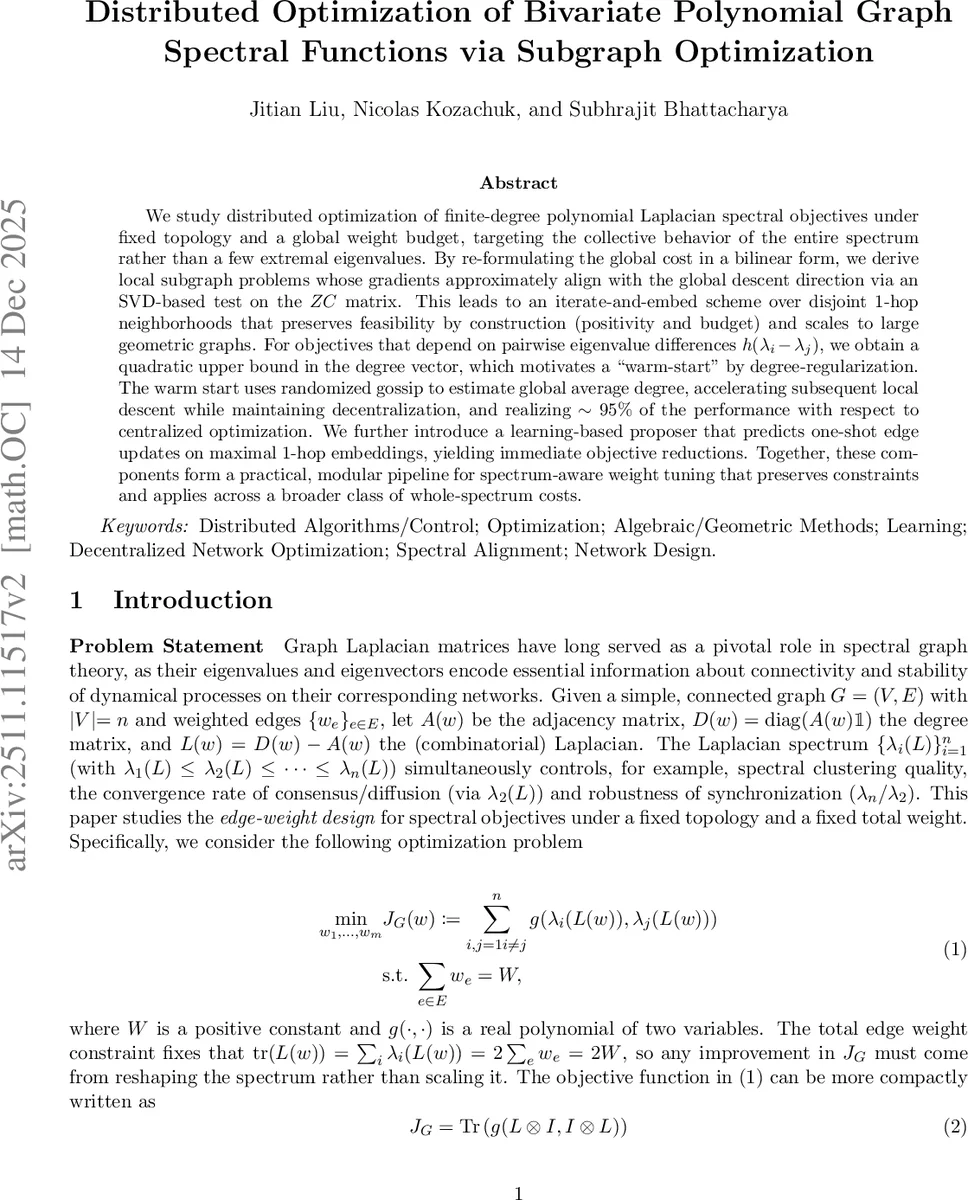
We study distributed optimization of finite-degree polynomial Laplacian spectral objectives under fixed topology and a global weight budget, targeting the collective behavior of the entire spectrum rather than a few extremal eigenvalues. By re-formulating the global cost in a bilinear form, we derive local subgraph problems whose gradients approximately align with the global descent direction via an SVD-based test on the (ZC) matrix. This leads to an iterate-and-embed scheme over disjoint 1-hop neighborhoods that preserves feasibility by construction (positivity and budget) and scales to large geometric graphs. For objectives that depend on pairwise eigenvalue differences (h(λ_i-λ_j)), we obtain a quadratic upper bound in the degree vector, which motivates a ``warm-start’’ by degree-regularization. The warm start uses randomized gossip to estimate global average degree, accelerating subsequent local descent while maintaining decentralization, and realizing $\sim95%{}$ of the performance with respect to centralized optimization. We further introduce a learning-based proposer that predicts one-shot edge updates on maximal 1-hop embeddings, yielding immediate objective reductions. Together, these components form a practical, modular pipeline for spectrum-aware weight tuning that preserves constraints and applies across a broader class of whole-spectrum costs.
💡 Research Summary
This paper presents a novel distributed framework for optimizing the entire spectrum of a graph Laplacian, moving beyond the traditional focus on extremal eigenvalues like algebraic connectivity. The core problem is to minimize a bivariate polynomial objective function J_G = Σ_{i≠j} g(λ_i, λ_j) over the edge weights of a fixed-topology graph, subject to a global weight budget constraint. This formulation captures collective spectral behavior, relevant for applications like spectral dispersion minimization.
The primary challenge is the non-local nature of J_G’s gradient, which depends on traces of Laplacian powers (Tr(L^p)) requiring global information. The authors’ key innovation is the “subgraph alignment” strategy. They reformulate J_G using a Kronecker product representation and theoretically analyze conditions under which the gradient of a local objective J_H, defined on an expanded subgraph H, aligns with the direction of the global gradient ∇J_G. This alignment is linked to how well the spectral moments (Tr(L_H^p)) approximate the global moments within a subgraph’s “core” region, which is at least d-hops away from the boundary, where d is the polynomial degree.
Based on this insight, they design a practical “iterate-and-embed” algorithm. The graph is partitioned into non-overlapping 1-hop neighborhoods. Each agent responsible for a neighborhood constructs a local subgraph H encompassing its core (the edges to be updated) and a surrounding buffer region (2-4 hops). It then solves a local constrained optimization problem minimizing J_H over the weights in H. Only the optimized weights for the core edges are embedded back into the global graph. This process inherently maintains the positivity and global budget constraints.
A significant secondary contribution is the analysis for the special case where g(λ_i, λ_j) = h(λ_i - λ_j). For analytic h with non-negative even-power coefficients, they prove an upper bound showing J_G is dominated by the squared differences in vertex degrees. This motivates a “warm-start” via degree regularization: first making vertex degrees as uniform as possible given the topology. A distributed randomized gossip protocol estimates the global average degree, followed by local optimization within each neighborhood to match this average. This warm-start significantly accelerates the subsequent spectral optimization phase.
Furthermore, the authors develop a learning-based proposer as a baseline. A deep neural network is trained on data from centralized optimization to predict one-shot weight updates for maximal 1-hop embeddings. While not outperforming the optimization-based method, it demonstrates an alternative data-driven approach.
Experimental results on large geometric graphs (random geometric graphs, stochastic block models) show that the proposed distributed pipeline (warm-start + local subgraph optimization) achieves approximately 95% of the performance of centralized optimization while dramatically reducing computational load and enabling scalability. The work provides a modular, practical, and scalable solution for distributed weight tuning targeting complex whole-spectrum objectives, broadening the scope of decentralized network design.
Comments & Academic Discussion
Loading comments...
Leave a Comment