On the Dirichlet problem for the degenerate $k$-Hessian equation
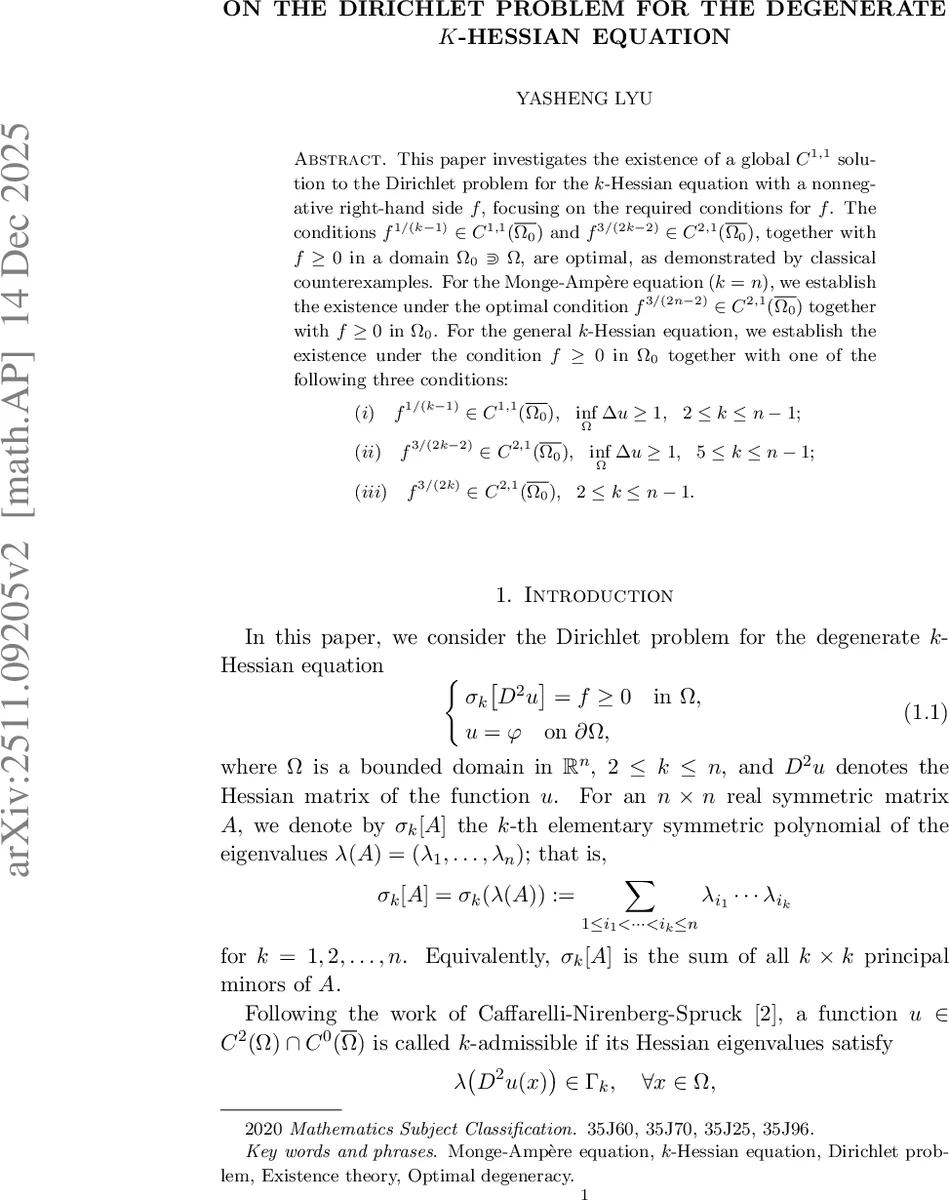
This paper investigates the existence of a global $C^{1,1}$ solution to the Dirichlet problem for the $k$-Hessian equation with a nonnegative right-hand side $f$, focusing on the required conditions for $f$. The conditions $f^{1/(k-1)}\in C^{1,1}(\overline{Ω_{0}})$ and $f^{3/(2k-2)}\in C^{2,1}(\overline{Ω_{0}})$, together with $f\geq0$ in a domain $Ω_{0}\SupsetΩ$, are optimal, as demonstrated by classical counterexamples. For the Monge-Ampère equation ($k=n$), we establish the existence under the optimal condition $f^{3/(2n-2)}\in C^{2,1}(\overline{Ω_{0}})$ together with $f\geq0$ in $Ω_{0}$. For the general $k$-Hessian equation, we establish the existence under the condition $f\geq0$ in $Ω_{0}$ together with one of the following three conditions: \begin{align*} &(1)\quad f^{1/(k-1)}\in C^{1,1}(\overline{Ω_{0}}),\ \ \inf_ΩΔu\geq1,\ \ 2\leq k\leq n-1;\ &(2)\quad f^{3/(2k-2)}\in C^{2,1}(\overline{Ω_{0}}),\ \ \inf_ΩΔu\geq1,\ \ 5\leq k\leq n-1;\ &(3)\quad f^{3/(2k)}\in C^{2,1}(\overline{Ω_{0}}),\ \ 2\leq k\leq n-1. \end{align*}
💡 Research Summary
This paper investigates the existence of global C¹,¹ solutions to the Dirichlet problem for the degenerate k-Hessian equation, σₖ(D²u) = f ≥ 0 in Ω, u = φ on ∂Ω, where f is allowed to vanish at some points. The central goal is to establish the optimal regularity conditions on the non-negative right-hand side f that guarantee the existence of a solution.
The main results are divided into three theorems. First, for the Monge-Ampère equation (k=n), Theorem 1.1 establishes the existence of a unique convex C¹,¹ solution under the optimal condition f³/(²ⁿ⁻²) ∈ C²,¹(Ω₀) and f ≥ 0 in Ω₀ (where Ω ⋐ Ω₀), provided the domain is uniformly convex with C³,¹ boundary and the boundary data φ is in C³,¹. The proof employs the method of Guan-Trudinger-Wang, which relies on the convexity of solutions and the affine invariance of the equation.
For the general k-Hessian equation (2 ≤ k ≤ n-1), the paper provides two key estimates. Theorem 1.2 establishes a “weak interior estimate”: under the condition that either f¹/(k-¹) ∈ C¹,¹(Ω₀) or (for k ≥ 5) f³/(²k-²) ∈ C²,¹(Ω₀), the second derivatives of an admissible solution satisfy |D²u(x)| ≤ (ε sup_∂Ω |D²u| + C_ε) / dist(x, ∂Ω) for any ε > 0. The constant C_ε is independent of the infimum of f, which is crucial for the degenerate case. The proof uses techniques inspired by the works of Ivochkina-Trudinger-Wang and Krylov.
The final existence result, Theorem 1.3, states that for the general k-Hessian equation, there exists a unique k-admissible C¹,¹ solution if f ≥ 0 in Ω₀ and one of the following three sets of conditions holds: (i) f¹/(k-¹) ∈ C¹,¹(Ω₀), inf_Ω Δu ≥ 1, for 2 ≤ k ≤ n-1; (ii) f³/(²k-²) ∈ C²,¹(Ω₀), inf_Ω Δu ≥ 1, for 5 ≤ k ≤ n-1; (iii) f³/(²k) ∈ C²,¹(Ω₀), for 2 ≤ k ≤ n-1. The proof combines the weak interior estimate of Theorem 1.2 with a boundary estimate for the second-order normal derivative. The additional condition inf Δu ≥ 1 in (i) and (ii) is required for this boundary estimate and remains a subtle point; the author notes that removing it would completely resolve the open problem posed by Ivochkina-Trudinger-Wang regarding the condition f¹/(k-¹) ∈ C¹,¹.
The paper includes a crucial technical lemma (Lemma 2.1) that provides pointwise inequalities for functions g > 0 in an enlarged domain Ω₀. It shows that if g ∈ C¹,¹(Ω₀), then |∇g|²/g is bounded, and if g ∈ C²,¹(Ω₀), then ∂ₑₑg - α|∂ₑg|²/g ≥ -K g¹/³ for any α < 1/2. These inequalities, applied to g = f¹/(k-¹) or g = f³/(²k-²), yield estimates independent of inf f and are fundamental to the subsequent proofs.
Overall, the paper significantly advances the understanding of the degenerate k-Hessian equation by identifying optimal or near-optimal regularity conditions on f for the existence of C¹,¹ solutions, unifying and extending previous methods for the Monge-Ampère and k-Hessian cases.
Comments & Academic Discussion
Loading comments...
Leave a Comment