Human-Like Robot Impedance Regulation Skill Learning from Human-Human Demonstrations
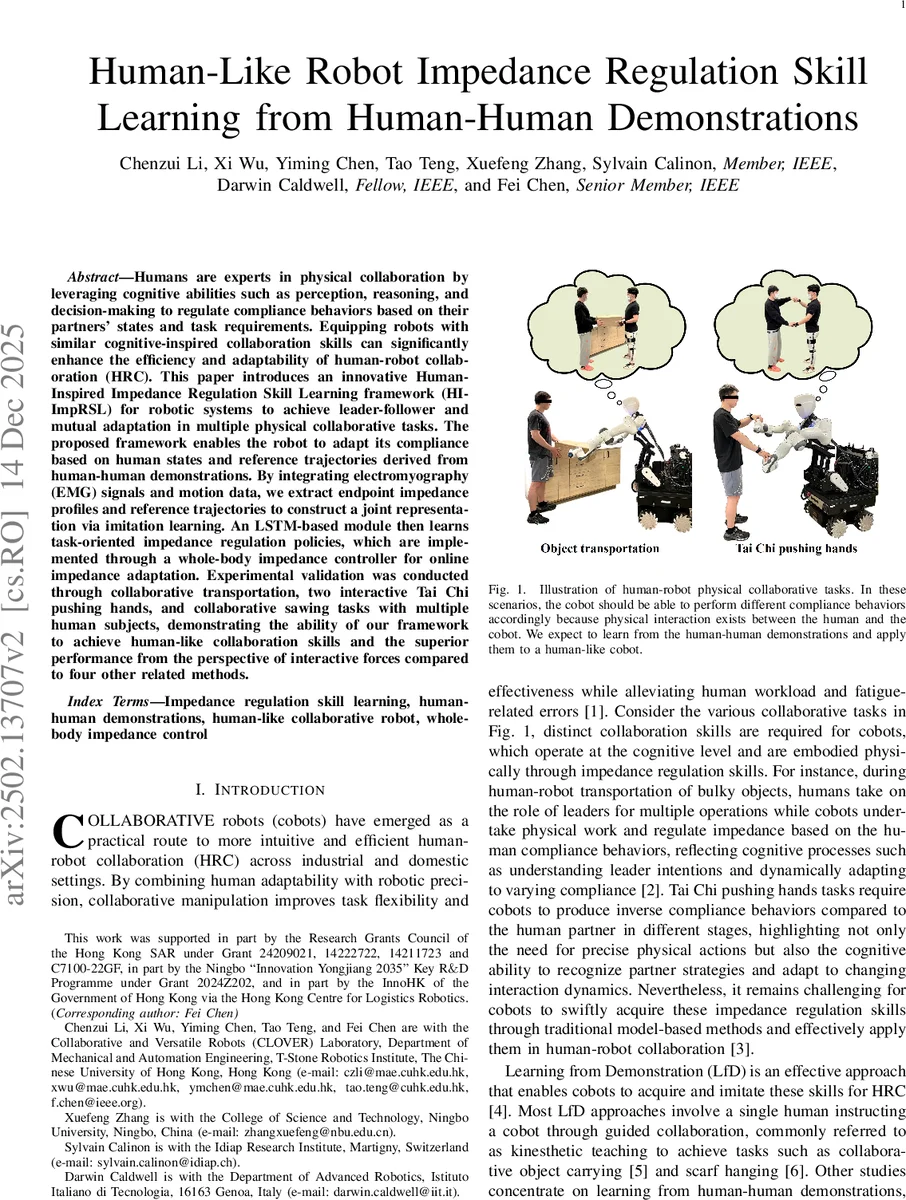
Humans are experts in physical collaboration by leveraging cognitive abilities such as perception, reasoning, and decision-making to regulate compliance behaviors based on their partners’ states and task requirements. Equipping robots with similar cognitive-inspired collaboration skills can significantly enhance the efficiency and adaptability of human-robot collaboration (HRC). This paper introduces an innovative HumanInspired Impedance Regulation Skill Learning framework (HIImpRSL) for robotic systems to achieve leader-follower and mutual adaptation in multiple physical collaborative tasks. The proposed framework enables the robot to adapt its compliance based on human states and reference trajectories derived from human-human demonstrations. By integrating electromyography (EMG) signals and motion data, we extract endpoint impedance profiles and reference trajectories to construct a joint representation via imitation learning. An LSTM-based module then learns task-oriented impedance regulation policies, which are implemented through a whole-body impedance controller for online impedance adaptation. Experimental validation was conducted through collaborative transportation, two interactive Tai Chi pushing hands, and collaborative sawing tasks with multiple human subjects, demonstrating the ability of our framework to achieve human-like collaboration skills and the superior performance from the perspective of interactive forces compared to four other related methods.
💡 Research Summary
**
The paper introduces a novel learning framework called Human‑Inspired Impedance Regulation Skill Learning (HI‑ImpRSL) that enables robots to acquire human‑like compliance behaviors from human‑human demonstrations. Recognizing that effective physical collaboration depends on cognitive processes that modulate mechanical impedance (stiffness and damping) according to a partner’s state and task demands, the authors propose a pipeline that fuses electromyography (EMG) and motion data to extract endpoint impedance profiles and reference trajectories, learns a joint representation with Task‑Parameterized Gaussian Mixture Models (TP‑GMM), and finally trains a Long Short‑Term Memory (LSTM) network to generate online impedance regulation policies.
Key technical contributions are:
-
EMG‑Based Stiffness Estimation – By modeling the co‑contraction index α(A) from biceps and triceps EMG, and using a geometric arm model, the endpoint stiffness matrix Kₑ is expressed as V H Vᵀ. Subject‑specific parameters (a₁, a₂, b₁, b₂) are identified through offline perturbation experiments, allowing real‑time stiffness estimation from processed EMG during demonstrations.
-
Joint Motion‑Impedance Representation – TP‑GMM captures both the demonstrated Cartesian trajectories and the associated stiffness/damping profiles, conditioned on task variables such as start‑goal configurations and collaborator kinematics. This yields a compact, generative model that can be re‑parameterized for new situations without retraining.
-
LSTM‑Based Policy Learning – The temporal dynamics of human compliance are learned by feeding the LSTM with sequential EMG features and the current impedance state. The network outputs desired stiffness and damping values, effectively mapping physiological signals to control parameters in real time. The policy generalizes across subjects and tasks, as demonstrated in both human‑human and human‑robot validation experiments.
-
Whole‑Body Variable Impedance Controller – The robot platform (a mobile base with a torso and two manipulators) is controlled by a whole‑body impedance controller that integrates the LQT‑based trajectory tracking with the learned impedance policy. Desired Cartesian stiffness/damping are translated into joint torques for coordinated whole‑body motion.
Experimental validation involved three representative collaborative scenarios: (i) collaborative transportation of a bulky load (leader‑follower mode), (ii) unimanual and bimanual Tai Chi “pushing hands” (mutual‑adaptation mode), and (iii) cooperative sawing (alternating force application). Multiple human subjects participated, providing diverse EMG and motion datasets. The proposed HI‑ImpRSL was benchmarked against four baselines: fixed impedance control, force‑feedback adaptive impedance, a prior EMG‑based variable impedance method, and a GMM‑DMP approach without impedance learning.
Results show that HI‑ImpRSL consistently reduces interaction forces by roughly 30 % compared with the baselines, improves task success rates, and yields higher subjective comfort scores from participants. The LSTM policy adapts quickly to changes in partner intent, enabling smooth role switching in mutual‑adaptation tasks. Moreover, the TP‑GMM representation allows the robot to reproduce learned behaviors under novel start‑goal configurations, demonstrating strong generalization.
In summary, the paper delivers a comprehensive, data‑driven solution for endowing robots with human‑like impedance regulation skills. By integrating physiological sensing, probabilistic motion‑impedance modeling, and deep sequential policy learning, the framework bridges the gap between high‑level cognitive collaboration concepts and low‑level physical control. The work advances the state of the art in Learning from Demonstration for physical human‑robot interaction and opens avenues for incorporating additional biosignals and higher‑order cognitive models to achieve even richer collaborative capabilities.
Comments & Academic Discussion
Loading comments...
Leave a Comment