Huber Theorem revisited in dimensions 2 and 4
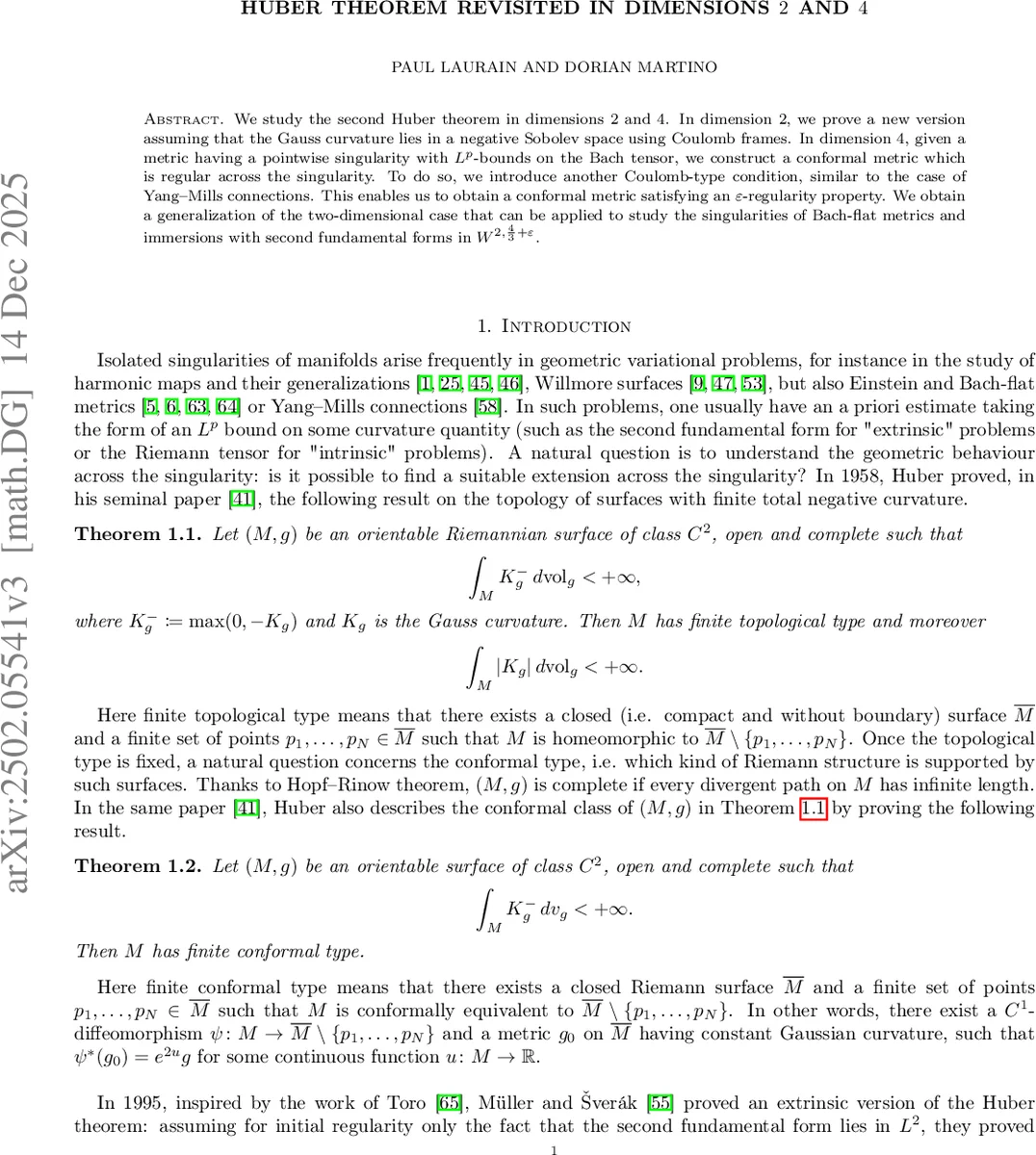
We study the second Huber theorem in dimensions 2 and 4. In dimension 2, we prove a new version assuming that the Gauss curvature lies in a negative Sobolev space using Coulomb frames. In dimension $4$, given a metric having a pointwise singularity with $L^p$-bounds on the Bach tensor, we construct a conformal metric which is regular across the singularity. To do so, we introduce another Coulomb-type condition, similar to the case of Yang–Mills connections. This enables us to obtain a conformal metric satisfying an $\varepsilon$-regularity property. We obtain a generalization of the two-dimensional case that can be applied to study the singularities of Bach-flat metrics and immersions with second fundamental forms in $W^{2,\frac{4}{3}+\varepsilon}$.
💡 Research Summary
The paper “Huber Theorem revisited in dimensions 2 and 4” presents a profound advancement in the field of geometric analysis, specifically focusing on the extension of the classical Huber Theorem to more singular and higher-dimensional settings. The Huber Theorem is a fundamental result in the study of complete surfaces, relating the integral of the Gauss curvature to the underlying topology and regularity of the manifold. This research pushes these boundaries into the realms of 2D and 4D geometries with significantly relaxed regularity conditions.
In the two-dimensional context, the authors address the challenge of dealing with highly irregular Gauss curvature. By moving beyond classical smoothness and considering cases where the Gauss curvature resides in a negative Sobolev space, they establish a new, more robust version of the theorem. The methodological breakthrough here is the application of “Coulomb frames,” a technique borrowed from gauge theory. This allows the researchers to handle distributions of curvature that are much “rougher” than previously possible, providing a way to regularize the geometric structure even when the curvature is not a well-behaved function.
The transition to four dimensions introduces a much higher level of complexity, as the focus shifts to the Bach tensor, a critical object in conformal geometry. The authors investigate metrics that possess pointwise singularities but maintain $L^p$-bounds on the Bach tensor. To resolve the singularity, they introduce a novel “Coulomb-type condition,” drawing direct inspiration from the mathematical framework used in the study of Yang-Mills connections. Through this approach, they successfully construct a conformal metric that remains regular even across the singularity, effectively “smoothing out” the problematic points of the original metric.
A pivotal achievement of this work is the derivation of an $\varepsilon$-regularity property. This property is a cornerstone of modern geometric analysis, implying that if the local energy of the curvature-related tensor (the Bach tensor) is sufficiently small, the metric itself exhibits controlled regularity. This provides a powerful mechanism for studying the convergence of sequences of metrics and the nature of singularities in higher-dimensional conformal geometry.
The implications of this research are far-reaching. The findings provide a rigorous mathematical foundation for studying the singularities of Bach-flat metrics, which are essential in the study of conformal invariants and general relativity. Furthermore, the results extend to the study of immersions where the second fundamental form is constrained within the $W^{2, \frac{4}{3}+\varepsilon}$ Sobolev space. Ultimately, this paper bridges the gap between classical surface theory and modern gauge-theoretic methods, offering new, powerful tools for analyzing singular geometric structures in both 2D and 4D manifolds.
Comments & Academic Discussion
Loading comments...
Leave a Comment