Navigating AI to Unpack Youth Privacy Concerns: An In-Depth Exploration and Systematic Review
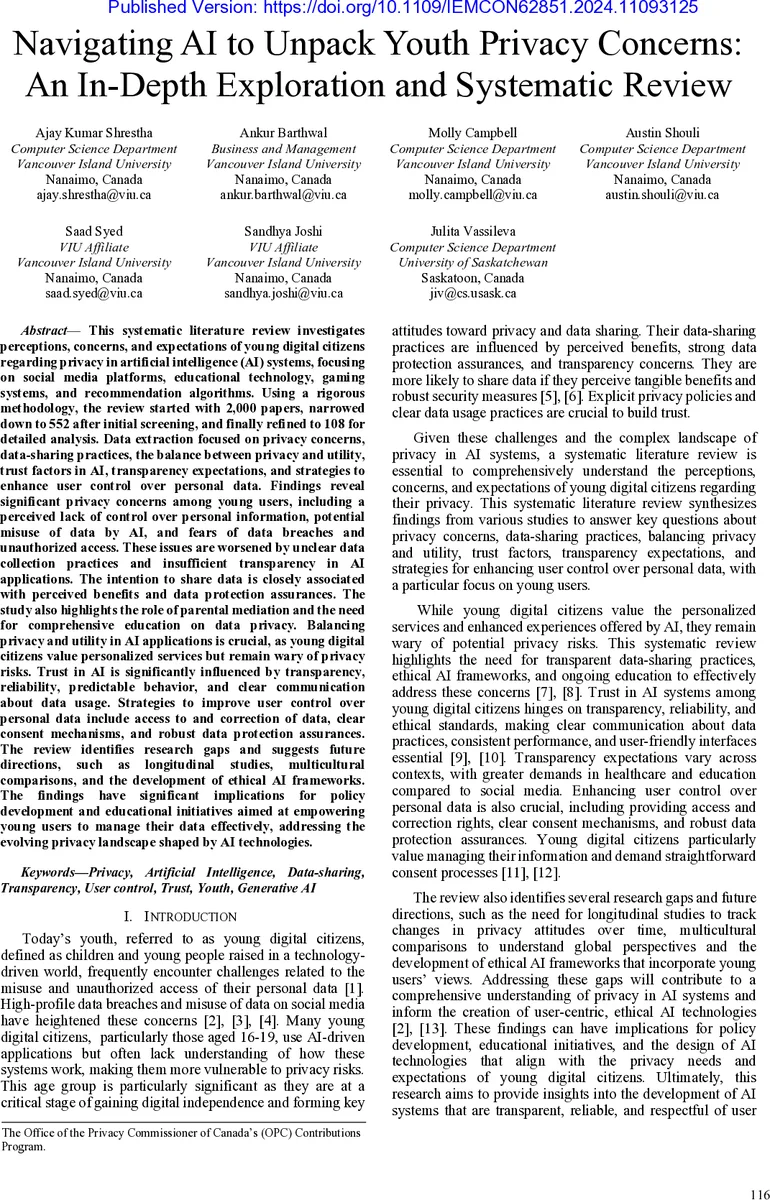
This systematic literature review investigates perceptions, concerns, and expectations of young digital citizens regarding privacy in artificial intelligence (AI) systems, focusing on social media platforms, educational technology, gaming systems, and recommendation algorithms. Using a rigorous methodology, the review started with 2,000 papers, narrowed down to 552 after initial screening, and finally refined to 108 for detailed analysis. Data extraction focused on privacy concerns, data-sharing practices, the balance between privacy and utility, trust factors in AI, transparency expectations, and strategies to enhance user control over personal data. Findings reveal significant privacy concerns among young users, including a perceived lack of control over personal information, potential misuse of data by AI, and fears of data breaches and unauthorized access. These issues are worsened by unclear data collection practices and insufficient transparency in AI applications. The intention to share data is closely associated with perceived benefits and data protection assurances. The study also highlights the role of parental mediation and the need for comprehensive education on data privacy. Balancing privacy and utility in AI applications is crucial, as young digital citizens value personalized services but remain wary of privacy risks. Trust in AI is significantly influenced by transparency, reliability, predictable behavior, and clear communication about data usage. Strategies to improve user control over personal data include access to and correction of data, clear consent mechanisms, and robust data protection assurances. The review identifies research gaps and suggests future directions, such as longitudinal studies, multicultural comparisons, and the development of ethical AI frameworks. The findings have significant implications for policy development and educational initiatives
💡 Research Summary
This paper, titled “Navigating AI to Unpack Youth Privacy Concerns: An In-Depth Exploration and Systematic Review,” presents a comprehensive systematic literature review investigating the perceptions, concerns, and expectations of young digital citizens (youth) regarding privacy in artificial intelligence (AI) systems. The review focuses on contexts such as social media, educational technology, gaming, and recommendation algorithms.
Employing a rigorous systematic review methodology, the authors began with an initial pool of approximately 2,000 papers gathered from major academic databases like IEEE Xplore, Scopus, and ACM Digital Library. Through a multi-stage screening process involving deduplication, title/abstract screening, and full-text review based on strict inclusion/exclusion criteria, the final set for in-depth analysis was refined to 108 highly relevant studies. The analysis was structured around seven core research questions (RQs) addressing key themes: predominant privacy concerns, the privacy-utility balance, data-sharing practices, trust factors in AI, transparency expectations, strategies for user control, and identified research gaps.
The synthesis reveals that young users acknowledge the significant benefits of AI, including personalized services and enhanced experiences. However, these are heavily tempered by substantial privacy concerns. The primary fears stem from a perceived lack of control over personal data, opaque data collection and processing practices by AI systems, and the potential for misuse, such as in targeted advertising or malicious activities. High-profile data breaches further exacerbate anxiety about the security of their information. This creates a clear “privacy-utility paradox,” where youth are caught between valuing AI’s functionality and fearing its risks to their personal information.
Trust in AI systems among young citizens is found to be highly contingent on transparency, reliability, and predictable behavior. Clear communication about how data is used is paramount, with expectations for transparency being particularly high in sensitive domains like healthcare and education. To empower users, the literature suggests effective strategies include providing rights to access and correct data, implementing clear and straightforward consent mechanisms, and ensuring robust data protection assurances like encryption.
The review also highlights the critical role of external factors, such as parental mediation and comprehensive digital privacy education, in shaping youth’s ability to navigate AI privacy landscapes. Finally, the authors identify important avenues for future research, including longitudinal studies to track evolving attitudes, cross-cultural comparisons to understand global perspectives, and the development of ethical AI frameworks that actively incorporate the views and needs of young users. The findings offer valuable evidence-based insights for policymakers, educators, and AI designers aiming to create technologies that are not only innovative and useful but also respectful of the privacy rights and concerns of the younger generation.
Comments & Academic Discussion
Loading comments...
Leave a Comment