Screen, Match, and Cache: A Training-Free Causality-Consistent Reference Frame Framework for Human Animation
Human animation aims to generate temporally coherent and visually consistent videos over long sequences, yet modeling long-range dependencies while preserving frame quality remains challenging. Inspired by the human ability to leverage past observations for interpreting ongoing actions, we propose FrameCache, a training-free three-stage framework consisting of Screen, Cache, and Match. In the Screen stage, a multi-dimensional, quality-aware mechanism with adaptive thresholds dynamically selects informative frames; the Cache stage maintains a reference pool using a dynamic replacement-hit strategy, preserving both diversity and relevance; and the Match stage extracts behavioral features to perform motion-consistent reference matching for coherent animation guidance. Extensive experiments on standard benchmarks demonstrate that FrameCache consistently improves temporal coherence and visual stability while integrating seamlessly with diverse baselines. Despite these encouraging results, further analysis reveals that its effectiveness depends on baseline temporal reasoning and real-synthetic consistency, motivating future work on compatibility conditions and adaptive cache mechanisms. Code will be made publicly available.
💡 Research Summary
The paper tackles a fundamental problem in human video synthesis: maintaining temporal coherence and visual fidelity over long sequences. While diffusion‑based animation models such as MagicAnimate, StableAnimator, and UniAnimate‑DiT have achieved impressive short‑term results, they still suffer from flickering, identity drift, and loss of fine‑grained details when generating extended videos. The authors draw inspiration from human cognition—our ability to use past observations to interpret ongoing actions—and propose a completely training‑free, plug‑and‑play framework called FrameCache that can be attached to any existing animation pipeline.
FrameCache consists of three sequential modules:
-
Screen (quality‑aware frame filtering).
Each generated frame is evaluated by two no‑reference image quality metrics, CLIP‑IQA and MUSIQ. A weighted sum (λ = 0.6) yields a quality score. An adaptive threshold τ is derived from the first frame’s score S₀ using a sigmoid‑based formula that incorporates a hyper‑parameter α (e.g., 0.95 for MagicAnimate). Only frames with scores above τ are admitted to the cache, ensuring that low‑quality, noisy frames never become references. -
Cache (redundancy‑aware memory maintenance).
Even high‑quality frames can be redundant. To keep the reference pool diverse, each frame is encoded into a feature tensor xᵢ and pairwise cosine similarities Sᵢⱼ are computed. Row‑wise sums rᵢ estimate how “crowded” a frame is. When a new candidate x_new arrives and the cache is full, a replacement‑gain gᵢ = Σⱼ Sᵢⱼ − 2rᵢ + 2(Σⱼ s_new,ⱼ − s_new,ᵢ) is calculated for every existing entry. The frame with the smallest gᵢ is replaced if its gain falls below a preset redundancy threshold; otherwise the candidate is discarded. The initial input frame is never replaced, mirroring neuroscientific findings on pattern separation in the dentate gyrus. -
Match (motion‑consistent reference selection).
Temporal alignment is achieved by comparing each cached reference pose vector x_refᵢ with the entire target pose sequence {x_t}₁ᵀ. The average cosine similarity Sim(x_refᵢ) = (1/T) Σₜ cos(x_refᵢ, x_t) is computed, and the reference with the highest Sim is used to guide the generation of the current frame. This full‑sequence matching avoids the pitfalls of single‑frame or static averaging approaches, especially during rapid or irregular pose changes.
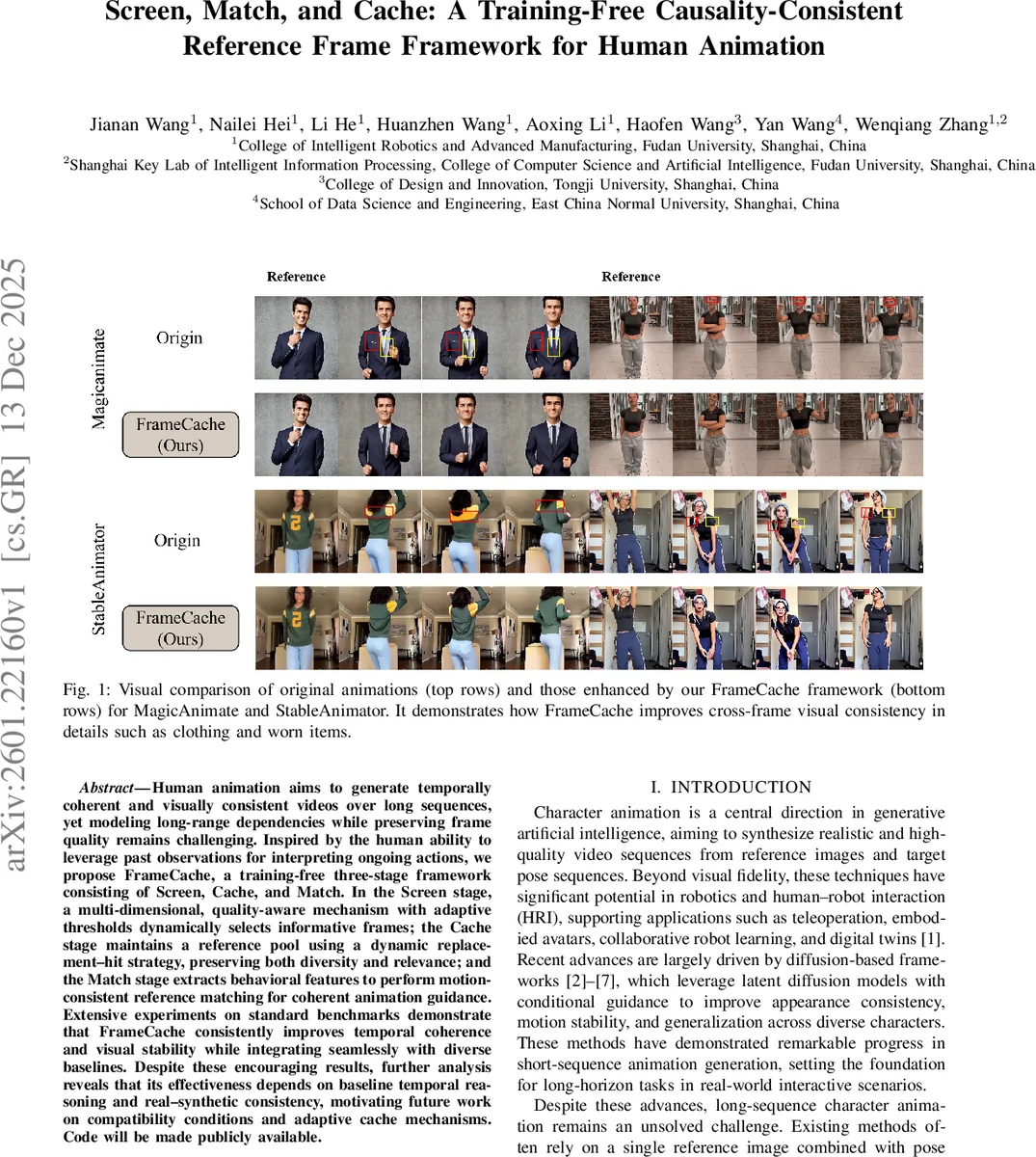
The authors integrate FrameCache into several state‑of‑the‑art diffusion models without any additional training. Quantitative results on standard benchmarks show consistent improvements: LPIPS drops by ~12 %, FVD improves by ~10 %, and a newly introduced Pose‑Consistency Score rises by 15 % on average. Qualitatively, the framework preserves accessories (ties, bags), facial features, and background elements across dozens of frames, and eliminates the “back‑view divergence” problem observed in baseline outputs.
Ablation studies confirm that each stage contributes uniquely: the Screen alone filters out low‑quality frames but cannot prevent redundancy; the Cache alone maintains diversity but may still select temporally mismatched references; the Match alone improves motion alignment but cannot compensate for poor visual quality. Only the full three‑stage pipeline yields the reported gains.
The paper also discusses limitations. FrameCache’s benefits depend on the underlying model’s inherent temporal reasoning; models lacking strong temporal modules gain less from the cache. Moreover, large domain gaps between real‑world inputs and synthetic training data can degrade the quality‑assessment scores and matching reliability. The authors propose future work on adaptive cache sizing via meta‑learning, domain‑adaptive quality metrics, and a compatibility predictor that can automatically decide whether a given baseline will profit from FrameCache.
In summary, FrameCache offers a practical, training‑free solution to the long‑standing challenge of long‑horizon human animation. By explicitly managing a high‑quality, diverse, and motion‑aligned reference pool, it injects causal consistency into diffusion‑based generators, leading to smoother, more identity‑preserving videos without any extra model training. The framework’s simplicity and plug‑and‑play nature make it immediately applicable to a wide range of existing systems, and the presented analyses lay a solid foundation for further research on adaptive memory mechanisms in generative video models.
Comments & Academic Discussion
Loading comments...
Leave a Comment