Interpolation problems in subdiagonal algebras
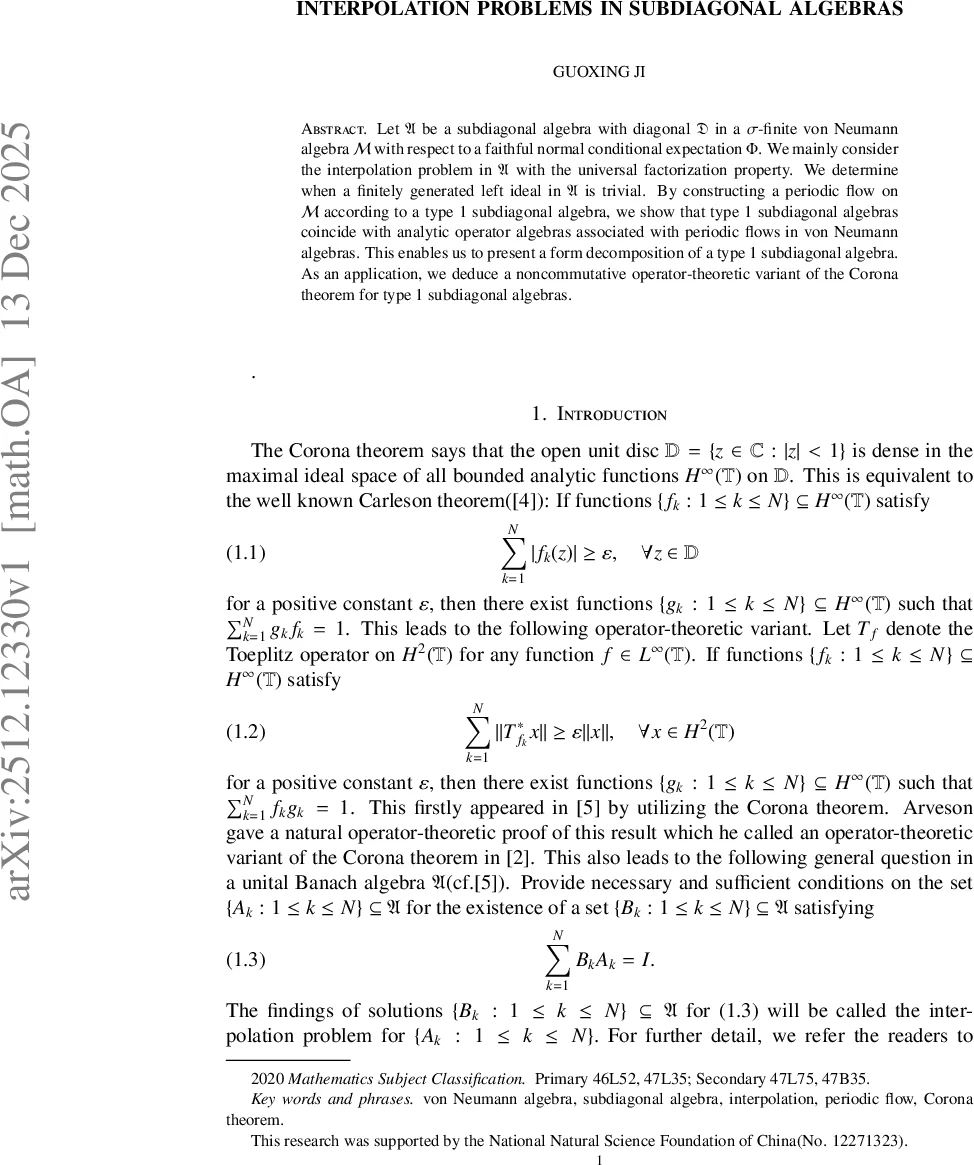
Let $\mathfrak A$ be a subdiagonal algebra with diagonal $\mathfrak D$ in a $σ$-finite von Neumann algebra $\mathcal M$ with respect to a faithful normal conditional expectation $Φ$. We mainly consider the interpolation problem in $\mathfrak A$ with the universal factorization property. We determine when a finitely generated left ideal in $\mathfrak A$ is trivial. By constructing a periodic flow on $\mathcal M$ according to a type 1 subdiagonal algebra, we show that type 1 subdiagonal algebras coincide with analytic operator algebras associated with periodic flows in von Neumann algebras. This enables us to present a form decomposition of a type 1 subdiagonal algebra. As an application, we deduce a noncommutative operator-theoretic variant of the Corona theorem for type 1 subdiagonal algebras.
💡 Research Summary
The paper investigates interpolation problems in subdiagonal algebras 𝔄 that sit inside a σ‑finite von Neumann algebra 𝓜 and possess a faithful normal conditional expectation Φ onto their diagonal 𝔇. The central hypothesis is that 𝔄 enjoys the universal factorization property: every invertible element of 𝓜 can be written as a product of a unitary and an element of 𝔄. Under this assumption 𝔄 is automatically maximal subdiagonal.
The authors first establish a distance formula for maximal subdiagonal algebras (Proposition 2.1) and a key lemma (Lemma 2.2) concerning partial isometries with diagonal support. Using these tools they prove the main interpolation theorem (Theorem 2.3): if a finite family {Aₖ}⊂𝔄 satisfies two quantitative lower bounds – (i) ‖Aₖx‖₂≥ε‖x‖₂ for all x∈L²(𝓜) and (ii) ‖(I−P)Aₖx‖₂≥ε‖(I−P)x‖₂ for the orthogonal projection P onto the non‑commutative Hardy space H² – then there exist elements {Bₖ}⊂𝔄 such that ΣBₖAₖ=I and ‖Bₖ‖≤4Nαε⁻³ (α=max‖Aₖ‖). The proof proceeds by forming the positive invertible operator ΣAₖ* Aₖ, factorizing it via the universal factorization property, and then applying Lemma 2.2 to a carefully constructed partial isometry in a matrix amplification of 𝔄. This yields a left inverse for each Aₖ within 𝔄 with controlled norm.
Corollaries 2.4 and 2.5 translate the theorem into statements about left and right Toeplitz operators on H², showing that the same ε‑condition on the Toeplitz symbols guarantees the existence of a bounded left (or right) inverse inside 𝔄. These results generalize Arveson’s operator‑theoretic Corona theorem from nest algebras of B(H) to the broader setting of subdiagonal algebras in arbitrary σ‑finite von Neumann algebras.
In Section 3 the authors apply the interpolation theorem to nest algebras whose nest order is isomorphic to a sublattice of the integer lattice ℤ∪{±∞}. They demonstrate that the ε‑condition on the generators is both necessary and sufficient for solvability of the interpolation problem, thereby extending Arveson’s classic result to the non‑commutative Lᵖ‑framework.
Section 4 introduces “type 1” subdiagonal algebras. By constructing a periodic flow {θₜ} on 𝓜 (a one‑parameter automorphism group with period T) and forming the crossed product 𝓜⋊{θ}ℝ, the authors show that any type 1 subdiagonal algebra coincides with the analytic operator algebra A_θ generated by the flow. This identification yields a canonical internal column decomposition 𝔄=⊕{col}𝔄_{ij} and enables the construction of a (1,1)‑form conditional expectation from the commutant of L(𝔇) (resp. R(𝔇)) onto R(𝓜) (resp. L(𝓜)). This expectation theorem (Theorem 4.5) is a non‑commutative analogue of Arveson’s expectation result for nest algebras.
Finally, Section 5 leverages the flow‑based structure to prove a non‑commutative operator‑theoretic Corona theorem for type 1 subdiagonal algebras (Theorem 5.1). If a finite family {Aₖ}⊂𝔄 satisfies the same quantitative lower bounds as in Theorem 2.3, then there exist {Bₖ}⊂𝔄 with ΣAₖBₖ=I and norm estimates identical to those in the earlier theorem. This result provides a robust, operator‑theoretic version of Carleson’s Corona theorem in the setting of non‑commutative Hardy spaces associated with periodic flows.
Overall, the paper unifies several strands: the classical Corona problem, Arveson’s operator‑theoretic approach, Haagerup’s non‑commutative Lᵖ‑spaces, and dynamical systems via periodic flows. By showing that type 1 subdiagonal algebras are precisely the analytic algebras arising from periodic automorphism groups, the authors obtain new structural decompositions, conditional expectations, and interpolation theorems that extend classical function‑theoretic results to a broad non‑commutative context. The work opens avenues for further research on multi‑variable non‑commutative Hardy spaces, non‑commutative function theory on crossed products, and applications to control theory and quantum information where interpolation and factorization play a central role.
Comments & Academic Discussion
Loading comments...
Leave a Comment