Epitaxial Recovery of beta-Ga2O3 after High Dose Implantation
As an ultrawide bandgap semiconductor, beta-Ga2O3 has been attractive for its strong tolerance to irradiation damage and high n-type conductivity through ion implantation. Homoepitaxial (010) \b{eta}-Ga2O3 films grown by MOCVD were implanted with Ge to study the post-implantation damage and lattice recovery after thermal annealing. Box profiles of 100 or 50 nm at concentration of 510^19 or 310^19 cm^-3 were formed, with maximum displacement per atom (DPA) of 1.2 or 2.0. Lattice recovery was investigated using X-ray diffraction (XRD) for anneals from 100 C to 1050 C. A gamma-phase related peak was observed for all implant conditions. All samples showed strain relaxation of beta-phase peak at temperature below 500 C, with no significant change for the gamma-phase related peak. For lower damage implants, films recovered fully to epitaxial beta-phase after sequential annealing to 900 C. For the higher damage implant, the gamma-phase associated peak annealed out with increasing temperature, but a new diffraction peak formed at slightly smaller lattice spacing; full recovery of the lattice was not observed until annealing at 1050 C. The newly formed diffraction peak is identified as beta-(20-4), beta-(512), or beta-(71-2), each potentially arising from the conversion of gamma-phase to beta-phase via a common oxygen sub-lattice.
💡 Research Summary
This paper presents a detailed investigation into the lattice damage and thermal recovery processes in beta-gallium oxide (β-Ga2O3) following high-dose germanium (Ge) ion implantation. β-Ga2O3 is an ultrawide bandgap semiconductor of significant interest for power electronics and radiation-hardened applications, with ion implantation being a key technique for selective area doping. The study aims to understand how implantation-induced damage, quantified by displacement per atom (DPA), influences the subsequent annealing behavior and the pathway to crystalline recovery.
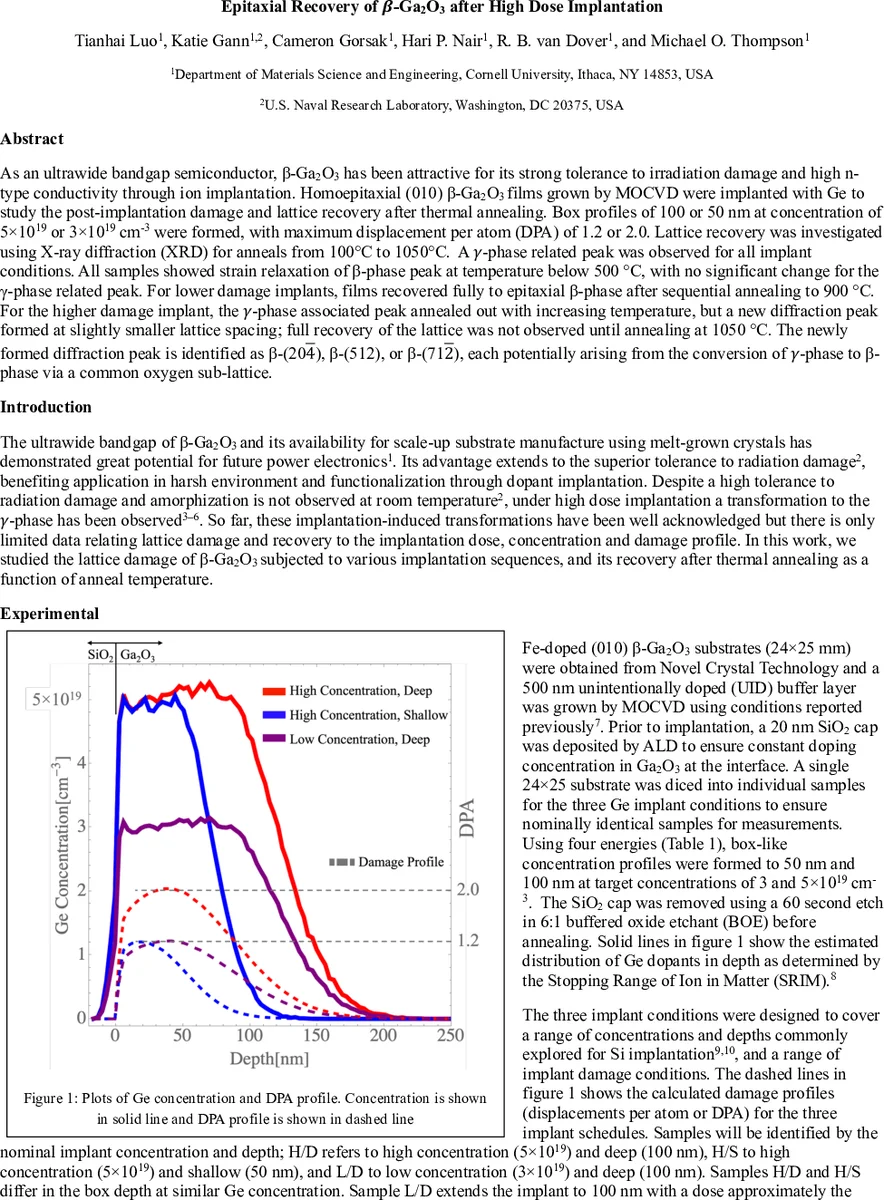
Homoepitaxial (010) β-Ga2O3 films were grown via MOCVD and implanted with Ge under three distinct conditions to create box-like profiles: a high-concentration, deep implant (H/D: 5e19 cm⁻³, 100 nm depth), a high-concentration, shallow implant (H/S: 5e19 cm⁻³, 50 nm depth), and a low-concentration, deep implant (L/D: 3e19 cm⁻³, 100 nm depth). SRIM simulations estimated maximum DPA values of 2.0 for the H/D sample (high-damage) and approximately 1.2 for the H/S and L/D samples (low-damage).
X-ray diffraction (XRD) analysis of the as-implanted samples revealed two key features for all conditions: a strained β-phase (020) peak and an additional peak near 63.5°, attributed to the formation of γ-Ga2O3 inclusions induced by radiation damage above a critical threshold. The γ-phase peak in the high-damage H/D sample was sharper and closer to the theoretical angle for the γ-(440) reflection, suggesting the formation of larger, more “γ-like” regions compared to the low-damage samples.
Samples were subjected to sequential thermal annealing in N₂ from 100°C to 1050°C, with XRD monitoring after each step. The recovery process occurred in two stages. First, at temperatures below ~500°C, strain relaxation within the β-phase matrix was observed, evidenced by the disappearance of a high-angle shoulder on the β-(020) peak, with no significant change in the γ-phase peak. Second, at temperatures above 500°C, the γ-phase peak began to diminish.
For the low-damage samples (H/S and L/D), the γ-phase peak completely vanished after annealing at 900°C, and the XRD pattern fully recovered to that of the original epitaxial β-phase. This indicates a complete conversion of the γ-phase inclusions back to the (010) β-phase orientation.
In stark contrast, the high-damage H/D sample exhibited a more complex recovery pathway. While its γ-phase peak also annealed out by 900°C, a new, distinct diffraction peak emerged at a slightly higher angle (smaller lattice spacing). This new peak persisted until a final anneal at 1050°C. The authors identify this peak as potentially arising from β-phase grains with orientations other than (010), specifically the (204), (512), or (712) planes. This interpretation is based on the established theory that the β- and γ-phases share a common oxygen sub-lattice. A crystallographic rotation operation demonstrates that these specific β-phase planes can satisfy the Bragg condition in a symmetric 2θ-ω scan aligned to the original (010) substrate, provided they nucleate from the γ-phase regions while maintaining the shared oxygen framework. Thus, for high-damage implants, the larger γ-phase regions transform not back to the original epitaxial orientation, but to these other β-phase orientations that are also commensurate with the underlying oxygen sublattice.
In conclusion, the work demonstrates that the thermal recovery of implanted β-Ga2O3 is highly dependent on the initial implant damage level (DPA). Low damage allows for full epitaxial recovery, while high damage leads to a more complex transformation sequence involving intermediate γ-phase formation and subsequent conversion to alternative β-phase orientations, requiring higher annealing temperatures for complete lattice restoration. These findings provide critical guidelines for designing implantation and annealing processes to achieve optimal electrical activation and crystal quality in β-Ga2O3-based devices.
Comments & Academic Discussion
Loading comments...
Leave a Comment