A discontinuous percolation phase transition on the hierarchical lattice
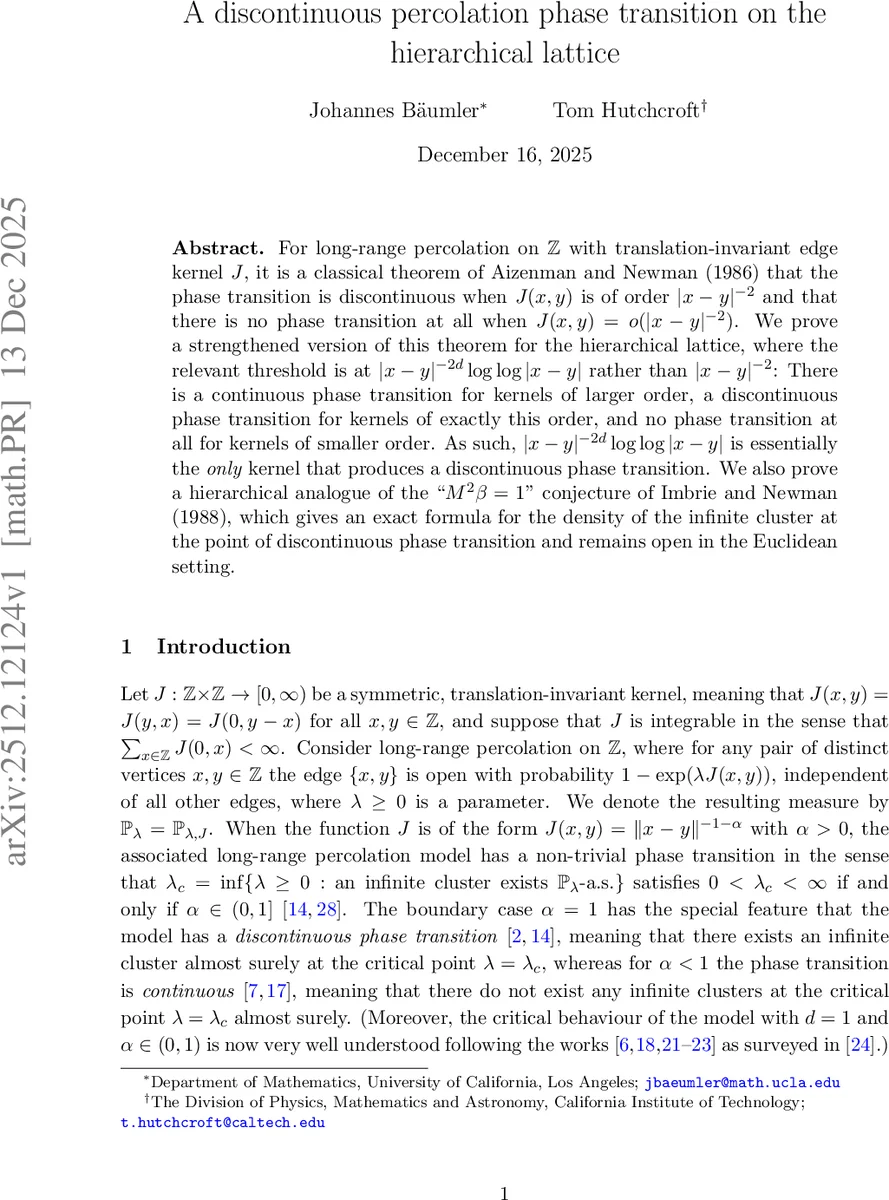
For long-range percolation on $\mathbb{Z}$ with translation-invariant edge kernel $J$, it is a classical theorem of Aizenman and Newman (1986) that the phase transition is discontinuous when $J(x,y)$ is of order $|x-y|^{-2}$ and that there is no phase transition at all when $J(x,y)=o(|x-y|^{-2})$. We prove a strengthened version of this theorem for the hierarchical lattice, where the relevant threshold is at $|x-y|^{-2d} \log\log |x-y|$ rather than $|x-y|^{-2}$: There is a continuous phase transition for kernels of larger order, a discontinuous phase transition for kernels of exactly this order, and no phase transition at all for kernels of smaller order. As such, $|x-y|^{-2d} \log\log |x-y|$ is essentially the \emph{only} kernel that produces a discontinuous phase transition. We also prove a hierarchical analogue of the ``$M^2β=1$’’ conjecture of Imbrie and Newman (1988), which gives an exact formula for the density of the infinite cluster at the point of discontinuous phase transition and remains open in the Euclidean setting.
💡 Research Summary
The paper investigates long‑range percolation on the hierarchical lattice (H_{d}^{L}), a non‑Euclidean ultrametric space built from the infinite direct sum (\bigoplus_{i=1}^{\infty}(\mathbb{Z}/L\mathbb{Z})^{d}). Edges are opened independently with probability (1-\exp(-J(e))), where the kernel (J) depends only on the hierarchical distance (|e|=|x-y|). The authors work under natural assumptions: the kernel is isometry‑invariant, integrable, and “regular” (its average over each distance shell is comparable to the average over the next shell). A one‑parameter family (J(\lambda,e)) is considered, typically of the form (\lambda J(e)) or a truncated version, which guarantees monotonicity, continuity in (\lambda), and non‑percolation for small (\lambda).
The central contribution is a complete classification of the percolation phase transition according to the asymptotic decay of the kernel. Three regimes are identified:
-
Continuous transition – If the kernel decays slower than (n^{-2d}\log\log n) (written (J\gg n^{-2d}\log\log n)), the critical parameter (\lambda_{c}) is finite but the probability of an infinite cluster at (\lambda_{c}) is zero. Thus the transition is continuous: the infinite cluster appears only for (\lambda>\lambda_{c}).
-
No transition – If the kernel decays faster than (n^{-2d}\log\log n) ((J\ll n^{-2d}\log\log n)), then (\lambda_{c}= \infty); the model never percolates.
-
Discontinuous transition – If the kernel is asymptotically equivalent to (n^{-2d}\log\log n) ((J\approx n^{-2d}\log\log n)), then (\lambda_{c}<\infty) and an infinite cluster already exists at the critical point, i.e. the transition is discontinuous.
The notation (J\approx f), (J\ll f), (J\gg f) is defined via liminf/limsup ratios being bounded away from zero and infinity. The classification holds under the mild regularity assumptions mentioned above.
The proof of continuity follows an optimized version of the “super‑critical strategy”: if an infinite cluster exists at some (\lambda), the authors construct a coarse‑grained version of the model that remains super‑critical, and then show that the set of (\lambda) for which percolation occurs is open. This yields continuity for kernels that decay slower than the critical scale. The discontinuous case is handled by establishing a lower bound analogous to the classical Aizenman–Newman inequality: \
Comments & Academic Discussion
Loading comments...
Leave a Comment