Technical Indicator Networks (TINs): An Interpretable Neural Architecture Modernizing Classic al Technical Analysis for Adaptive Algorithmic Trading
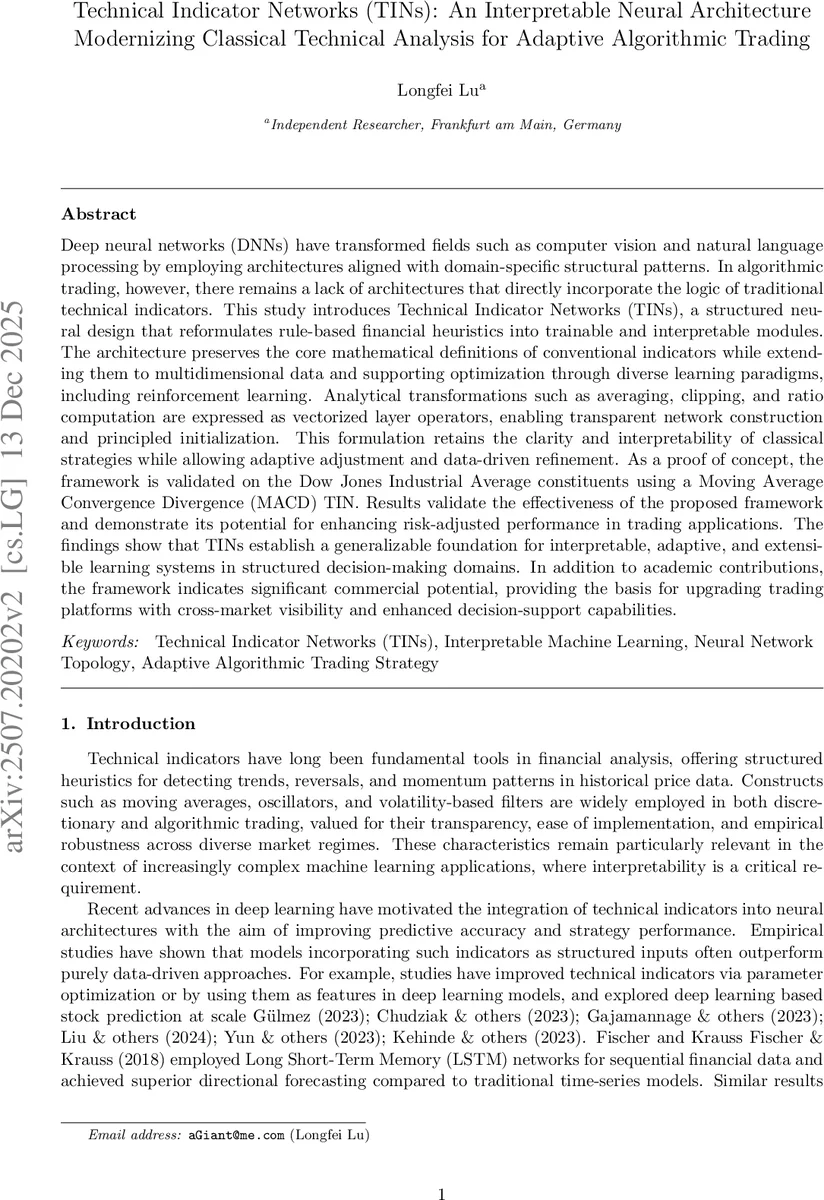
Deep neural networks (DNNs) have transformed fields such as computer vision and natural language processing by employing architectures aligned with domain-specific structural patterns. In algorithmic trading, however, there remains a lack of architectures that directly incorporate the logic of traditional technical indicators. This study introduces Technical Indicator Networks (TINs), a structured neural design that reformulates rule-based financial heuristics into trainable and interpretable modules. The architecture preserves the core mathematical definitions of conventional indicators while extending them to multidimensional data and supporting optimization through diverse learning paradigms, including reinforcement learning. Analytical transformations such as averaging, clipping, and ratio computation are expressed as vectorized layer operators, enabling transparent network construction and principled initialization. This formulation retains the clarity and interpretability of classical strategies while allowing adaptive adjustment and data-driven refinement. As a proof of concept, the framework is validated on the Dow Jones Industrial Average constituents using a Moving Average Convergence Divergence (MACD) TIN. Empirical results demonstrate improved risk-adjusted performance relative to traditional indicator-based strategies. Overall, the findings suggest that TINs provide a generalizable foundation for interpretable, adaptive, and extensible learning architectures in structured decision-making domains and indicate substantial commercial potential for upgrading trading platforms with cross-market visibility and enhanced decision-support capabilities.
💡 Research Summary
The research paper introduces “Technical Indicator Networks (TINs),” a novel neural architecture designed to bridge the gap between traditional rule-based technical analysis and modern deep learning. While deep neural networks (DNNs) have achieved unprecedented success in domains like computer vision and natural language processing by aligning their architectures with structural patterns of the data, they have struggled to incorporate the domain-specific, rule-based heuristics essential to financial technical analysis. This lack of structural alignment often results in “black-box” models that lack interpretability and fail to leverage decades of established financial expertise.
To address this, the authors propose TINs, a structured neural design that reformulates classical technical indicators into trainable and interpretable modules. The core innovation lies in the transformation of mathematical primitives—such as averaging, clipping, and ratio computations—into vectorized layer operators. By doing so, the architecture preserves the fundamental mathematical definitions of conventional indicators (like MACD) while allowing the network to learn and optimize the parameters within these indicators through various learning paradigms, including reinforcement learning. This approach enables “principled initialization,” where the network starts with a foundation of proven financial logic rather than random weights, significantly reducing the complexity of the learning task.
The TINs framework offers three primary advantages: interpretability, adaptability, and extensibility. Unlike standard DNNs, the decision-making process in TINs can be traced back to specific mathematical transformations, providing the transparency required in high-stakes financial environments. Furthermore, the architecture is inherently adaptive, as it can fine-tune its internal parameters to respond to shifting market regimes and volatility. Finally, the modular nature of the vectorized operators allows for the easy integration of new technical indicators, making the framework highly extensible for diverse trading strategies.
The efficacy of the TINs architecture was validated using a MACD-based TIN applied to the constituents of the Dow Jones Industrial Average (DJIA). The empirical results demonstrated that the TINs-based strategy achieved superior risk-adjusted performance compared to traditional, fixed-rule indicator strategies. This suggests that the ability to learn from data while adhering to domain-specific structures leads to more robust and effective trading decisions.
In conclusion, the study presents TINs as a foundational framework for creating interpretable and adaptive learning architectures in structured decision-making domains. Beyond algorithmic trading, the implications of TINs extend to any field where expert-driven heuristic rules can be mathematically reformulated into trainable neural components. The research highlights significant commercial potential for upgrading existing trading platforms with enhanced decision-support capabilities, offering a sophisticated blend of human-engineered logic and data-driven optimization.
Comments & Academic Discussion
Loading comments...
Leave a Comment