What Comes After Harm? Mapping Reparative Actions in AI through Justice Frameworks
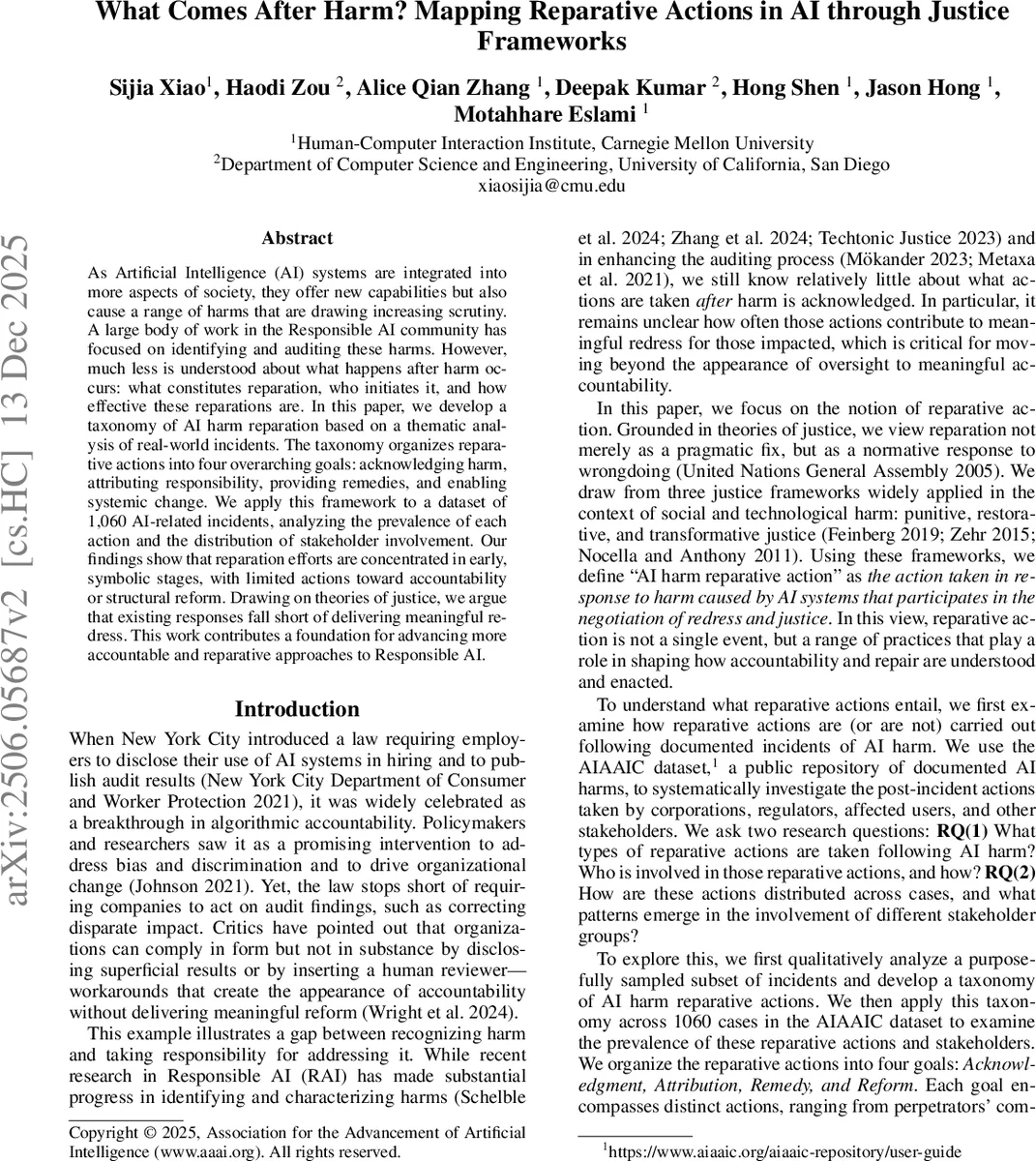
As Artificial Intelligence (AI) systems are integrated into more aspects of society, they offer new capabilities but also cause a range of harms that are drawing increasing scrutiny. A large body of work in the Responsible AI community has focused on identifying and auditing these harms. However, much less is understood about what happens after harm occurs: what constitutes reparation, who initiates it, and how effective these reparations are. In this paper, we develop a taxonomy of AI harm reparation based on a thematic analysis of real-world incidents. The taxonomy organizes reparative actions into four overarching goals: acknowledging harm, attributing responsibility, providing remedies, and enabling systemic change. We apply this framework to a dataset of 1,060 AI-related incidents, analyzing the prevalence of each action and the distribution of stakeholder involvement. Our findings show that reparation efforts are concentrated in early, symbolic stages, with limited actions toward accountability or structural reform. Drawing on theories of justice, we argue that existing responses fall short of delivering meaningful redress. This work contributes a foundation for advancing more accountable and reparative approaches to Responsible AI.
💡 Research Summary
This paper, titled “What Comes After Harm? Mapping Reparative Actions in AI through Justice Frameworks,” presents a foundational study that shifts the focus in Responsible AI research from harm prevention and detection to the critical, yet under-explored, phase of what happens after harm occurs. The authors systematically investigate the reparative actions taken in response to documented AI incidents, analyzing their nature, prevalence, and the stakeholders involved, all through the lens of established justice theories.
The research is based on a comprehensive analysis of 1,060 real-world AI incident reports from the AIAAIC repository. The methodology unfolds in two key stages. First, the authors conduct a qualitative thematic analysis on a purposively sampled subset of 200 incidents that involved “substantial reparative action.” This inductive analysis, informed by punitive, restorative, and transformative justice frameworks, leads to the development of a novel taxonomy of AI harm reparation. This taxonomy organizes reparative actions into four overarching goals: Acknowledgment (e.g., public statements, apologies), Attribution (e.g., internal/third-party audits, legal charges), Remedy (e.g., financial compensation, product recall, service restoration), and Reform (e.g., policy change, algorithmic redesign, staffing changes). This framework provides a structured way to categorize actions based on their progressive role in achieving justice, from recognizing harm to fixing systemic flaws.
Second, to scale the analysis, the authors employ Large Language Models (GPT-4 Turbo) to apply this taxonomy to the entire dataset of 1,060 incidents. The LLM was tasked with multi-label classification, identifying the presence of each action category and the responsible stakeholders. This automated approach was rigorously validated against human annotations, achieving 87% accuracy for action classification and 79% for stakeholder identification, confirming its reliability for this large-scale deductive coding task.
The core findings reveal a stark and significant imbalance in current reparation practices. Over 90% of incident responses involved actions pertaining to Acknowledgment and Attribution. These are largely symbolic or procedural steps, such as issuing press releases or commissioning audits. In contrast, actions that provide direct Remedy to affected parties were present in only about 30% of cases. Most critically, actions aimed at Reform—changing systems or policies to prevent recurrence—were observed in a mere ~10% of incidents. This distribution highlights a pervasive “accountability shortfall,” where the AI ecosystem is adept at performative responses but severely lacking in delivering tangible redress or driving structural change.
Furthermore, the analysis of stakeholder involvement shows that reparative actions are predominantly initiated by the corporations responsible for the harm or by regulatory bodies. The role of affected users and civil society organizations in initiating or shaping reparative processes is minimal, indicating a power imbalance in who gets to define and execute “repair.”
The paper powerfully interprets these empirical patterns through justice frameworks. It argues that current practices fall short of the ideals of any single justice model: they lack the consequential accountability emphasized by punitive justice, often fail to center and support harmed communities as restorative justice demands, and rarely address the root systemic conditions as transformative justice requires. The concentration on early-stage actions creates a facade of accountability without substantive repair.
In conclusion, this work makes a major contribution by providing the first large-scale, systematic map of post-harm responses in AI. It moves beyond anecdotal evidence to document a systemic failure in achieving meaningful redress. By introducing a justice-grounded taxonomy and revealing the clear gap between symbolic and substantive repair, the study lays a crucial foundation for advancing more accountable, reparative, and transformative approaches in Responsible AI, urging both researchers and practitioners to look beyond harm detection and consider what truly constitutes repair.
Comments & Academic Discussion
Loading comments...
Leave a Comment