Modeling and Analysis of VOC-based Interplant Molecular Communication Channel
Molecular communication (MC) enables information transfer using particles inspired by biological systems. Volatile Organic Compounds (VOCs) are one of the most abundant and diverse classes of signaling molecules used by living or non-living objects. VOC-based MC holds great promise in developing long-range, bio-compatible communication systems capable of interfacing nano- and micro-scale devices. In this paper, we present a comprehensive end-to-end framework for VOC-based interplant MC from an ICT perspective. The communication process is divided into three stages: transmission (VOC biosynthesis and emission from leaves), channel propagation (advection-diffusion in turbulent wind via Gaussian puff for stress-induced VOC release and Gaussian plume for constitutive VOC release), and reception (VOC uptake and physiological response in the receiver plant). Each stage is analyzed by its attenuation and delay. Numerical results demonstrate that VOC-based channels exhibit low-pass behavior, with bandwidth and capacity heavily influenced by distance, wind velocity, and noise. Though the physical channel supports moderate frequencies, biological constraints at the transmitter restrict the end-to-end channel to slow-varying signals.
💡 Research Summary
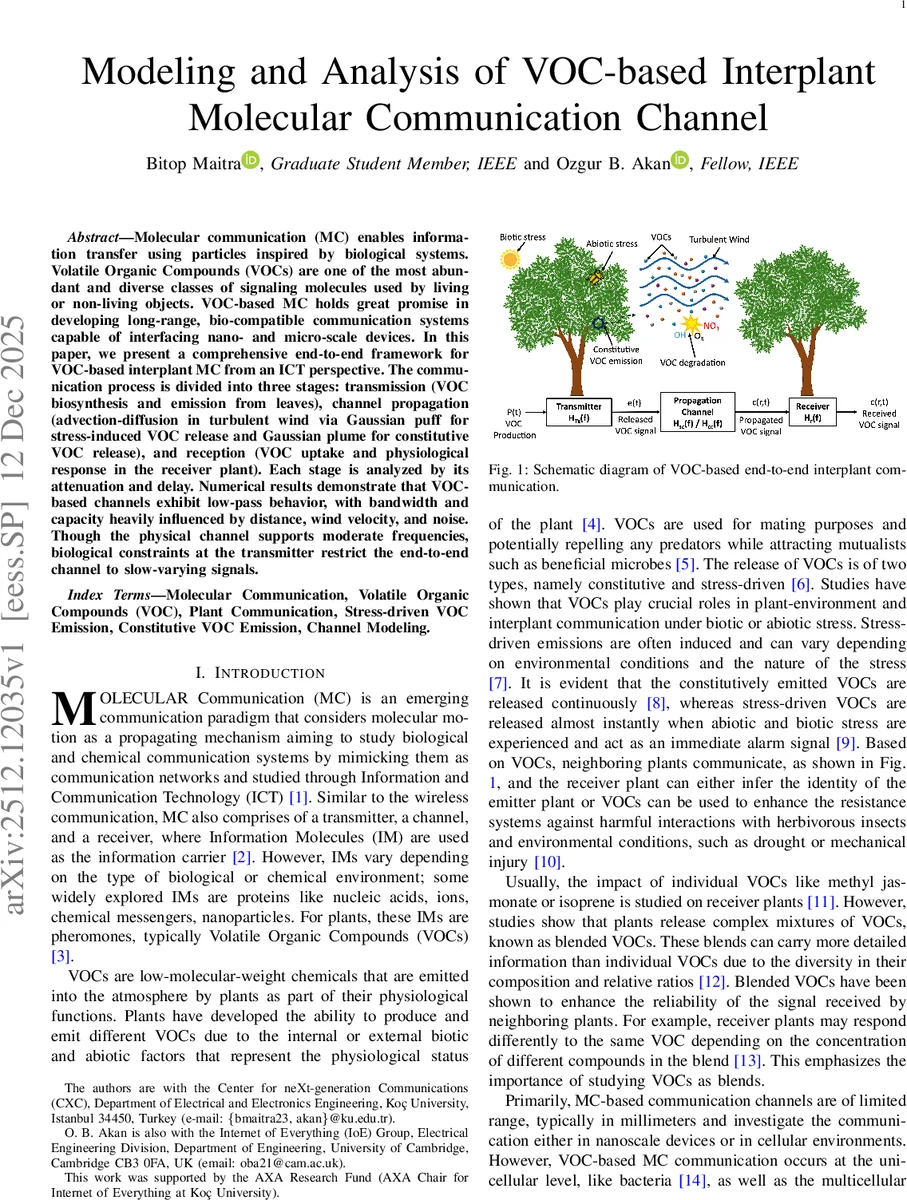
The paper presents a comprehensive end‑to‑end model for inter‑plant molecular communication that uses volatile organic compounds (VOCs) as information carriers. The authors divide the communication process into three stages—transmission, propagation, and reception—and analyze each stage in terms of attenuation and delay.
In the transmission stage, VOC biosynthesis inside leaf cells is described in detail. The compounds are first stored in aqueous (S_a) and lipid (S_l) pools, each governed by first‑order kinetics (dS_a/dt = ηP(t) – k_aS_a, dS_l/dt = (1–η)P(t) – k_lS_l). The two pools feed a gas‑phase pool (S_g) that releases VOCs to the atmosphere at a rate e(t) = k_gS_g. By taking Laplace transforms, the authors derive a transfer function H_Tx(f) that captures the low‑pass nature of the biochemical release process. Normalized gain and phase delay are expressed analytically, showing that the transmitter behaves like a first‑order filter whose cutoff frequency is set by the stomatal conductance k_g and the pool decay constants k_a, k_l.
The propagation stage models VOC transport through air using advection‑diffusion equations. Assuming a constant wind speed u directed along the x‑axis and a neutral atmospheric stability class (Pasquill‑Gifford D), the authors employ two classic Gaussian models. Stress‑induced, instantaneous releases are treated with a Gaussian puff model, while constitutive, continuous emissions use a Gaussian plume model. Dispersion coefficients σ_y and σ_z are calculated from Briggs‑Griffiths empirical formulas; longitudinal dispersion σ_x is approximated as √(σ_yσ_z). Chemical loss mechanisms (reactions with OH, NO₃, O₃, and photodissociation) are incorporated as an exponential decay term e^{–k_d t}, and the resulting stochastic degradation is modeled as additive Gaussian noise. The overall channel transfer function H_ch(f) = H_Tx(f)·H_prop(f)·e^{–k_d t} therefore exhibits a pronounced low‑pass characteristic whose bandwidth shrinks with increasing distance, decreasing wind speed, and higher turbulence.
In the reception stage, VOC uptake by the receiver plant’s stomata is modeled as a conductance‑limited diffusion process. The absorbed concentration C_in(t) = g_s·c(r,t)·Δt is compared against a biologically relevant threshold C_thr; exceeding this threshold triggers downstream physiological responses (e.g., activation of defense genes). This step is also approximated by a first‑order system with transfer function H_Rx(f) = g_s/(j2πf + g_s).
Numerical simulations explore distances from 10 m to 100 m, wind speeds of 3–7 m/s, and noise power around –90 dBm. Results show that channel gain decays exponentially with distance, becoming less than –30 dB beyond 50 m. Total delay, approximated as d/u plus the transmitter and receiver phase delays, ranges from a few seconds at 10 m to about 20 s at 100 m—still shorter than typical plant physiological response times (minutes to hours). Bandwidth is limited primarily by the transmitter’s biochemical dynamics (k_g ≈ 0.01 s⁻¹), yielding usable frequencies between 0.1 Hz and a few Hz. Consequently, the achievable data rate is on the order of a few bits per second, far below the physical channel’s potential of tens of hertz.
The authors conclude that while VOC‑based molecular communication can theoretically span hundreds of meters, the biological constraints on VOC synthesis, emission, and plant response dominate the system’s performance, restricting it to very low‑rate, low‑frequency signaling. They suggest future work on multi‑VOC spectral encoding, artificial VOC emitters and sensors, and adaptive transmission strategies that account for varying wind, temperature, and humidity conditions.
Comments & Academic Discussion
Loading comments...
Leave a Comment