A Reference Architecture for Embedding Quantum Software Into Enterprise Systems
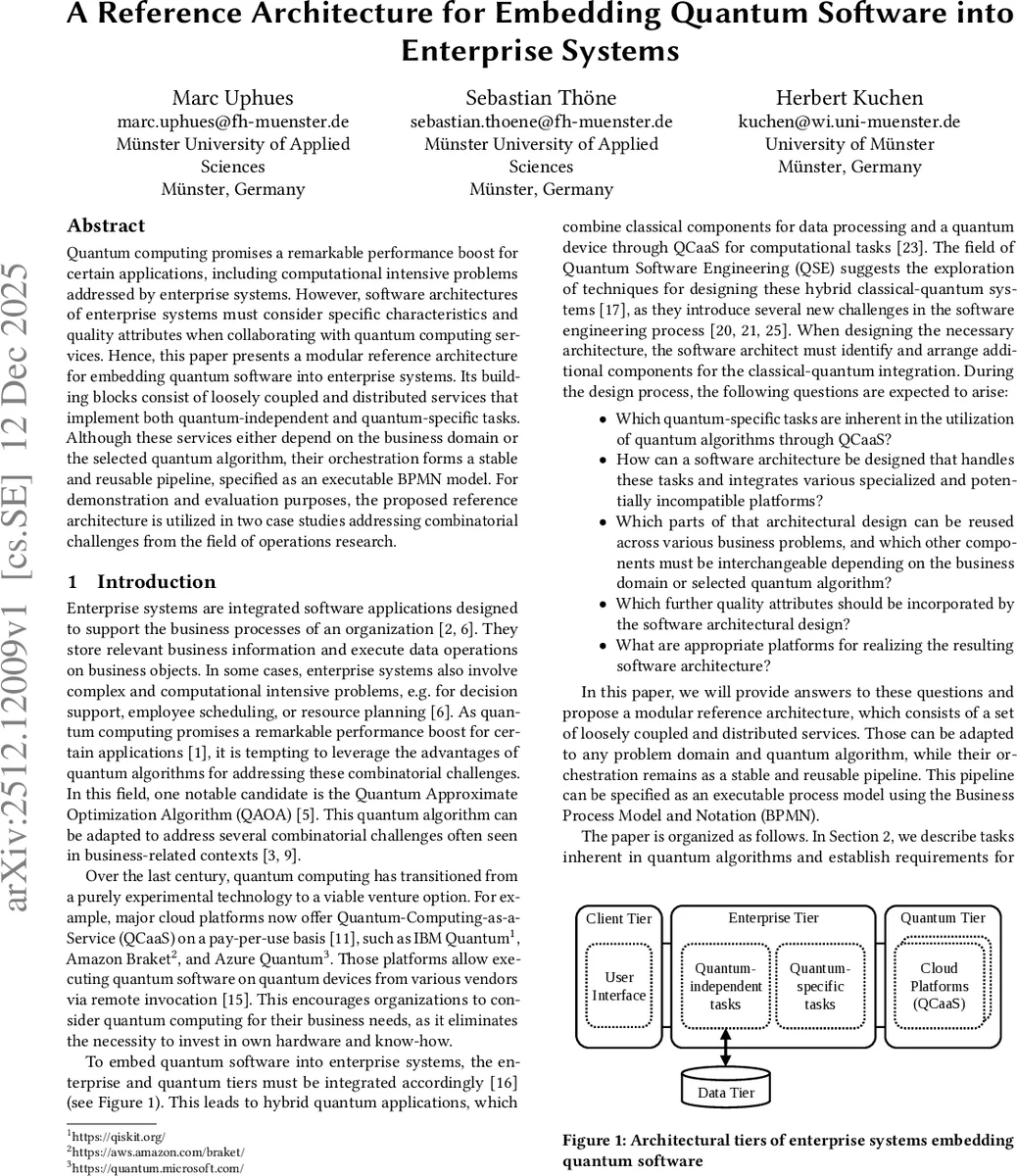
Quantum computing promises a remarkable performance boost for certain applications, including computational intensive problems addressed by enterprise systems. However, software architectures of enterprise systems must consider specific characteristics and quality attributes when collaborating with quantum computing services. Hence, this paper presents a modular reference architecture for embedding quantum software into enterprise systems. Its building blocks consist of loosely coupled and distributed services that implement both quantum-independent and quantum-specific tasks. Although these services either depend on the business domain or the selected quantum algorithm, their orchestration forms a stable and reusable pipeline, specified as an executable BPMN model. For demonstration and evaluation purposes, the proposed reference architecture is utilized in two case studies addressing combinatorial challenges from the field of operations research.
💡 Research Summary
This paper addresses the growing interest in leveraging quantum computing’s potential for solving complex, computationally intensive problems within enterprise systems, such as supply chain optimization or financial portfolio management. The core challenge lies in the seamless integration of emerging, often unstable quantum computing resources with established, robust enterprise software architectures. The authors argue that ad-hoc integration is insufficient and propose a structured, reusable reference architecture to bridge this gap.
The proposed solution is a two-layered reference architecture. The first layer is a Quantum Orchestration Pipeline, modeled using the Business Process Model and Notation (BPMN). This pipeline defines a stable sequence of six quantum-specific tasks required to execute a quantum algorithm via Quantum-Computing-as-a-Service (QCaaS): Problem Mapping (translating business data into formal models), Circuit Generation, Device Selection, Circuit Refinement (e.g., parameter optimization for QAOA), Circuit Execution, and Solution Mapping (interpreting quantum results back to the business domain). This BPMN model provides a clear, executable blueprint for the workflow that is independent of any specific business problem or quantum algorithm.
The second layer is a Modular Service Architecture that physically implements the pipeline’s tasks. It is composed of loosely coupled, distributed microservices, each responsible for a single task (e.g., a dedicated “Circuit Generation Service”). An orchestrator component manages the workflow by interpreting the BPMN model, dispatching tasks to the appropriate services via asynchronous messaging, and tracking the state of each execution. This design directly addresses key quality attributes: Modularity and Maintainability through separation of concerns, allowing domain and quantum experts to work independently. Multi-Platform Compatibility is achieved as services can be implemented in different technologies (e.g., Java/Spring for business logic, Python/Qiskit for quantum tasks). Availability and Scalability concerns are mitigated by the asynchronous, non-blocking communication pattern, which handles unpredictable quantum device queue times and execution durations. Adaptability is built-in through interchangeable services and the novel application of the Strategy design pattern for algorithm selection, enabling runtime switching between different quantum or classical solvers. Finally, the entire pipeline’s Reusability across different business domains is a primary goal.
The architecture is evaluated through two case studies addressing combinatorial optimization problems from operations research. These demonstrations show how the reference architecture can be instantiated for concrete use cases, validating its practicality and effectiveness. The paper positions this work as a significant contribution to Quantum Software Engineering (QSE), providing a much-needed design framework for building hybrid quantum-classical enterprise applications that are robust, maintainable, and ready to evolve with the rapidly advancing quantum computing ecosystem.
Comments & Academic Discussion
Loading comments...
Leave a Comment