Coherently synchronized oscillations in many-body localization
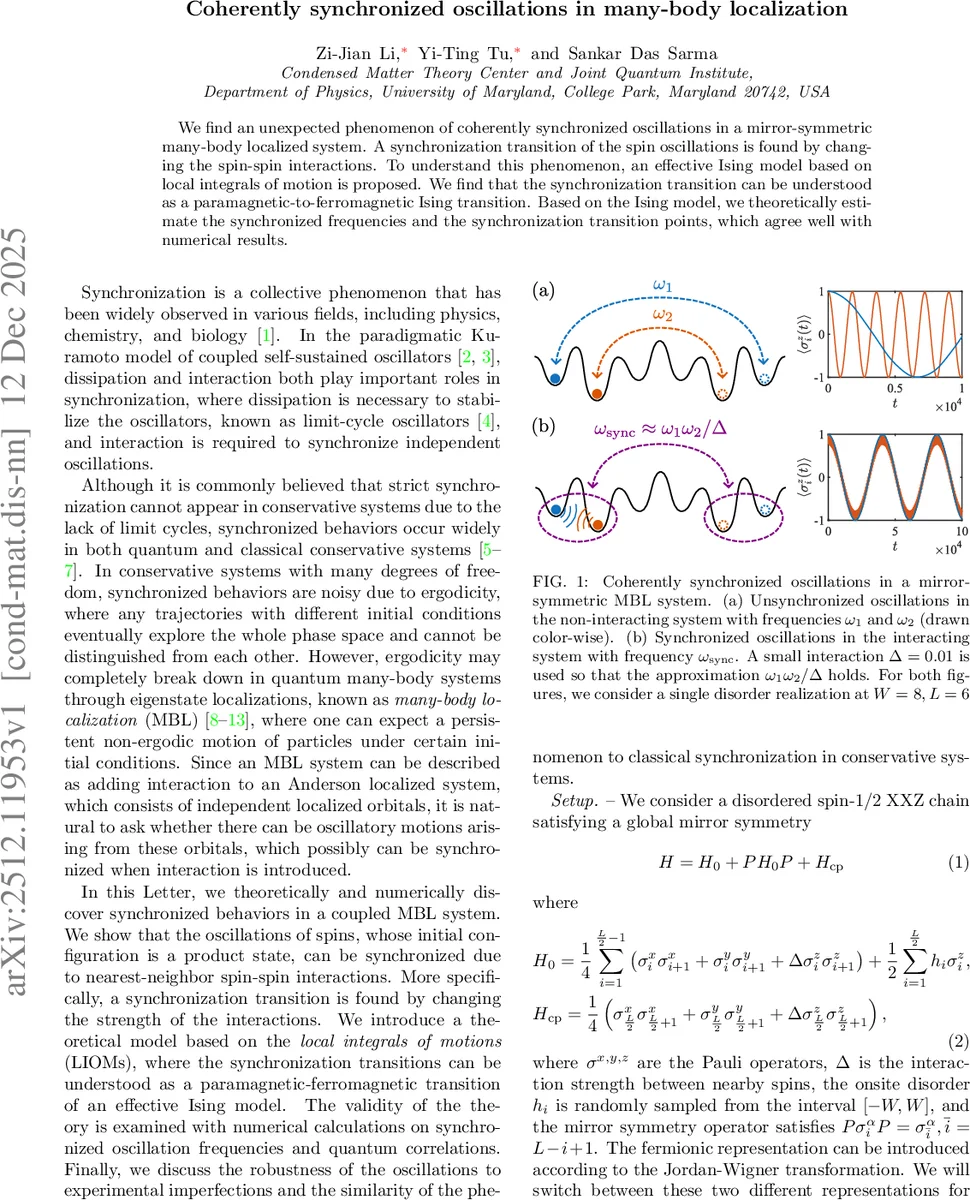
We find an unexpected phenomenon of coherently synchronized oscillations in a mirror-symmetric many-body localized system. A synchronization transition of the spin oscillations is found by changing the spin-spin interactions. To understand this phenomenon, an effective Ising model based on local integrals of motion is proposed. We find that the synchronization transition can be understood as a paramagnetic-to-ferromagnetic Ising transition. Based on the Ising model, we theoretically estimate the synchronized frequencies and the synchronization transition points, which agree well with numerical results.
💡 Research Summary
This paper presents the theoretical discovery and analysis of “coherently synchronized oscillations” in a many-body localized (MBL) system, challenging the conventional wisdom that strict synchronization requires dissipation.
The study focuses on a mirror-symmetric, disordered spin-1/2 XXZ chain. One half of the chain is an MBL system, and the other is its mirror image, coupled by a weak link at the center. In the non-interacting limit, an initially localized particle oscillates between a site and its mirror partner with a site-dependent frequency. When multiple particles are present, they oscillate independently.
The central finding is that introducing spin-spin interactions (parameter Δ) can synchronize these independent oscillations. As Δ increases, a synchronization transition occurs where the oscillation frequencies of different spins lock into a single, shared frequency (ω_sync). The transition point for a pair of spins depends exponentially on their distance from the chain’s center.
To explain this phenomenon, the authors develop a theoretical framework based on the concept of local integrals of motion (LIOMs), which characterize MBL systems. By treating the inter-chain coupling and weak interactions as perturbations, they map the original problem onto an effective disordered transverse-field Ising model for a new set of “effective spins” (η-spins). These η-spins correspond to active degrees of freedom in the degenerate subspaces of the unperturbed system.
In this effective model, the inter-chain coupling generates an exponentially decaying transverse field (h_eff), while the original spin-spin interaction Δ generates nearest-neighbor Ising couplings (J_eff). Crucially, h_eff is strong near the chain’s center and weak at the edges, while J_eff is relatively uniform. This competition defines two regions: a paramagnetic (PM) region near the center where h_eff > J_eff, and a ferromagnetic (FM) region at the edges where h_eff < J_eff.
The synchronization is understood as a spontaneous symmetry-breaking transition within the FM region. The effective spins in this region form a cat-like superposition due to the transverse field, and an initial product state oscillates between the two components of this cat state at a single frequency ω_sync. This frequency is determined by a product of the individual bare frequencies divided by factors of Δ, as given in Eq. (11). The PM region remains unsynchronized, oscillating with independent local frequencies. Thus, increasing Δ expands the FM region, synchronizing more spins.
Numerical simulations on finite chains confirm the theory. The median oscillation frequency extracted from the spectral function shows a clear synchronization transition as Δ varies, with multiple spin frequencies coalescing into one (Fig. 3). The theoretical prediction for ω_sync at small Δ matches the numerical data remarkably well. Furthermore, the long-time average of spin-spin correlations acts as an order parameter, switching from zero (unsynchronized) to a finite value (synchronized) precisely at the interaction strength predicted by the theory (Fig. 4). This transition point scales as ~exp
Comments & Academic Discussion
Loading comments...
Leave a Comment