From DGLAP to Sudakov: Precision Predictions for Energy-Energy Correlators
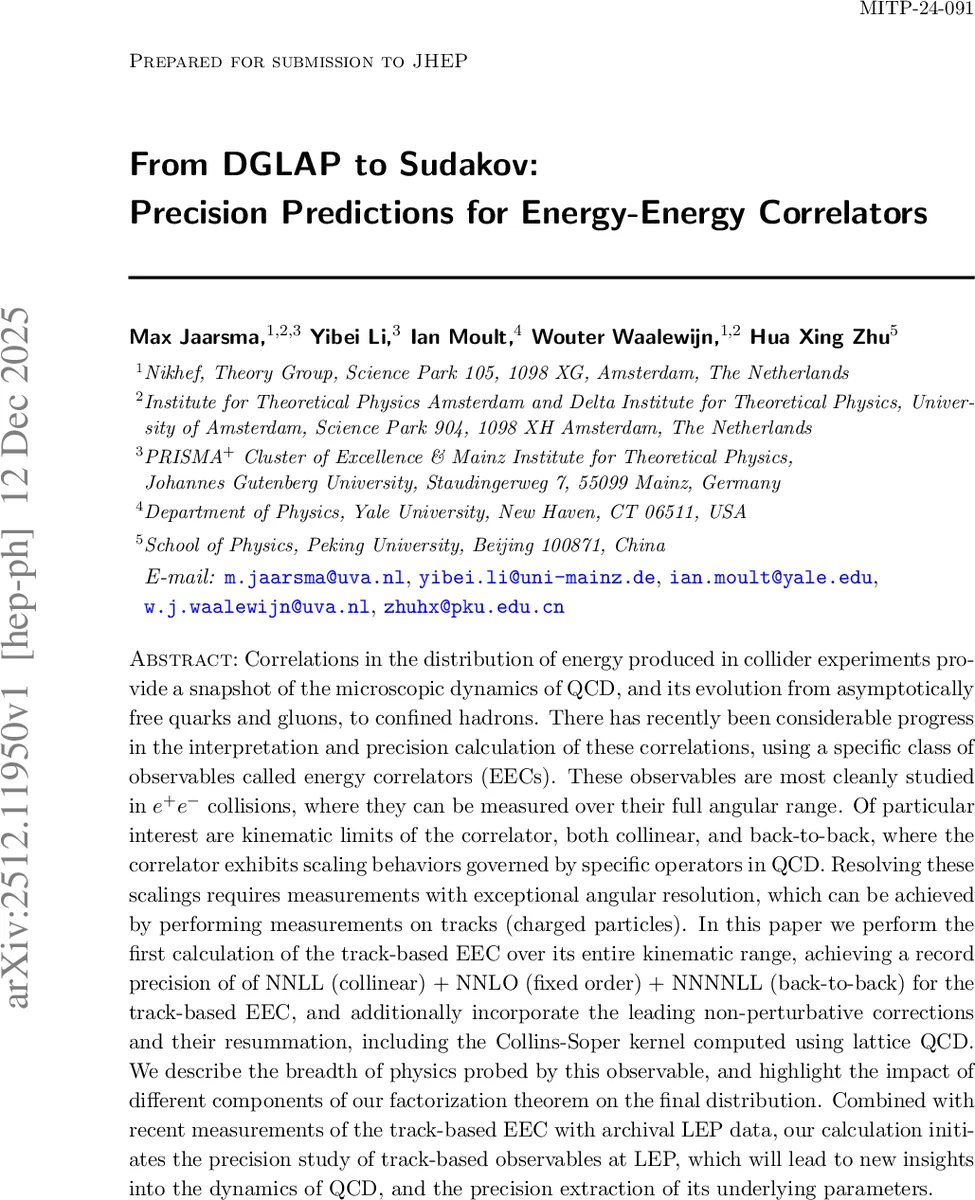
Correlations in the distribution of energy produced in collider experiments provide a snapshot of the microscopic dynamics of QCD, and its evolution from asymptotically free quarks and gluons, to confined hadrons. There has recently been considerable progress in the interpretation and precision calculation of these correlations, using a specific class of observables called energy correlators (EECs). These observables are most cleanly studied in $e^+e^-$ collisions, where they can be measured over their full angular range. Of particular interest are kinematic limits of the correlator, both collinear, and back-to-back, where the correlator exhibits scaling behaviors governed by specific operators in QCD. Resolving these scalings requires measurements with exceptional angular resolution, which can be achieved by performing measurements on tracks (charged particles). In this paper we perform the first calculation of the track-based EEC over its entire kinematic range, achieving a record precision of of NNLL (collinear) + NNLO (fixed order) + NNNNLL (back-to-back) for the track-based EEC, and additionally incorporate the leading non-perturbative corrections and their resummation, including the Collins-Soper kernel computed using lattice QCD. We describe the breadth of physics probed by this observable, and highlight the impact of different components of our factorization theorem on the final distribution. Combined with recent measurements of the track-based EEC with archival LEP data, our calculation initiates the precision study of track-based observables at LEP, which will lead to new insights into the dynamics of QCD, and the precision extraction of its underlying parameters.
💡 Research Summary
This paper presents a groundbreaking theoretical calculation of the Energy-Energy Correlator (EEC) measured on charged particle tracks, achieving unprecedented precision across its full angular range in electron-positron collisions. The EEC is a fundamental observable that probes the energy flow correlations in QCD, capturing its evolution from asymptotically free quarks and gluons to confined hadrons.
The primary challenge addressed is the need for exceptional angular resolution to study the scaling behavior of the EEC in its kinematic extremes: the collinear limit (z → 0, where particles are nearly parallel) and the back-to-back limit (z → 1, where particles are opposite). The authors overcome the experimental limitations of traditional calorimetric measurements by focusing on tracks from charged particles, which offer superior angular resolution. However, this makes the observable infrared-and-collinear unsafe, requiring a sophisticated theoretical framework beyond pure perturbation theory.
The core achievement is a state-of-the-art prediction combining several high-precision elements:
- Perturbative Mastery: The calculation achieves next-to-next-to-leading order (NNLO) fixed-order accuracy for the bulk region. It incorporates next-to-next-to-leading logarithmic (NNLL) resummation in the collinear limit, governed by DGLAP-like evolution, and an extraordinary next-to-next-to-next-to-next-to-leading logarithmic (NNNNLL) resummation in the back-to-back limit, controlled by Sudakov suppression.
- Factorization Framework: The theoretical description relies on distinct factorization theorems valid in the collinear and back-to-back limits. The track function formalism is employed to systematically handle the conversion of partons to charged hadrons.
- Non-Perturbative Integration: The calculation goes beyond perturbation theory by incorporating leading power corrections (1/Q). A landmark inclusion is the use of the Collins-Soper kernel – a fundamental non-perturbative object related to transverse momentum dynamics – computed from lattice QCD, which is crucial for the back-to-back region.
- Uncertainty Quantification: A comprehensive analysis of theoretical uncertainties is performed, including variations of renormalization scales, models for the track functions, and non-perturbative parameters like the strong coupling constant (α_s) and the moment Ω_1.
- Comparison with Data: The final theoretical prediction is compared with recent high-precision measurements of the track-based EEC using archival LEP data from the ALEPH detector. The agreement between theory and experiment is remarkable across the entire angular spectrum, validating the sophisticated theoretical framework.
This work initiates a new era in the precision study of track-based observables at LEP energies. It demonstrates the powerful synergy between advanced perturbative calculations, effective field theory factorization, lattice QCD inputs, and high-resolution experimental data. The results pave the way for future applications, including precise extractions of the strong coupling constant, detailed investigations of non-perturbative phenomena like hadronization and color confinement, and comparative studies with calculations in other gauge theories (e.g., N=4 SYM) to explore universal features of gauge dynamics.
Comments & Academic Discussion
Loading comments...
Leave a Comment