Quotient branching laws and Gan-Gross-Prasad relevance for general linear groups
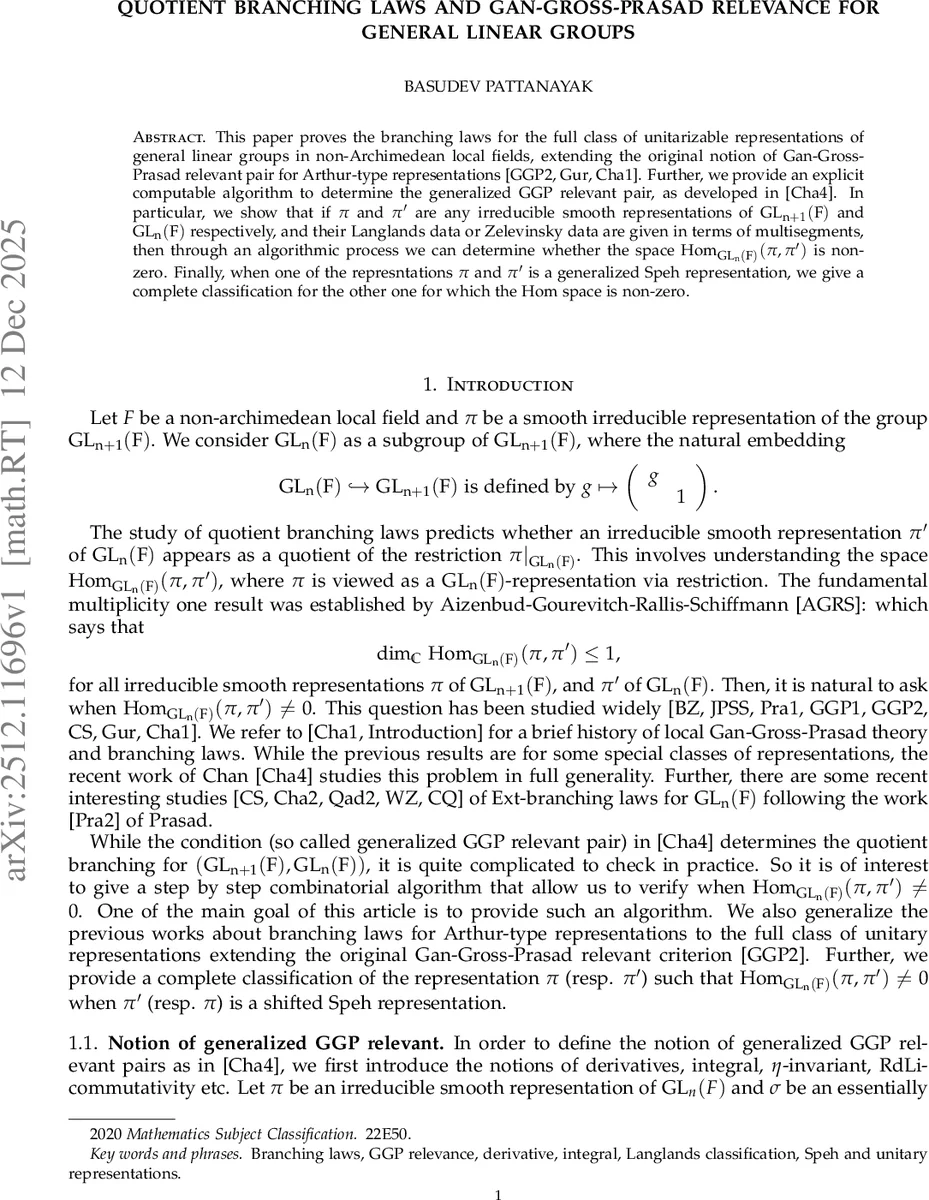
This paper proves the branching laws for the full class of unitarizable representations of general linear groups in non-Archimedean local fields, extending the original notion of Gan-Gross-Prasad relevant pair for Arthur-type representations \cite{GGP2, Gur, Cha_crelle}. Further, we provide an explicit computable algorithm to determine the generalized GGP relevant pair, as developed in \cite{Cha_qbl}. In particular, we show that if $π$ and $π’$ are any irreducible smooth representations of $\mathrm{GL_{n+1}(F)}$ and $\mathrm{GL_{n}(F)}$ respectively, and their Langlands data or Zelevinsky data are given in terms of multisegments, then through an algorithmic process we can determine whether the space $\mathrm{Hom}_{\mathrm{GL_n(F)}}(π, π’)$ is non-zero. Finally, when one of the represntations $π$ and $ π’$ is a generalized Speh representation, we give a complete classification for the other one for which the Hom space is non-zero.
💡 Research Summary
This paper presents a comprehensive study of branching laws for general linear groups over non-Archimedean local fields, achieving several major theoretical and practical advancements.
The core problem is determining when an irreducible smooth representation π of GL_{n+1}(F) admits a given irreducible representation π’ of GL_n(F) as a quotient upon restriction, i.e., when the Hom space Hom_{GL_n(F)}(π, π’) is non-zero. Building upon Chan’s prior work
Comments & Academic Discussion
Loading comments...
Leave a Comment