A constructive approach to the double-categorical small object argument
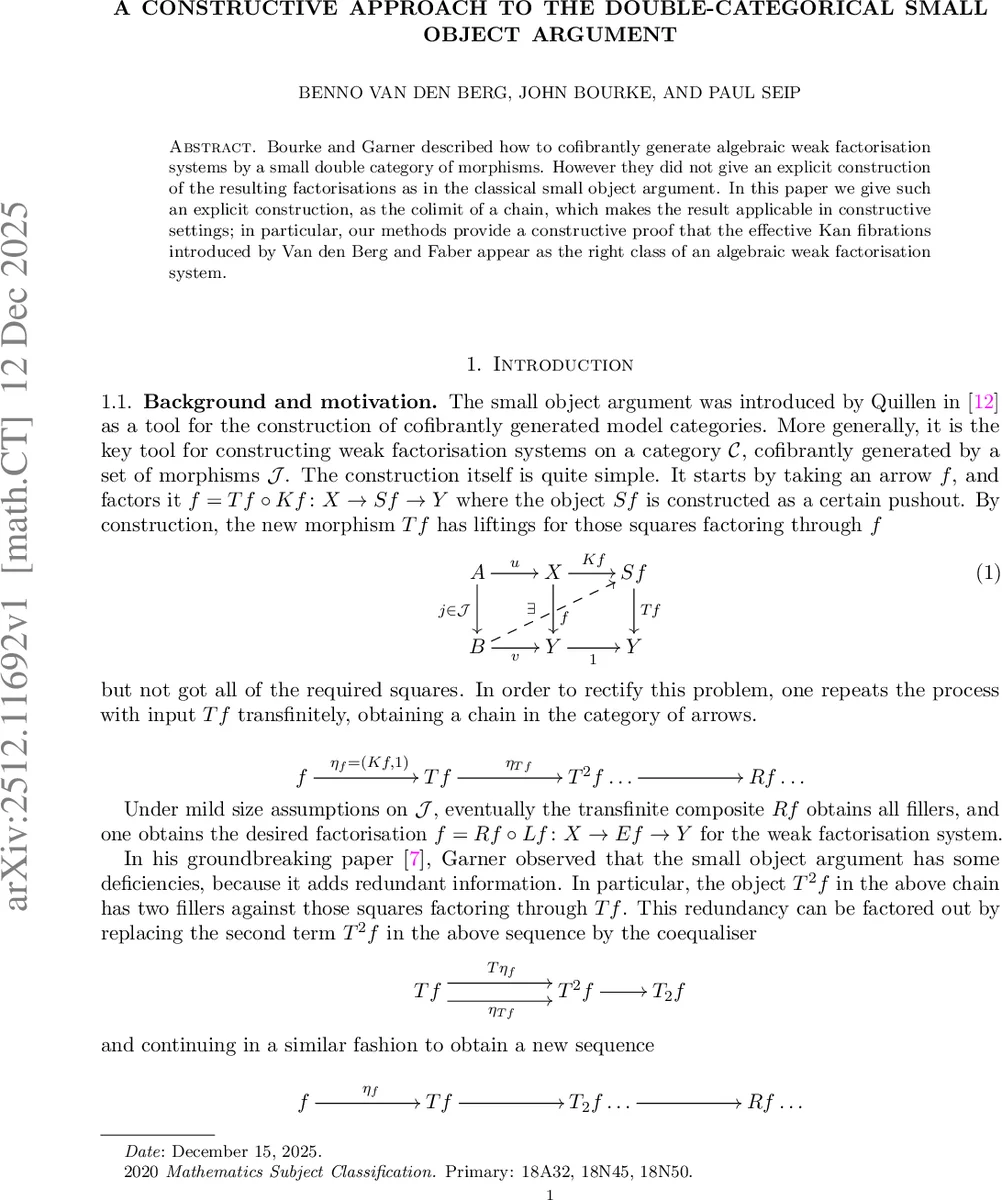
Bourke and Garner described how to cofibrantly generate algebraic weak factorisation systems by a small double category of morphisms. However they did not give an explicit construction of the resulting factorisations as in the classical small object argument. In this paper we give such an explicit construction, as the colimit of a chain, which makes the result applicable in constructive settings; in particular, our methods provide a constructive proof that the effective Kan fibrations introduced by Van den Berg and Faber appear as the right class of an algebraic weak factorisation system.
💡 Research Summary
The paper addresses a gap in the theory of algebraic weak factorisation systems (awfs) generated by a small double category of morphisms, as originally described by Bourke and Garner. While Bourke‑Garner showed that any accessible awfs on a locally presentable category can be cofibrantly generated by such a double category, they did not provide an explicit, constructive construction of the factorisations, nor did they require the base category to be locally presentable. This work fills that gap by giving a concrete, step‑by‑step construction that works in a fully constructive setting.
The authors begin by recalling the classical small‑object argument (SOA) of Quillen, which builds a factorisation of a map f:X→Y by repeatedly forming pushouts along a set J of generating cofibrations. The process yields a transfinite chain X₀→X₁→…→X_λ whose colimit provides the right‑hand map Rf with the desired lifting property. Garner later refined this argument by observing that the chain contains redundant information: each successor stage adds liftings that were already present. He eliminated the redundancy by replacing the second successor with a coequaliser that forces the new liftings to be compatible with the previous ones, thereby producing the free T‑algebra on f for a pointed endofunctor (T,η). This yields an algebraic weak factorisation system (L,R) rather than just a weak factorisation system.
The key novelty of the present paper is to extend Garner’s refinement to the double‑categorical setting, where the generating data J is not merely a small category of arrows but a small double category. In this context, liftings must satisfy both horizontal compatibility (as in the ordinary case) and vertical compatibility, reflecting the extra 2‑dimensional structure of J. To enforce vertical compatibility, the authors replace each ordinary coequaliser at a successor stage with a “join‑coequaliser”, i.e. a coequaliser that simultaneously identifies two parallel pairs of morphisms. This construction ensures that the liftings for composite vertical arrows are uniquely determined by the liftings of their components, exactly the condition required for a double‑categorical lifting operation.
Technically, the paper proceeds as follows. Section 2 reviews the necessary background on awfs, double‑categorical liftings, and pointed endofunctors. Section 3 analyses the pointed endofunctor (T,η) that appears in the first stage of Garner’s construction, establishing a new universal property with respect to one‑step lifting operations. Section 4 contains the main results. Theorem 18 shows that for any small double category J→Sq(C) the forgetful functor V₁:J⋔⋔₁→C² admits a left adjoint, constructed explicitly as the colimit of a transfinite chain built using join‑coequalisers. This left adjoint yields the free J‑algebraic right map, and consequently an awfs cofibrantly generated by J. Remark 19 compares this construction with Garner’s original SOA, highlighting that the only additional ingredient is the join‑coequaliser enforcing vertical compatibility.
The authors then apply their construction to the effective Kan fibrations introduced by Van den Berg and Faber. Those fibrations are defined by a double‑categorical lifting condition that precisely matches the structure of a double‑category J of generating cofibrations for simplicial sets. By invoking Theorem 20, the paper provides a constructive proof that effective Kan fibrations form the right class of an awfs generated by this J. This resolves a long‑standing problem: previously, the existence of an algebraic model structure on simplicial sets with effective Kan fibrations required non‑constructive arguments (e.g., the axiom of choice). The present work shows that the entire construction can be carried out in a constructive metatheory, making it suitable for formalisation in proof assistants such as Coq or Agda.
In summary, the paper delivers:
- An explicit, constructive construction of the factorisations produced by a double‑categorical small‑object argument, realised as the colimit of a transfinite chain with join‑coequalisers at successor stages.
- A proof that the left adjoint to the forgetful functor V₁ exists without assuming local presentability, thereby extending the applicability of the double‑categorical SOA to a broader class of categories.
- A concrete application to effective Kan fibrations, establishing them as the right class of a constructive awfs on simplicial sets.
The work bridges the gap between the abstract existence results of Bourke‑Garner and the concrete, constructive needs of homotopy‑type‑theoretic applications, and it opens the door for further constructive developments of algebraic model structures in settings where classical choice principles are unavailable.
Comments & Academic Discussion
Loading comments...
Leave a Comment