Logarithmic Cartier Transform
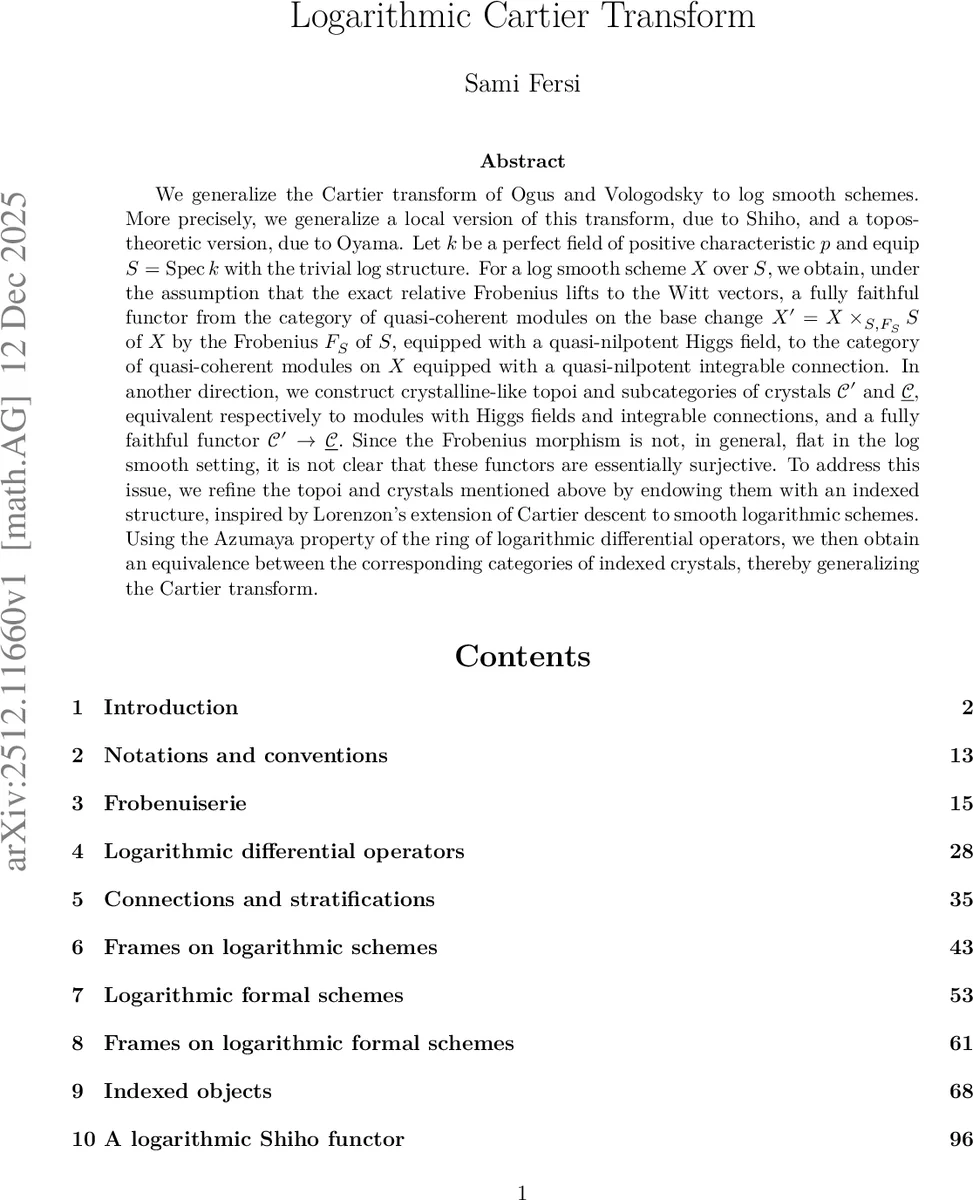
We generalize the Cartier transform of Ogus and Vologodsky to log smooth schemes. More precisely, we generalize a local version of this transform, due to Shiho, and a topos-theoretic version, due to Oyama. Let $k$ be a perfect field of positive characteristic $p$ and equip $S=\operatorname{Spec}k$ with the trivial log structure. For a log smooth scheme $X$ over $S,$ we obtain, under the assumption that the exact relative Frobenius lifts to the Witt vectors, a fully faithful functor from the category of quasi-coherent modules on the base change $X’=X\times_{S,F_S}S$ of $X$ by the Frobenius $F_S$ of $S,$ equipped with a quasi-nilpotent Higgs field, to the category of quasi-coherent modules on $X$ equipped with a quasi-nilpotent integrable connection. In another direction, we construct crystalline-like topoi and subcategories of crystals $\mathcal{C}’$ and $\underline{\mathcal{C}},$ equivalent respectively to modules with Higgs fields and integrable connections, and a fully faithful functor $\mathcal{C}’ \rightarrow \underline{\mathcal{C}}.$ Since the Frobenius morphism is not, in general, flat in the log smooth setting, it is not clear that these functors are essentially surjective. To address this issue, we refine the topoi and crystals mentioned above by endowing them with an indexed structure, inspired by Lorenzon’s extension of Cartier descent to smooth logarithmic schemes. Using the Azumaya property of the ring of logarithmic differential operators, we then obtain an equivalence between the corresponding categories of indexed crystals, thereby generalizing the Cartier transform.
💡 Research Summary
The paper “Logarithmic Cartier Transform” extends the classical Cartier transform of Ogus and Vologodsky to the setting of log‑smooth schemes over a perfect field k of characteristic p. In the smooth case the Cartier transform provides an equivalence between quasi‑coherent modules equipped with a nilpotent Higgs field and those equipped with a nilpotent integrable connection, and it underlies the Deligne‑Illusie decomposition of the de Rham complex. When one passes to logarithmic geometry, the absolute Frobenius morphism is generally not flat, which obstructs a direct generalisation of the smooth theory.
The authors address this difficulty in two complementary ways. First, they generalise Shiho’s local construction of the Cartier transform. To do this they introduce the notion of a frame on a log‑scheme (originally due to Kato and Saito) which allows the diagonal immersion to be factored into an exact immersion followed by a log‑étale morphism. This exactification makes it possible to define two groupoids—one governing Higgs modules, the other governing connections—by taking PD‑envelopes of suitable dilatations. Using a log‑flat descent theorem (proved by extending Kato’s results), they construct a functor from the category of quasi‑coherent modules with a quasi‑nilpotent Higgs field on the Frobenius twist X′ to the category of quasi‑coherent modules with a quasi‑nilpotent integrable connection on X, and they prove that this functor is fully faithful. However, because the Frobenius is not flat, essential surjectivity cannot be obtained at this stage.
The second line of attack follows Oyama’s crystalline‑like interpretation of the Cartier transform. The authors build two crystalline‑type topoi associated to a log‑smooth morphism of framed formal schemes, together with a morphism between them. Crystals in these topoi correspond respectively to Higgs modules and to modules with integrable connections. Again a pull‑back functor yields a fully faithful “Cartier” functor, but essential surjectivity remains out of reach.
To overcome the remaining obstacle, the paper adopts Lorenzon’s indexed algebra framework. An indexed algebra is a sheaf of algebras equipped with a locally constant “index” such that addition of sections is defined only when the indices match, and multiplication adds the indices. In the logarithmic setting the authors consider the indexed algebras (\mathcal{A}) (the sheaf of logarithmic functions) and (\mathcal{B}) (its sheaf of horizontal sections). They show, using results of Ohkawa and Schepler, that the sheaf of logarithmic differential operators (\mathcal{D}_{X/S}) is an Azumaya algebra over its centre, which itself is identified with the indexed algebra (\mathcal{B}). This Azumaya property allows one to pass from modules over (\mathcal{A}) with a connection to modules over (\mathcal{B}) with a Higgs field via Morita equivalence.
With these tools the authors define indexed crystals in the two topoi and construct an indexed logarithmic Cartier transform—a functor that is not only fully faithful but also essentially surjective, thus yielding an equivalence of categories between Higgs‑module crystals and connection‑module crystals in the logarithmic context. The main theorems (Theorem 15.13/15.14 and Theorem 20.3) state precisely this equivalence and its compatibility with the underlying geometric structures.
In summary, the paper achieves three major milestones: (1) a fully faithful local Shiho‑type functor for framed log‑smooth schemes; (2) a global crystalline‑like interpretation à la Oyama for log schemes; (3) the introduction of indexed algebras and the Azumaya property of logarithmic differential operators to obtain a genuine equivalence—the logarithmic Cartier transform. This work not only resolves the flatness obstacle in the log setting but also provides a robust framework that unifies Higgs and connection theories via indexed Azumaya algebras, opening the way for further developments in p‑adic Hodge theory and logarithmic non‑abelian Hodge correspondence.
Comments & Academic Discussion
Loading comments...
Leave a Comment