On the rational approximation to linear combinations of powers
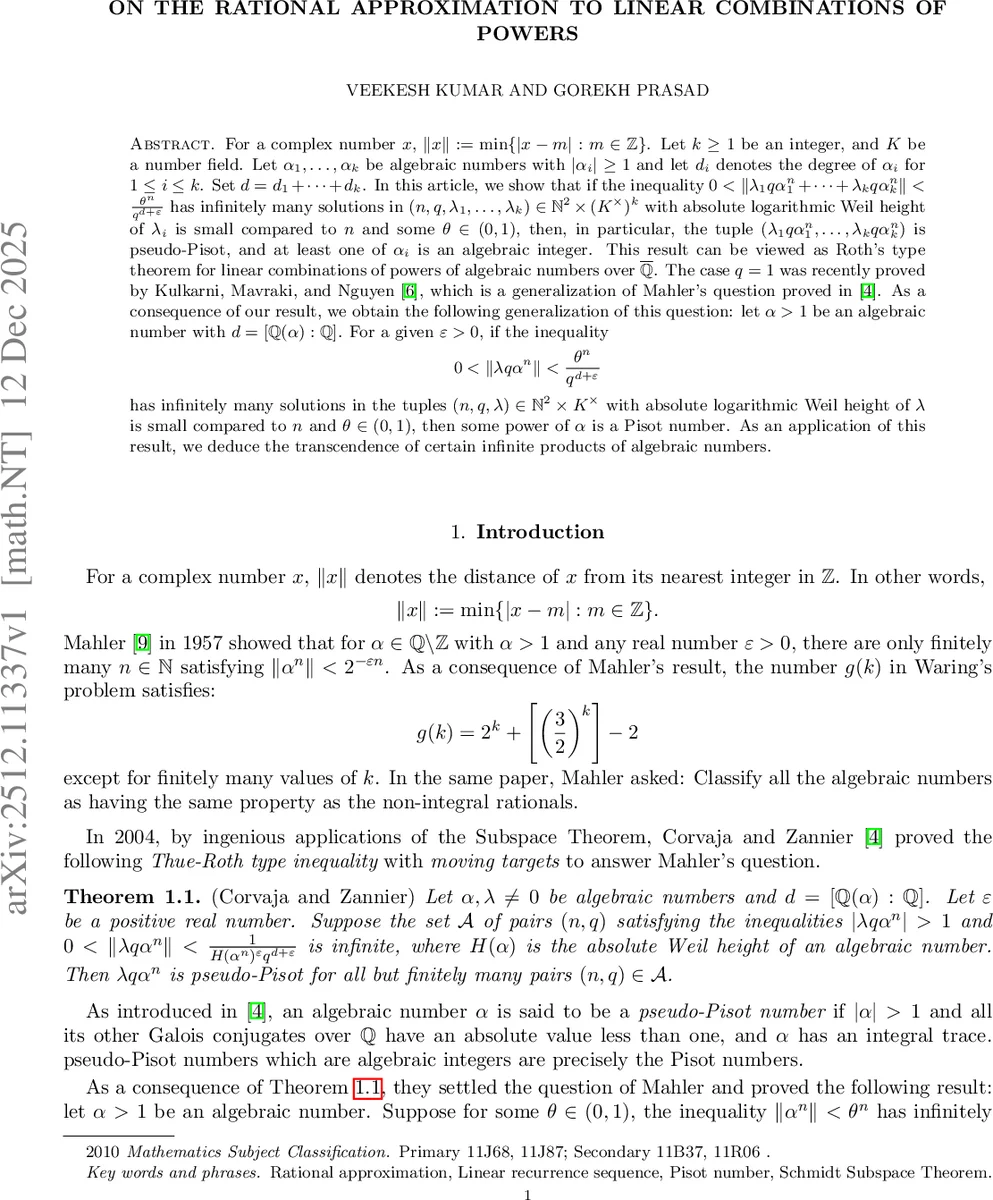
For a complex number $x$, $\Vert x\Vert:=\min{|x-m|:m\in\mathbb{Z}}$. Let $k\geq 1$ be an integer, and $K$ be a number field. Let $α_1,\ldots,α_k$ be algebraic numbers with $|α_i|\geq 1$ and let $d_i$ denotes the degree of $α_i$ for $1\leq i\leq k$. Set $d=d_1+\cdots+d_k$. In this article, we show that if the inequality $ 0<\Vertλ_1 qα^n_1+\cdots+λ_k qα^n_k\Vert<\frac{θ^n}{q^{d+\varepsilon}} $ has infinitely many solutions in $(n, q,λ_1,\ldots,λ_k)\in \mathbb{N}^2\times (K^\times)^k$ with absolute logarithmic Weil height of $λ_i$ is small compared to $n$ and some $θ\in (0,1)$, then, in particular, the tuple $(λ_1 qα^n_1,\ldots, λ_k qα^n_k)$ is pseudo-Pisot, and at least one of $α_i$ is an algebraic integer. This result can be viewed as Roth’s type theorem for linear combinations of powers of algebraic numbers over $\overline{\mathbb{Q}}$. The case $q=1$ was recently proved by Kulkarni, Mavraki, and Nguyen \cite{kul}, which is a generalization of Mahler’s question proved in \cite{corv}. As a consequence of our result, we obtain the following generalization of this question: let $α>1$ be an algebraic number with $d=[\mathbb{Q}(α):\mathbb{Q}]$. For a given $\varepsilon>0$, if the inequality $$ 0<\Vertλqα^n\Vert<\frac{θ^n}{q^{d+\varepsilon}} $$ has infinitely many solutions in the tuples $(n,q,λ)\in \mathbb{N}^2\times K^\times$ with absolute logarithmic Weil height of $λ$ is small compared to $n$ and $θ\in (0,1)$, then some power of $α$ is a Pisot number. As an application of this result, we deduce the transcendence of certain infinite products of algebraic numbers.
💡 Research Summary
This paper presents a significant advancement in the field of Diophantine approximation, specifically focusing on the rational approximation of linear combinations of powers of algebraic numbers. The core of the research investigates the deep connection between the precision of integer approximation and the underlying algebraic structure of the numbers involved.
The study examines the distance to the nearest integer, denoted by $\Vert x \Vert$, for a linear combination of the form $\sum_{i=1}^k \lambda_i q \alpha_i^n$. The authors investigate the conditions under which the inequality $0 < \Vert \lambda_1 q \alpha_1^n + \dots + \lambda_k q \alpha_k^n \Vert < \frac{\theta^n}{q^{d+\epsilon}}$ possesses infinitely many solutions for $(n, q, \lambda_1, \dots, \lambda_k) \in \mathbb{N}^2 \times (K^\times)^k$. Here, $d$ represents the sum of the degrees of the algebraic numbers $\alpha_i$, and $\theta \in (0, 1)$ represents an exponential decay factor. A crucial constraint is imposed on the absolute logarithmic Weil height of the coefficients $\lambda_i$, ensuring they do not grow too rapidly relative to $n$.
The primary mathematical contribution is the generalization of previous results. While recent works, such as those by Kulkarni, Mavraki, and Nguyen, addressed the case where $q=1$, this paper extends the scope to include the integer $q$, effectively dealing with a more complex approximation landscape. This expansion allows for a “Roth-type theorem” for linear combinations of powers over the field of algebraic numbers $\overline{\mathbb{Q}}$.
The paper proves that if such an inequality holds for infinitely many solutions, the resulting tuple $(\lambda_1 q \alpha_1^n, \dots, \lambda_k q \alpha_k^n)$ must be “pseudo-Pisot,” and at least one of the algebraic numbers $\alpha_i$ must be an algebraic integer. In a specialized case involving a single algebraic number $\alpha$, the authors demonstrate that if the approximation is sufficiently dense, then some power of $\alpha$ must be a Pisot number.
Beyond its theoretical implications in number theory, the paper provides a powerful tool for transcendence theory. The authors demonstrate that this result can be applied to deduce the transcendence of certain infinite products of algebraic numbers. By establishing that certain approximation properties force specific algebraic structures, the paper provides a new methodology for proving that certain numbers cannot be roots of any non-zero polynomial with rational coefficients, thereby advancing our understanding of the boundary between algebraic and transcendental numbers.
Comments & Academic Discussion
Loading comments...
Leave a Comment