Note on Iitaka Conjecture $C_{n,m}$
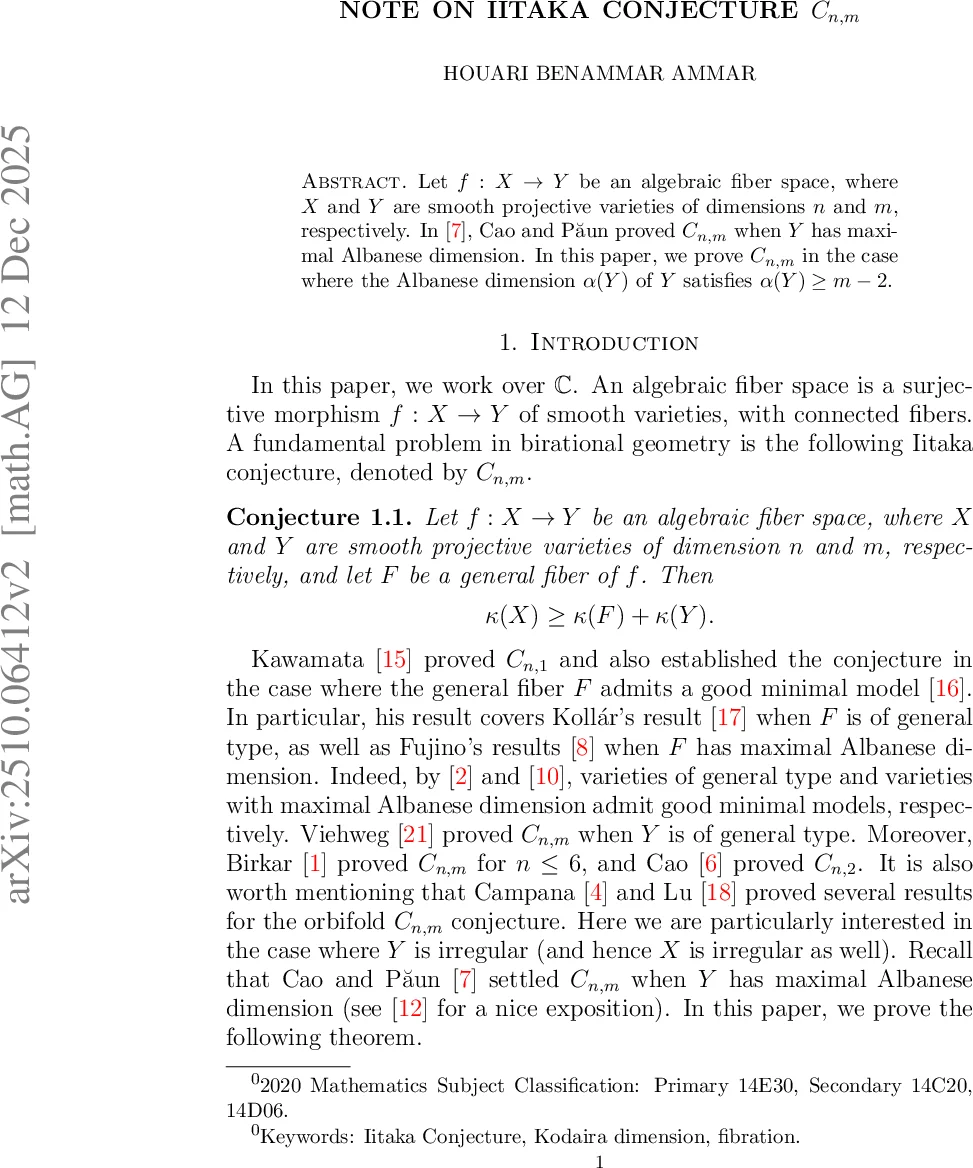
Let ( f: X \to Y ) be an algebraic fiber space, where ( X ) and ( Y ) are smooth projective varieties of dimensions ( n ) and ( m ), respectively. In \cite{Caopaun}, Cao and Păun proved ( C_{n,m} ) when ( Y ) has maximal Albanese dimension. In this paper, we prove ( C_{n,m} ) in the case where the Albanese dimension $α(Y)$ of ( Y ) satisfies ( α(Y) \geq m-2 ).
💡 Research Summary
This paper establishes a significant case of the Iitaka conjecture C_{n,m} in algebraic geometry. The conjecture concerns an algebraic fiber space f: X → Y between smooth projective varieties of dimensions n and m, and asserts an inequality between their Kodaira dimensions: κ(X) ≥ κ(F) + κ(Y), where F is a general fiber of f. The main result proves that this inequality holds under the assumption that the base variety Y has high Albanese dimension, specifically when α(Y) ≥ m-2. This extends the earlier work of Cao and Păun, which proved the conjecture when Y has maximal Albanese dimension (α(Y) = m).
The proof strategy is ingenious and multi-layered, centering on the use of the Albanese morphism of the base. The key steps are as follows:
First, the Albanese map alb_Y: Y → alb_Y(Y) is considered. Its image has maximal Albanese dimension, allowing the application of the Cao-Păun theorem to the composed map h = alb_Y ∘ f: X → alb_Y(Y). This yields the first inequality: κ(X) ≥ κ(H) + κ(alb_Y(Y)), where H is a general fiber of h.
Next, the restriction of f to H, denoted f|_H: H → G, is analyzed. Here, G is a general fiber of alb_Y. The condition α(Y) ≥ m-2 implies dim(G) ≤ 2. For these low-dimensional bases, known cases of the Iitaka conjecture come into play: Cao’s theorem for dim(G)=2 and Kawamata’s theorem for dim(G)=1. Applying these gives κ(H) ≥ κ(F) + κ(G). Combining this with the first inequality produces a fundamental relation: κ(X) ≥ κ(F) + κ(G) + κ(alb_Y(Y)).
The proof then proceeds by examining specific scenarios. If κ(Y) = 0, applying the Cao-Păun result to alb_Y itself forces κ(G) = κ(alb_Y(Y)) = 0, and the desired inequality follows directly. A technically profound step (Step 4) demonstrates that if κ(X) = 0, then necessarily κ(Y) = 0. This step is crucial for the subsequent induction argument. It involves applying the Fujino-Mori canonical bundle formula to f and conducting a detailed analysis of the nef divisor appearing in the formula on the fibers G of the Albanese map. These fibers are either elliptic curves or surfaces with κ=0 (K3, abelian, Enriques, or bi-elliptic). The analysis meticulously shows that a key nef divisor L_Y must be the pullback of a non-torsion line bundle from the Albanese variety, leading to the conclusion that κ(Y)=0.
For the remaining case where κ(X) > 0, the proof employs induction on the dimension of X. The Iitaka fibration g: X → Z of X is introduced, and the restriction of f to a general fiber X_Z of g (which has κ(X_Z)=0) is studied. Using a lemma of Kawamata and a proposition of Fujino, it is shown that the image B = f(X_Z) inherits a suitable Albanese dimension condition (α_f(B) ≤ 2), permitting the application of the induction hypothesis to f|_{X_Z}. Careful manipulation of the properties of the Iitaka fibration and Mori’s easy addition formula then completes the induction, finally proving κ(X) ≥ κ(F) + κ(Y).
The paper also includes a corollary showing a more direct proof under the additional assumption that the Iitaka variety of Y is not uniruled, utilizing a theorem on the effectiveness of pseudo-effective divisors.
In essence, this work provides a powerful generalization of known results on the Iitaka conjecture by masterfully leveraging the structural properties imposed by high Albanese dimension. It combines deep tools from higher-dimensional birational geometry, such as the canonical bundle formula and the minimal model program, with precise geometric analysis of low-dimensional fibers, showcasing a sophisticated synthesis of techniques in modern algebraic geometry.
Comments & Academic Discussion
Loading comments...
Leave a Comment