Advancing Weakly-Supervised Change Detection in Satellite Images via Adversarial Class Prompting
Weakly-Supervised Change Detection (WSCD) aims to distinguish specific object changes (e.g., objects appearing or disappearing) from background variations (e.g., environmental changes due to light, weather, or seasonal shifts) in paired satellite images, relying only on paired image (i.e., image-level) classification labels. This technique significantly reduces the need for dense annotations required in fully-supervised change detection. However, as image-level supervision only indicates whether objects have changed in a scene, WSCD methods often misclassify background variations as object changes, especially in complex remote-sensing scenarios. In this work, we propose an Adversarial Class Prompting (AdvCP) method to address this co-occurring noise problem, including two phases: a) Adversarial Prompt Mining: After each training iteration, we introduce adversarial prompting perturbations, using incorrect one-hot image-level labels to activate erroneous feature mappings. This process reveals co-occurring adversarial samples under weak supervision, namely background variation features that are likely to be misclassified as object changes. b) Adversarial Sample Rectification: We integrate these adversarially prompt-activated pixel samples into training by constructing an online global prototype. This prototype is built from an exponentially weighted moving average of the current batch and all historical training data. Our AdvCP can be seamlessly integrated into current WSCD methods without adding additional inference cost. Experiments on ConvNet, Transformer, and Segment Anything Model (SAM)-based baselines demonstrate significant performance enhancements. Furthermore, we demonstrate the generalizability of AdvCP to other multi-class weakly-supervised dense prediction scenarios. Code is available at https://github.com/zhenghuizhao/AdvCP
💡 Research Summary
The paper tackles a fundamental limitation of weakly‑supervised change detection (WSCD) in satellite imagery: with only image‑level “changed/unchanged” labels, models frequently mistake background variations (lighting, weather, seasonal shifts) for actual object changes. To address this co‑occurring noise, the authors propose Adversarial Class Prompting (AdvCP), a plug‑and‑play training strategy that requires no extra parameters and incurs zero inference overhead.
AdvCP consists of two sequential phases. In the first phase, Adversarial Prompt Mining, the ground‑truth label of every “unchanged” image pair is deliberately flipped to “changed”. This adversarial label forces the classification backbone to generate change localization maps (e.g., CAM or Grad‑CAM) that highlight regions it now incorrectly believes to be changes. Because the underlying scene is truly unchanged, the highlighted regions correspond to background variations that are most likely to be mis‑classified in normal training. These pixels are harvested as adversarial samples.
In the second phase, Adversarial Sample Rectification, the harvested pixel features are incorporated back into training. The authors maintain an online global prototype for each class, updated via an exponential moving average (EMA) that blends the current mini‑batch statistics with all historical batches. This prototype acts as an unbiased anchor representing the true “changed” and “unchanged” feature distributions. A rectification loss encourages adversarial sample features to diverge from the “changed” prototype (or converge toward the “unchanged” prototype), thereby teaching the model that the previously confusing background patterns should not be treated as changes. The EMA ensures the prototype adapts smoothly without storing the entire dataset, keeping computational cost minimal.
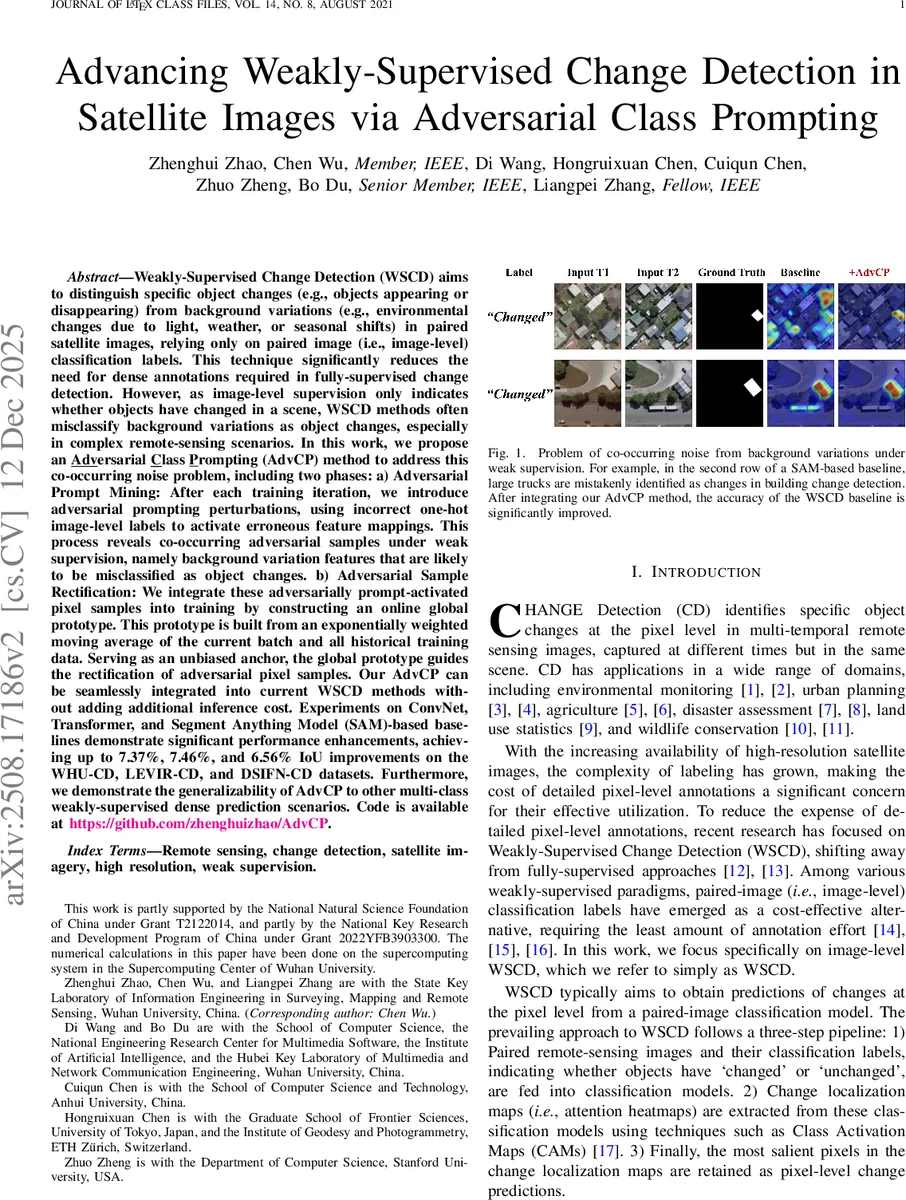
The method is architecture‑agnostic. The authors embed AdvCP into six state‑of‑the‑art WSCD baselines: three ConvNet‑based, two Transformer‑based, and one SAM‑based model. Experiments on three benchmark datasets—WHU‑CD, LEVIR‑CD, and DSIFN‑CD—show consistent improvements, with IoU gains of up to 7.37 %, 7.46 %, and 6.56 %, respectively. Qualitative results illustrate a marked reduction of false positives such as trucks or shadows being labeled as building changes.
A thorough ablation study dissects the contributions: (1) using adversarial label flipping alone yields modest gains; (2) employing a batch‑level prototype instead of the global EMA prototype reduces performance; (3) varying the EMA decay factor reveals a sweet spot (β≈0.9–0.99) where the prototype is stable yet responsive. The authors also demonstrate that AdvCP generalizes beyond WSCD: when applied to fully‑supervised change detection and multi‑class weakly‑supervised semantic segmentation, similar performance lifts are observed, confirming the broader applicability of adversarial prompting combined with prototype rectification.
Limitations are acknowledged. AdvCP relies on a sufficient number of “unchanged” samples to generate diverse adversarial noise; in highly imbalanced datasets its effectiveness may diminish. Early training stages can suffer from an unstable prototype, suggesting a warm‑up period or reduced rectification weight may be beneficial. Moreover, the current formulation addresses binary change detection; extending it to multi‑type change categorization would require additional design.
Future directions include (i) adaptive sampling to balance label flips, (ii) multi‑modal prototype learning to capture heterogeneous background patterns, and (iii) extending the adversarial prompting concept to temporal sequences for continuous monitoring.
In summary, AdvCP offers a simple yet powerful mechanism to expose and suppress background‑induced false alarms in weakly‑supervised satellite change detection. By turning the weakness of image‑level supervision (lack of pixel guidance) into a strength—using the model’s own misclassifications as training signals—AdvCP achieves notable accuracy gains without extra inference cost, making it a valuable addition to the remote‑sensing toolbox.
Comments & Academic Discussion
Loading comments...
Leave a Comment