Modification of adhesion between microparticles and engineered silicon surfaces
A key challenge in performing experiments with microparticles is controlling their adhesion to substrates. For example, levitation of a microparticle initially resting on a surface requires overcoming the surface adhesion forces to deliver the microparticle into a mechanical potential acting as a trap. By engineering the surface of silicon substrates, we aim to decrease the adhesion force between a metallic microparticle and the silicon surface. To this end, we investigate different methods of surface engineering that are based on chemical, physical, or physio-chemical modifications of the surface of silicon. We give quantitative results on the detachment force, finding a correlation between the water contact angle and the mean detachment force, indicating that hydrophobic surfaces are desired for low microparticle adhesion. We develop surface preparations decreasing the mean detachment force by more than a factor of three compared to an untreated silicon surface. Our results will enable reliable levitation of microparticles and are relevant for experiments requiring low adhesion between microparticles and a surface.
💡 Research Summary
This paper presents a comprehensive study on reducing adhesion forces between metallic microparticles and silicon substrates through surface engineering, with direct application to improving the loading efficiency of microparticles into levitation traps, particularly for superconducting magnetic traps.
The core challenge addressed is the strong adhesion of microparticles (specifically 50μm diameter SnPb spheres) to surfaces, which must be overcome by a lift force (e.g., magnetic) to achieve levitation. The authors systematically investigate and compare eight different surface modifications of silicon chips, categorized into physical (KOH etching, plasma etching), chemical (Parylene C, PMMA, HSQ spin-coatings, Au deposition), and physio-chemical (PTFE membrane attachment) treatments. The goal is to identify modifications that minimize adhesion while being compatible with high-vacuum and cryogenic environments.
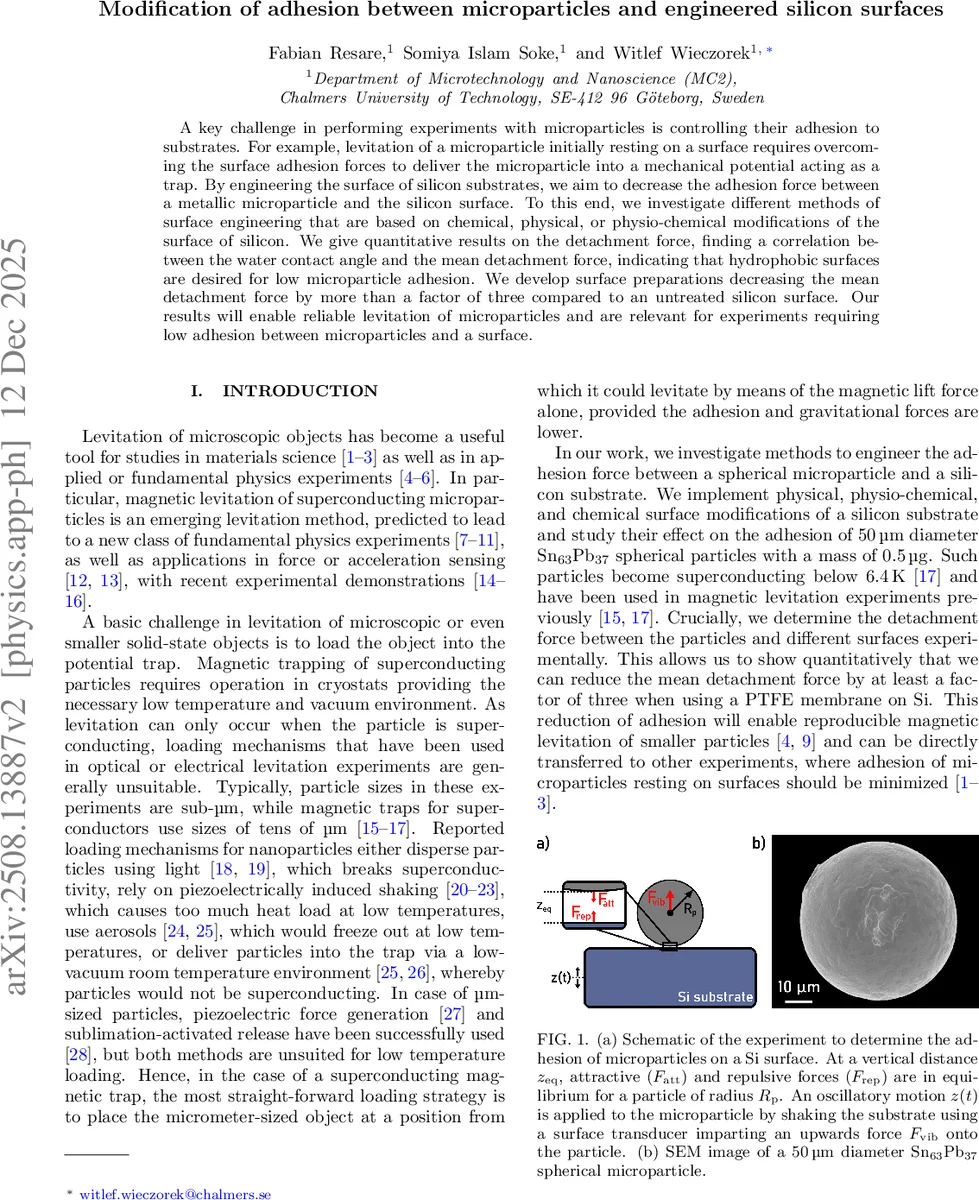
The surface properties of each modification were characterized using Atomic Force Microscopy (AFM) and Scanning Electron Microscopy (SEM) for morphology and roughness, and water contact angle (WCA) measurements for wettability. The key quantitative data comes from a direct detachment force measurement. Particles are placed on the test substrate, which is then mounted on a calibrated surface transducer. By applying a sinusoidal voltage, the substrate is vibrated vertically. The acceleration is gradually increased until particles detach. The detachment force is calculated from the critical acceleration and the particle’s mass. This process is repeated for many particles (10-50 per sample) to build a statistical distribution.
The main findings are:
- Untreated silicon showed high adhesion, with a mean detachment force of approximately 1250 nN.
- Purely physical structuring (KOH and plasma etching) unexpectedly increased the adhesion force significantly, likely due to mechanical interlocking or increased contact points.
- Chemical coatings showed varied results. Parylene C and HSQ (Hydrogen Silsesquioxane) successfully reduced the mean detachment force to ~730 nN and ~510 nN, respectively. Gold deposition, however, increased adhesion drastically.
- The most effective treatment was the physio-chemical modification using a PTFE (Teflon) membrane, which achieved the lowest mean detachment force of ~340 nN—a reduction by more than a factor of three compared to untreated silicon.
- A clear correlation was observed between a high water contact angle (hydrophobicity) and a low mean detachment force. PTFE and HSQ, both with high WCAs (130° and 80°), yielded the lowest adhesion. This aligns with the theory that lower surface free energy reduces van der Waals interactions.
- The adhesion force measured by AFM tip (
F_AFM_adh) showed a qualitative trend with the particle detachment force but is not a direct quantitative predictor due to scale and material differences.
The study concludes that reducing adhesion requires a combined approach targeting both the chemical nature (low surface energy, hydrophobicity) and the physical morphology of the surface. While PTFE membranes provided the best performance, HSQ coating is noted as a promising alternative, especially for applications where transparency or minimal added thickness is required. These results provide a practical guide for selecting surface treatments to enable reliable microparticle levitation and manipulation in advanced physics experiments and microsystem applications.
Comments & Academic Discussion
Loading comments...
Leave a Comment