Reentrant Rigidity Transition in Planar Epithelia with Volume- and Area Elasticity
We find a reentrant columnar-to-squamous rigidity transition in 3D epithelia, governed by volume- and area elasticity. Our framework maps onto the classic 2D Area- and Perimeter-Elasticity model but, unlike its 2D counterpart, exhibits both softening and stiffening depending on the initial state. The phase diagram reveals floppy states with vanishing shear and in-plane bulk moduli, alongside a lateral-tension-driven discontinuous columnar-to-squamous transition. The critical behavior underlying the emergence of the reentrant transition belongs to the mean-field universality class.
💡 Research Summary
This paper presents a theoretical and computational study investigating a novel “reentrant rigidity transition” in three-dimensional (2D) epithelial monolayers governed by Volume- and Area Elasticity (VAE). The model describes cells that energetically prefer a target volume (V0) and a target total surface area (S0), with an additional constant lateral tension (γ) representing cell-cell adhesion.
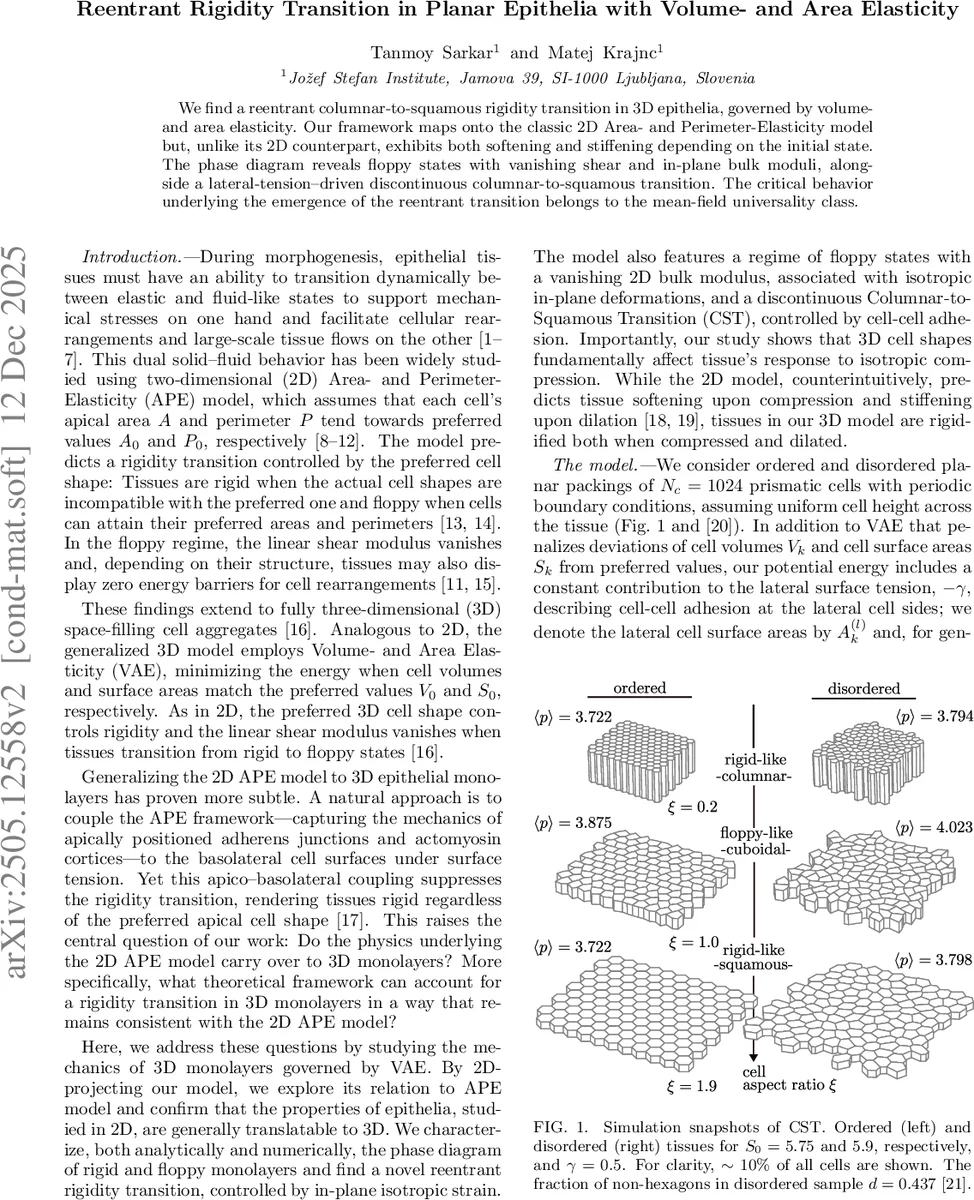
The central finding is that the mechanical rigidity of the tissue can be tuned non-monotonically by in-plane isotropic strain, which changes the three-dimensional cell aspect ratio (ξ, defined as width-to-height). As ξ is varied quasistatically, the tissue undergoes a reentrant transition: it is rigid in columnar (tall and thin) shapes, becomes floppy (with vanishing shear and in-plane bulk moduli) near a cuboidal shape (ξ ≈ 1), and rigidifies again in squamous (short and wide) shapes. This creates a regime where a floppy, fluid-like state is sandwiched between two solid-like states.
A key theoretical achievement is the exact mapping of the 3D VAE model (in the incompressible cell limit) onto the well-established 2D Area-Perimeter Elasticity (APE) model. This mapping reveals that varying the 3D cell aspect ratio effectively nonlinearly changes the preferred 2D cell shape index (p0), which is the control parameter for the rigidity transition in 2D. The phase boundary between rigid and floppy states in the (S0, ξ) plane is derived analytically and confirmed by vertex model simulations on both ordered and disordered cell packings.
The transition only occurs for S0 above a critical value S0*. Near this critical point, the behavior is analyzed using a mean-field Landau theory. The free energy expansion in terms of an order parameter (Ξ = ξ - ξ*) and a generalized temperature (T = S0 - S0*) shows that the critical exponents (e.g., |Ξ| ∝ T^(1/2)) belong to the mean-field Ising universality class. The lateral tension γ acts as a symmetry-breaking field, favoring columnar shapes for γ > 0 and squamous shapes for γ < 0, and can drive a discontinuous columnar-to-squamous transition.
Importantly, this model revises a counterintuitive prediction of the pure 2D APE model. While the 2D model predicts softening under compression and stiffening under dilation, the 3D VAE model predicts that both compression and dilation away from the cuboidal state lead to stiffening, as the third dimension (cell height) provides an additional degree of freedom that is constrained.
The study concludes that the VAE model provides a more direct 3D generalization of the 2D APE physics than other proposed models (e.g., those with apico-basolateral coupling), successfully preserving the rigidity transition. The findings offer a new theoretical framework for understanding how epithelial tissues may dynamically switch between solid and fluid states during processes like morphogenesis by modulating cell shape and tension.
Comments & Academic Discussion
Loading comments...
Leave a Comment