The Large-scale Environments of Low-luminosity AGNs at $3.9 < z < 6$ and Implications for Their Host Dark Matter Halos from a Complete NIRCam Grism Redshift Survey
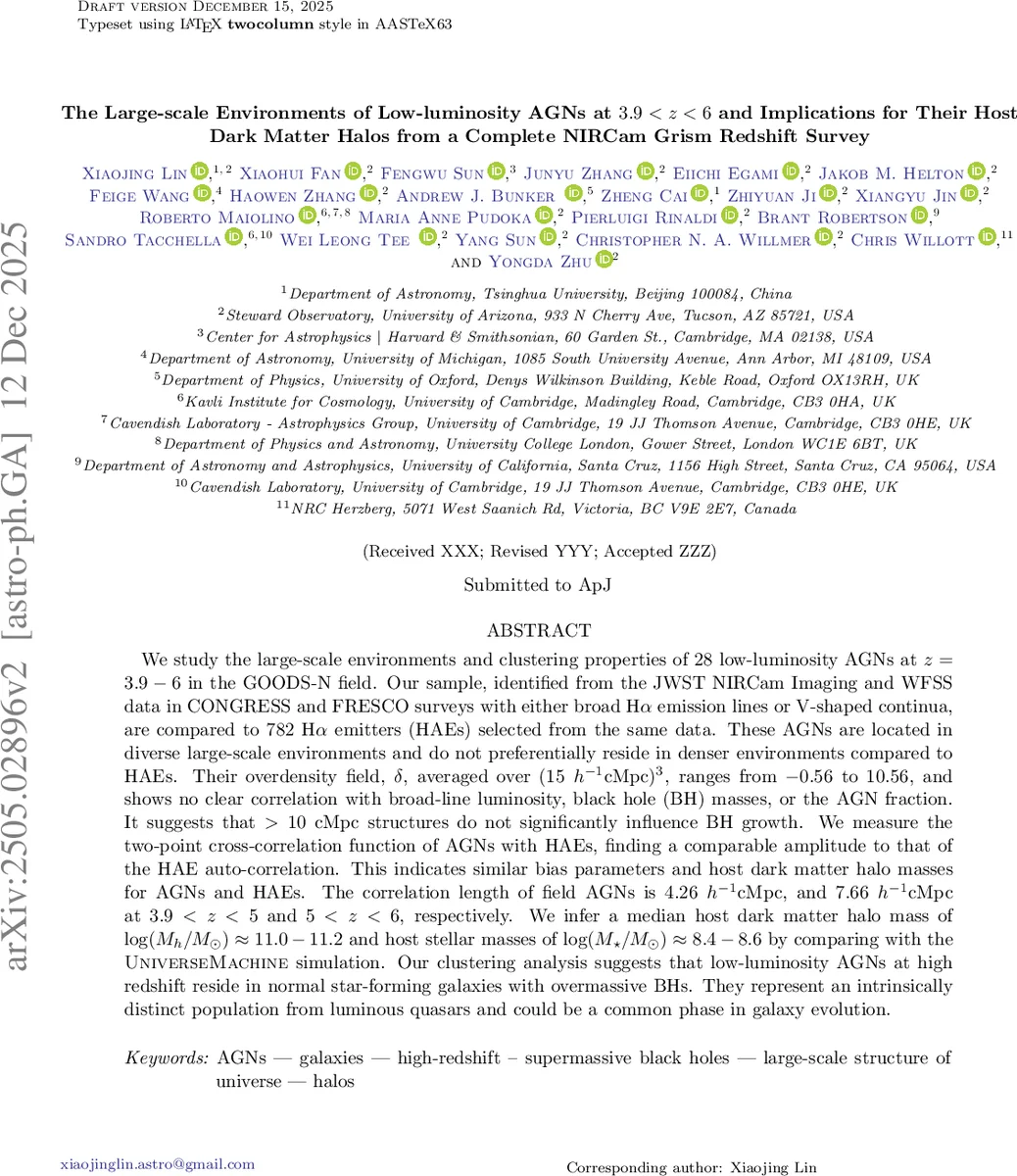
We study the large-scale environments and clustering properties of 28 low-luminosity AGNs at $z=3.9-6$ in the GOODS-N field. Our sample, identified from the JWST NIRCam Imaging and WFSS data in CONGRESS and FRESCO surveys with either broad H$α$ emission lines or V-shape continua, are compared to 782 H$α$ emitters (HAEs) selected from the same data. These AGNs are located in diverse large-scale environments and do not preferentially reside in denser environments compared to HAEs. Their overdensity field, $δ$, averaged over (15 $h^{-1}$cMpc)$^3$, ranges from $-0.56$ to 10.56, and shows no clear correlation with broad-line luminosity, black hole (BH) masses, or the AGN fraction. It suggests that $> 10$ cMpc structures do not significantly influence BH growth. We measure the two-point cross-correlation function of AGNs with HAEs, finding a comparable amplitude to that of the HAE auto-correlation. This indicates similar bias parameters and host dark matter halo masses for AGNs and HAEs. The correlation length of field AGNs is 4.26 $h^{-1}$cMpc, and 7.66 $h^{-1}$cMpc at $3.9 < z < 5$ and $5 < z < 6$, respectively. We infer a median host dark matter halo mass of $\log (M_h/M_\odot)\approx 11.0-11.2$ and host stellar masses of $\log (M_\star/M_\odot) \approx 8.4-8.6$ by comparing with the UniverseMachine simulation. Our clustering analysis suggests that low-luminosity AGNs at high redshift reside in normal star-forming galaxies with overmassive BHs. They represent an intrinsically distinct population from luminous quasars and could be a common phase in galaxy evolution.
💡 Research Summary
**
This paper presents the first systematic study of the large‑scale environments and clustering properties of low‑luminosity active galactic nuclei (AGNs) at redshifts 3.9 < z < 6 using the JWST NIRCam Wide‑Field Slitless Spectroscopy (WFSS) data from the CONGRESS and FRESCO programs in the GOODS‑N field. The authors compile a sample of 28 AGNs identified either by broad H α emission (FWHM > 1000 km s⁻¹) in the grism spectra, by NIRSpec detections of broad H α, or by the characteristic “V‑shaped” spectral energy distribution (red optical continuum combined with a blue UV slope). These AGNs are compared to a much larger population of 782 H α emitters (HAEs) selected from the same grism data in the same redshift interval, providing a homogeneous control sample of star‑forming galaxies.
Data and Sample Construction
The analysis uses deep JWST/NIRCam imaging from JADES (11 NIRCam filters plus five HST/ACS bands) to obtain precise photometric redshifts with EAZY. Grism spectra covering 3.1–5.0 µm (F356W and F444W) are reduced with a custom pipeline that performs flat‑fielding, sky subtraction, astrometric alignment, wavelength calibration, and optimal 1‑D extraction. Emission‑line detection employs a median‑filter continuum subtraction and a semi‑automated line‑finding algorithm that uses photometric redshifts as priors. HAEs are required to have H α luminosities L_Hα > 10⁴¹·⁵ erg s⁻¹ to ensure completeness; the same cut is applied to the total H α flux of AGNs to avoid selection bias.
Large‑Scale Overdensity Measurement
For each AGN the authors compute the galaxy overdensity δ = (N − ⟨N⟩)/⟨N⟩ within a cubic volume of (15 h⁻¹ cMpc)³ centered on the AGN. The δ values span a wide range (−0.56 to 10.56), indicating that AGNs inhabit both under‑dense fields and significant overdensities. Crucially, statistical tests reveal no correlation between δ and AGN properties such as H α luminosity, black‑hole (BH) mass (estimated from line width and luminosity scaling relations), or the overall AGN fraction. This suggests that structures on scales ≳10 cMpc do not play a dominant role in driving BH growth at these epochs.
Clustering Analysis
The two‑point cross‑correlation function (CCF) between AGNs and HAEs, ξ_AG‑HAE(r), is measured using the Landy‑Szalay estimator and compared to the HAE auto‑correlation function, ξ_HAE‑HAE(r). Both functions exhibit comparable amplitudes, implying that low‑luminosity AGNs and HAEs share similar linear bias factors (b_AG ≈ b_HAE). Power‑law fits (ξ ∝ r⁻γ with γ ≈ 1.8) yield correlation lengths r₀ = 4.26 h⁻¹ cMpc for 3.9 < z < 5 and r₀ = 7.66 h⁻¹ cMpc for 5 < z < 6. Translating these r₀ values into halo masses via the Sheth‑Tormen bias model within a ΛCDM framework gives median host halo masses log M_h/M_⊙ ≈ 11.0–11.2 (≈10¹¹ M_⊙). These halo masses are essentially identical to those inferred for the HAEs, and are an order of magnitude lower than the ≈10¹²·⁵ M_⊙ halos typically associated with luminous quasars at similar redshifts.
Comparison with Simulations
To break the degeneracy inherent in SED‑based stellar mass estimates, the authors compare their clustering results with the UniverseMachine semi‑empirical model (Behroozi et al.). Matching the observed bias and r₀ selects a subset of simulated galaxies with stellar masses log M_★/M_⊙ ≈ 8.4–8.6 (≈3 × 10⁸ M_⊙). When combined with the BH mass estimates (10⁶–10⁸ M_⊙), these objects lie far above the local M_BH–M_★ relation, i.e., they host “overmassive” black holes relative to their modest stellar content.
Interpretation and Implications
The key conclusions are:
-
Environment Independence – Low‑luminosity AGNs do not preferentially occupy the most overdense regions, indicating that large‑scale structure (≳10 cMpc) is not the primary driver of early BH growth for this population.
-
Typical Halo Masses – Their host halos of ≈10¹¹ M_⊙ are comparable to those of normal star‑forming galaxies at the same epoch, implying that these AGNs reside in “main‑sequence” galaxies rather than in the massive proto‑clusters that host bright quasars.
-
Overmassive Black Holes – The inferred BH‑to‑stellar mass ratios are significantly higher than those of luminous quasars and the local scaling relations, suggesting a phase of rapid BH accretion that outpaces host galaxy growth.
-
Distinct Evolutionary Path – The clustering and halo mass results place low‑luminosity AGNs in a different evolutionary track from UV‑bright quasars. They may represent a common, possibly recurrent, low‑luminosity accretion phase that contributes substantially to the overall SMBH mass density at early times.
-
Physical Mechanisms – The characteristic V‑shaped SEDs, weak X‑ray emission, and lack of a hot dust torus observed in many of these objects are consistent with theoretical scenarios invoking super‑Eddington accretion, optically thin disks, or strong radiatively driven outflows in low‑mass hosts.
Caveats and Future Work
The sample size (28 AGNs) limits the statistical power, especially for the higher‑redshift bin where the correlation length appears larger. BH mass estimates rely on single‑epoch virial scaling relations; reverberation mapping or high‑resolution IFU spectroscopy would provide more robust masses. The analysis focuses on optical/near‑IR tracers; incorporating deep X‑ray, radio, and sub‑mm data will be essential to assess obscuration, feedback, and multi‑phase gas properties. Expanding the survey area with additional JWST grism pointings or complementary ground‑based spectroscopic campaigns will improve constraints on the duty cycle and the prevalence of this low‑luminosity phase.
Overall Significance
By leveraging the unprecedented sensitivity and field‑of‑view of JWST NIRCam WFSS, this work demonstrates that low‑luminosity AGNs at z ≈ 4–6 inhabit typical star‑forming galaxies with modest dark‑matter halos yet host disproportionately massive black holes. Their lack of environmental bias and distinct halo mass scale differentiate them from the luminous quasar population, highlighting a previously under‑explored channel of early SMBH growth. This study thus enriches our understanding of the diversity of black‑hole fueling modes in the first billion years of cosmic history and underscores the importance of JWST’s grism surveys for mapping the co‑evolution of galaxies and their central black holes.
Comments & Academic Discussion
Loading comments...
Leave a Comment