Symmetric products and puncturing Campana-special varieties
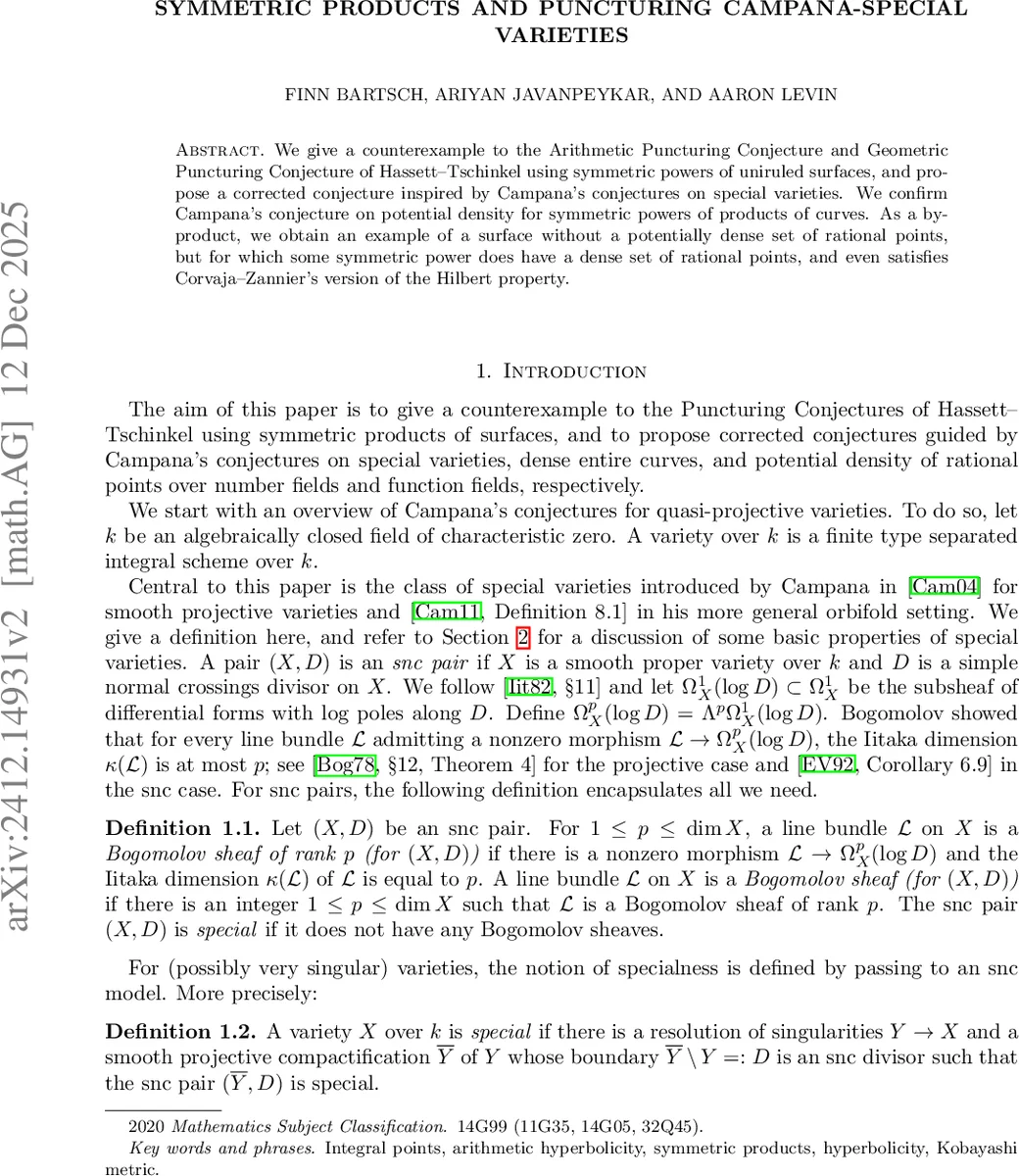
We give a counterexample to the Arithmetic Puncturing Conjecture and Geometric Puncturing Conjecture of Hassett-Tschinkel using symmetric powers of uniruled surfaces, and propose a corrected conjecture inspired by Campana’s conjectures on special varieties. We confirm Campana’s conjecture on potential density for symmetric powers of products of curves. As a by-product, we obtain an example of a surface without a potentially dense set of rational points, but for which some symmetric power does have a dense set of rational points, and even satisfies Corvaja-Zannier’s version of the Hilbert property.
💡 Research Summary
The paper investigates the interplay between Campana’s notion of special varieties and the “puncturing” conjectures of Hassett–Tschinkel, using symmetric powers of surfaces as a testing ground. After recalling Campana’s definitions—specialness via the absence of Bogomolov sheaves, and its three analytic avatars (Body‑special, Kobayashi‑special, and Brody‑special)—the authors introduce arithmetic specialness (density of near‑integral points over a finitely generated subring) and geometric specialness (dense coverage of a variety by graphs of maps from a fixed curve). Campana conjectured that these three notions are equivalent; similarly, he predicted that specialness should be equivalent to arithmetic and geometric specialness over any algebraically closed field of characteristic zero.
The central objects are symmetric powers Symⁿ(X) of a quasi‑projective variety X. While it is immediate that if X is special then all its symmetric powers are special, the converse fails in general. The authors focus on the surface S = C × ℙ¹, where C is a smooth projective curve of genus g ≥ 2, and consider its m‑th symmetric power Symᵐ(S) with m ≥ g. Building on a result of Campana–Cadorel–Rousseau, they first show (Theorem A) that Symᵐ(S) is not only special in the analytic sense but also arithmetic‑special and geometrically‑special. In particular, despite the original surface S often lacking a potentially dense set of rational points, its symmetric power possesses a dense set of near‑integral points and is covered densely by graphs of maps from a fixed curve.
This phenomenon provides a counterexample to the Arithmetic and Geometric Puncturing Conjectures of Hassett–Tschinkel, which predicted that the density of rational points (or of pointed curves) should be preserved under passage to symmetric powers. The authors thus demonstrate that the conjectures are false in general.
The paper then turns to the Hilbert property. Following Corvaja–Zannier’s weak Hilbert property (the complement of finitely many ramified covers should still be dense), the authors prove (Theorem B) that after a finite field extension L/K, the symmetric power Symᵐ(C_L × ℙ¹_L) satisfies the weak Hilbert property over L. The proof relies on a recent Hilbert irreducibility theorem for abelian varieties (C. D. J. et al., 2022) and a new irreducibility result for Symᵐ(C) itself, which also yields an infinity of Sₘ‑Galois points on C.
Extending the analysis, the authors consider products C × E where E is an elliptic curve. If C dominates E (i.e., there exists a non‑constant morphism C → E), then for m ≥ g the symmetric power Symᵐ(C × E) is again arithmetic‑special and geometrically‑special (Theorem C). The proof uses a density criterion for graphs (Theorem 4.5) derived from properties of Hilbert schemes. When C does not dominate E, the authors are unable to establish specialness, leaving this as an open problem.
A more abstract result (Theorem D) is proved: given a family of morphisms φ_i : Y → X with a point y₀ ∈ Y such that the set {φ_i(y₀)} is dense in X, the union of the graphs Γ_{φ_i} is dense in Y × X. This provides a versatile tool for establishing graph‑density statements, which underlies several of the paper’s main arguments.
In summary, the work shows that symmetric powers can dramatically change the arithmetic and geometric behavior of a variety, disproving the puncturing conjectures, and it proposes a refined conjectural framework aligning Campana’s specialness with the weak Hilbert property. The results open new directions for studying potential density, Hilbert irreducibility, and specialness in higher‑dimensional and non‑uniruled contexts.
Comments & Academic Discussion
Loading comments...
Leave a Comment