Absement: Quantitative Assessment of Metabolic Cost during Quasi-Isometric Muscle Loading
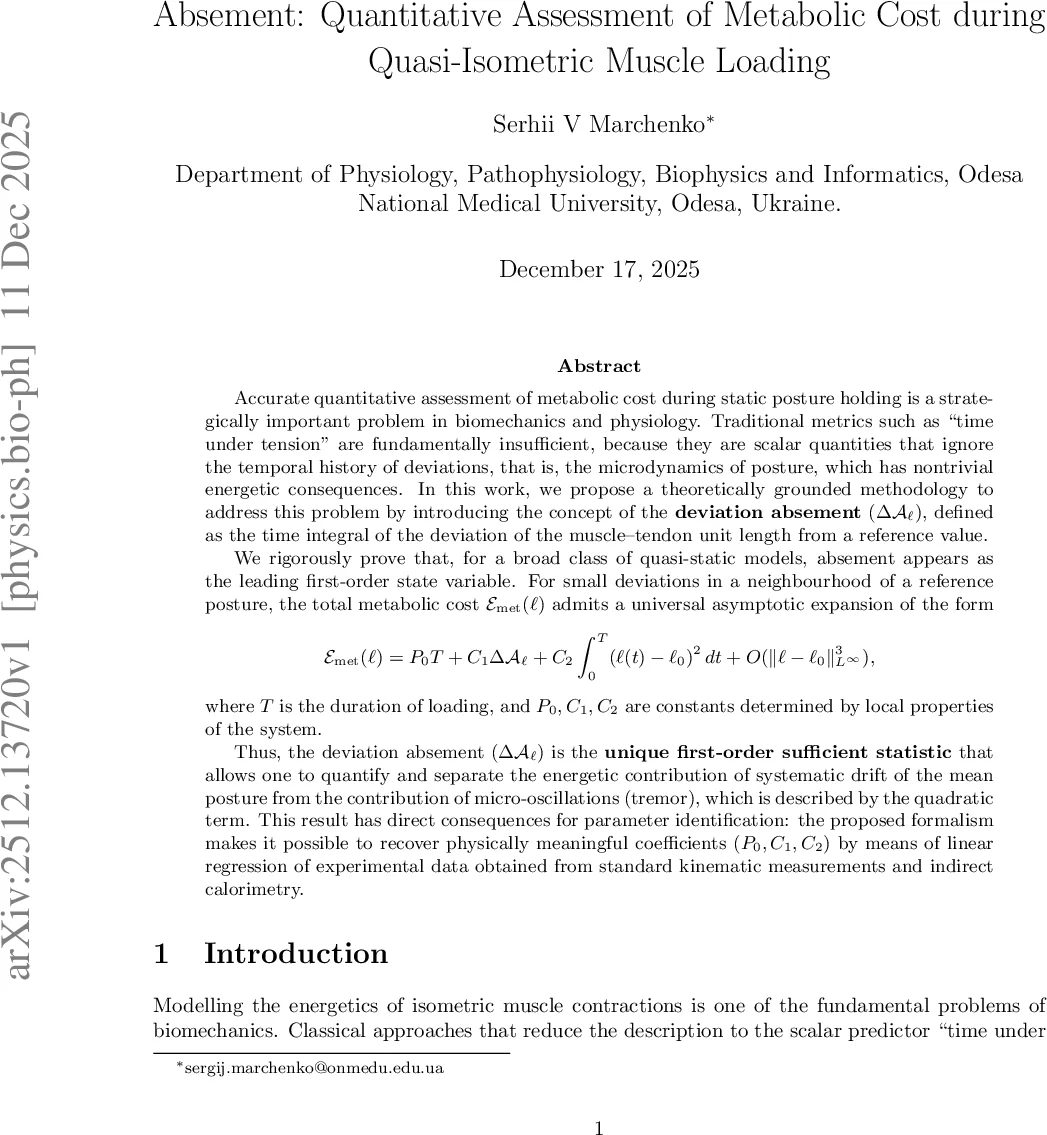
Accurate quantitative assessment of metabolic cost during static posture holding is a strategically important problem in biomechanics and physiology. Traditional metrics such as ``time under tension’’ are fundamentally insufficient, because they are scalar quantities that ignore the temporal history of deviations, that is, the microdynamics of posture, which has nontrivial energetic consequences. In this work, we propose a theoretically grounded methodology to address this problem by introducing the concept of the \textbf{deviation absement} ($Δ\mathcal{A}\ell$), defined as the time integral of the deviation of the muscle–tendon unit length from a reference value. We rigorously prove that, for a broad class of quasi-static models, absement appears as the leading first-order state variable. For small deviations in a neighbourhood of a reference posture, the total metabolic cost $\mathcal{E}{\mathrm{met}}(\ell)$ admits a universal asymptotic expansion of the form \begin{equation*} \mathcal{E}{\mathrm{met}}(\ell) = P_0 T + C_1 Δ\mathcal{A}\ell + C_2 \int_0^T(\ell(t)-\ell_0)^2,dt + O(|\ell-\ell_0|{L^\infty}^3), \end{equation*} where $T$ is the duration of loading, and $P_0, C_1, C_2$ are constants determined by local properties of the system. Thus, the deviation absement ($Δ\mathcal{A}\ell$) is the \textbf{unique first-order sufficient statistic} that allows one to quantify and separate the energetic contribution of systematic drift of the mean posture from the contribution of micro-oscillations (tremor), which is described by the quadratic term. This result has direct consequences for parameter identification: the proposed formalism makes it possible to recover physically meaningful coefficients $(P_0, C_1, C_2)$ by means of linear regression of experimental data obtained from standard kinematic measurements and indirect calorimetry.
💡 Research Summary
This paper presents a novel theoretical framework for quantitatively assessing the metabolic cost of maintaining a static posture under quasi-isometric muscle loading. The authors argue that traditional scalar metrics like “time under tension” are fundamentally inadequate because they ignore the temporal history of postural deviations—the microdynamics of posture, including drift and tremor, which have significant energetic consequences.
To address this gap, the paper introduces the concept of “deviation absement” (ΔAℓ), defined as the time integral of the deviation of the muscle-tendon unit length from a reference value. The core theoretical contribution is a rigorous mathematical demonstration that, for a broad class of quasi-static muscle-tendon models, this absement emerges as the unique first-order sufficient statistic in an asymptotic expansion of the total metabolic energy cost functional.
The authors construct a minimalist model of a single-joint muscle-tendon system maintaining a posture. The model defines muscle force as a function of length and activation, and imposes a quasi-static equilibrium condition balancing muscle moment and external joint moment. Under the key local assumption that activation changes affect joint moment (ensuring the implicit function theorem applies), activation can be expressed as a function of joint angle, and thus muscle-tendon length, near an equilibrium point. The metabolic cost is modeled as the time integral of a power function linear in activation and force.
Through asymptotic analysis (Taylor expansion) of this energy functional around the equilibrium state, the authors derive a universal expansion for the total metabolic cost E_met(ℓ) over a duration T: E_met(ℓ) = P0 T + C1 ΔAℓ + C2 ∫₀ᵀ (ℓ(t)-ℓ₀)² dt + higher-order terms. Here, P0 represents the baseline power cost of maintaining the ideal reference posture. The coefficient C1, multiplied by the deviation absement ΔAℓ, quantifies the energetic cost attributable to a systematic drift of the mean posture. The coefficient C2, multiplied by the integral of squared deviation, quantifies the cost associated with posture variability or tremor. The authors rigorously prove (Lemma 1) that the linear term depends solely on ΔAℓ, making it the essential first-order descriptor.
This structural decomposition has direct practical implications. It provides a principled methodology for parameter identification: by performing linear regression of experimentally measured total metabolic cost (e.g., from indirect calorimetry) against the easily computed kinematic measures ΔAℓ and ∫(ℓ-ℓ₀)²dt, one can recover the physically meaningful coefficients P0, C1, and C2. This bridges theoretical biomechanics with experimental practice, offering a powerful tool for predicting energy expenditure, assessing fatigue, and optimizing rehabilitation protocols based on simple kinematic tracking.
Comments & Academic Discussion
Loading comments...
Leave a Comment