Negative Marginal Densities in Mixed Quantum-Classical Liouville Dynamics
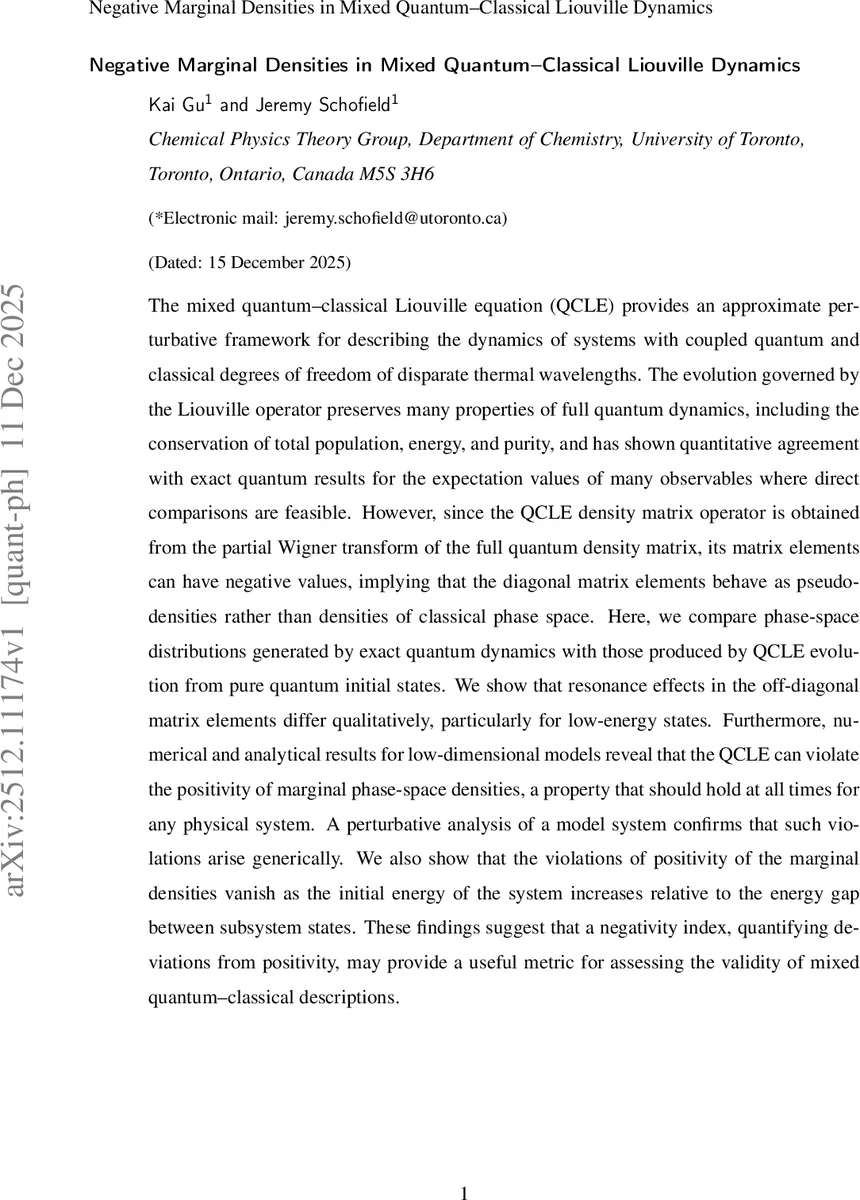
The mixed quantum-classical Liouville equation (QCLE) provides an approximate perturbative framework for describing the dynamics of systems with coupled quantum and classical degrees of freedom of disparate thermal wavelengths. The evolution governed by the Liouville operator preserves many properties of full quantum dynamics, including the conservation of total population, energy, and purity, and has shown quantitative agreement with exact quantum results for the expectation values of many observables where direct comparisons are feasible. However, since the QCLE density matrix operator is obtained from the partial Wigner transform of the full quantum density matrix, its matrix elements can have negative values, implying that the diagonal matrix elements behave as pseudo-densities rather than densities of classical phase space. Here, we compare phase-space distributions generated by exact quantum dynamics with those produced by QCLE evolution from pure quantum initial states. We show that resonance effects in the off-diagonal matrix elements differ qualitatively, particularly for low-energy states. Furthermore, numerical and analytical results for low-dimensional models reveal that the QCLE can violate the positivity of marginal phase-space densities, a property that should hold at all times for any physical system. A perturbative analysis of a model system confirms that such violations arise generically. We also show that the violations of positivity of the marginal densities vanish as the initial energy of the system increases relative to the energy gap between subsystem states. These findings suggest that a negativity index, quantifying deviations from positivity, may provide a useful metric for assessing the validity of mixed quantum\textendash{}classical descriptions.
💡 Research Summary
This paper presents a critical examination of the Mixed Quantum-Classical Liouville Equation (QCLE), a widely used approximate framework for simulating systems with coupled quantum and classical degrees of freedom. While the QCLE preserves important global properties like total energy, population, and purity, the authors identify a fundamental flaw: it can generate unphysical, negative values for marginal phase-space densities.
The study compares dynamics from exact quantum mechanics (solving the time-dependent Schrödinger equation) and from the QCLE for simple low-dimensional, two-level model systems starting from pure quantum states. The key finding is that while reduced observables like state populations agree well between the two methods, the underlying phase-space distributions differ qualitatively. Most importantly, the QCLE-derived marginal probability densities for the classical bath coordinates—specifically the position distribution n(R,t) and momentum distribution η(P,t)—can become negative in certain regions. This violates the basic axiom of probability theory that requires probability densities to be non-negative at all points for any physical system.
The authors trace this pathology to the mathematical foundation of the QCLE. The central object in QCLE dynamics is the partial Wigner transform of the full quantum density matrix. Its diagonal elements, which are interpreted as the phase-space density for the classical bath, are not true probability densities but “pseudo-densities” that can inherently assume negative values. A perturbative analysis of a model system confirms that such violations of positivity arise generically within the QCLE framework.
Furthermore, the paper establishes a condition for the severity of this flaw. The violations are most pronounced when the initial energy of the system is low compared to the energy gap between the quantum subsystem states, i.e., in regimes where quantum coherence and resonance effects are strong. As the initial energy increases, these unphysical negativities diminish.
The work concludes that agreement on reduced observables is an insufficient metric for validating mixed quantum-classical methods. The loss of positivity in marginal densities represents a serious interpretative and physical limitation of the QCLE. The authors suggest that a quantitative “negativity index,” measuring deviations from positive definiteness, could serve as a crucial new metric for assessing the validity and applicability boundaries of not just the QCLE but also related approximate trajectory-based methods like surface hopping.
Comments & Academic Discussion
Loading comments...
Leave a Comment