A Unified Theory of Dynamic Programming Algorithms in Small Target Detection
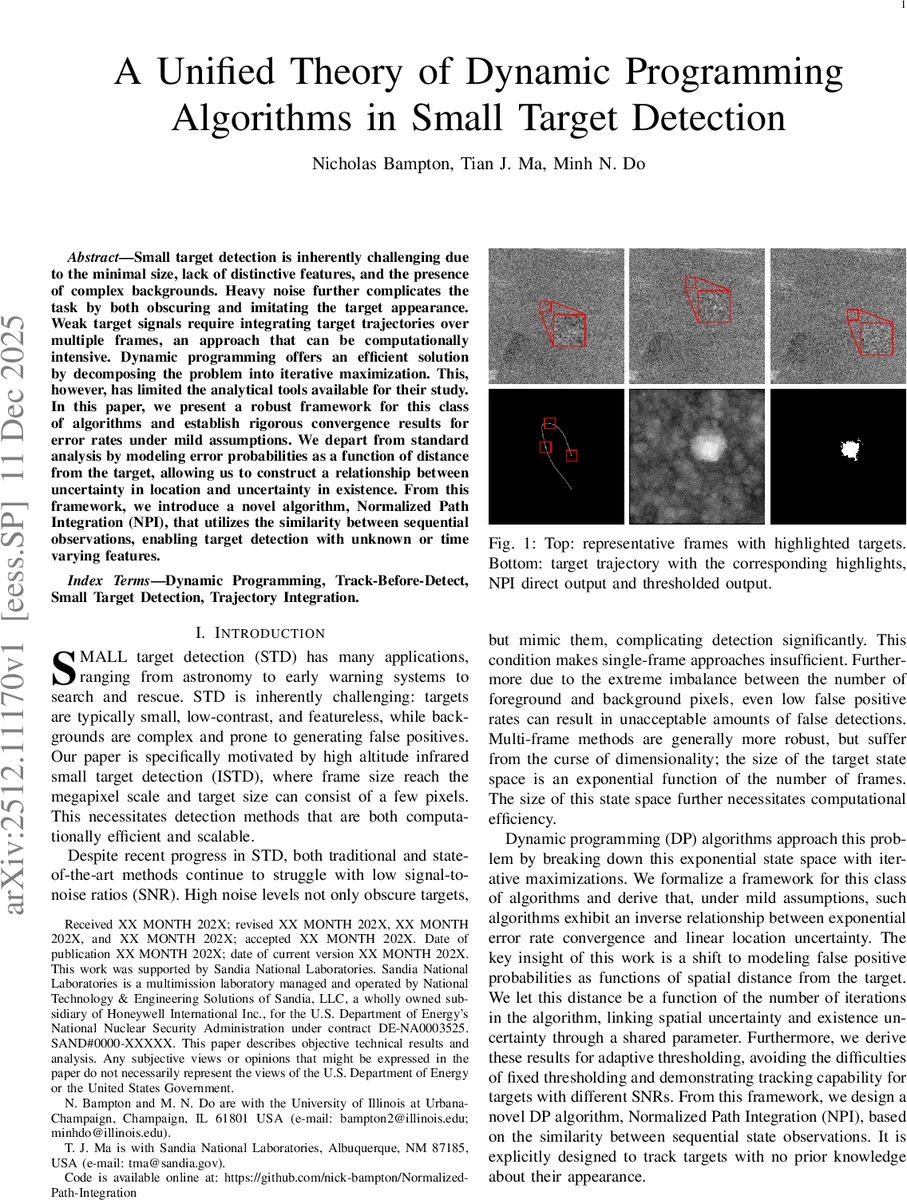
Small target detection is inherently challenging due to the minimal size, lack of distinctive features, and the presence of complex backgrounds. Heavy noise further complicates the task by both obscuring and imitating the target appearance. Weak target signals require integrating target trajectories over multiple frames, an approach that can be computationally intensive. Dynamic programming offers an efficient solution by decomposing the problem into iterative maximization. This, however, has limited the analytical tools available for their study. In this paper, we present a robust framework for this class of algorithms and establish rigorous convergence results for error rates under mild assumptions. We depart from standard analysis by modeling error probabilities as a function of distance from the target, allowing us to construct a relationship between uncertainty in location and uncertainty in existence. From this framework, we introduce a novel algorithm, Normalized Path Integration (NPI), that utilizes the similarity between sequential observations, enabling target detection with unknown or time varying features.
💡 Research Summary
The detection of small targets remains one of the most formidable challenges in signal and image processing due to the inherent lack of distinctive features, minimal target size, and the presence of overwhelming background clutter and noise. In scenarios where the signal-to-noise ratio (SNR) is extremely low, a single-frame detection is often insufficient, necessitating the integration of target trajectories across multiple temporal frames. While Dynamic Programming (DP) has emerged as an efficient computational strategy to solve this through iterative maximization, the field has long lacked a robust analytical framework to rigorously study the convergence and error rates of such algorithms.
This paper addresses this gap by presenting a unified theoretical framework for the class of DP-based algorithms used in small target detection. The authors introduce a groundbreaking mathematical approach by modeling error probabilities as a function of the distance from the actual target location. This departure from standard analysis allows for the establishment of a formal relationship between the uncertainty in target localization and the uncertainty in target existence. By doing so, the paper provides rigorous convergence results for error rates under mild assumptions, providing much-needed mathematical certainty to the performance of DP-based detection methods.
Building upon this theoretical foundation, the paper introduces a novel algorithm: Normalized Path Integration (NPI). Unlike traditional methods that rely on predefined templates or static features—which often fail when targets undergo shape changes or orientation shifts—NPI leverages the intrinsic similarity between sequential observations. This allows the algorithm to effectively track targets with unknown or time-varying features. By focusing on the structural consistency of observations over time rather than fixed appearance, NPI achieves high robustness against heavy noise and complex backgrounds.
In summary, this research provides both the mathematical rigor required to understand the convergence of dynamic programming in detection tasks and a practical, high-performance algorithm capable of handling the unpredictable nature of real-world targets. The implications of this work are significant for various high-stakes applications, including satellite surveillance, autonomous navigation, and advanced radar systems, where detecting minute, moving objects in noisy environments is critical.
Comments & Academic Discussion
Loading comments...
Leave a Comment