Benchmarking RL-Enhanced Spatial Indices Against Traditional, Advanced, and Learned Counterparts
Reinforcement learning has recently been used to enhance index structures, giving rise to reinforcement learning-enhanced spatial indices (RLESIs) that aim to improve query efficiency during index construction. However, their practical benefits remain unclear due to the lack of unified implementations and comprehensive evaluations, especially in disk-based settings. We present the first modular and extensible benchmark for RLESIs. Built on top of an existing spatial index library, our framework decouples index training from building, supports parameter tuning, and enables consistent comparison with traditional, advanced, and learned spatial indices. We evaluate 12 representative spatial indices across six datasets and diverse workloads, including point, range, kNN, spatial join, and mixed read/write queries. Using latency, I/O, and index statistics as metrics, we find that while RLESIs can reduce query latency with tuning, they consistently underperform learned spatial indices and advanced variants in both query efficiency and index build cost. These findings highlight that although RLESIs offer promising architectural compatibility, their high tuning costs and limited generalization hinder practical adoption.
💡 Research Summary
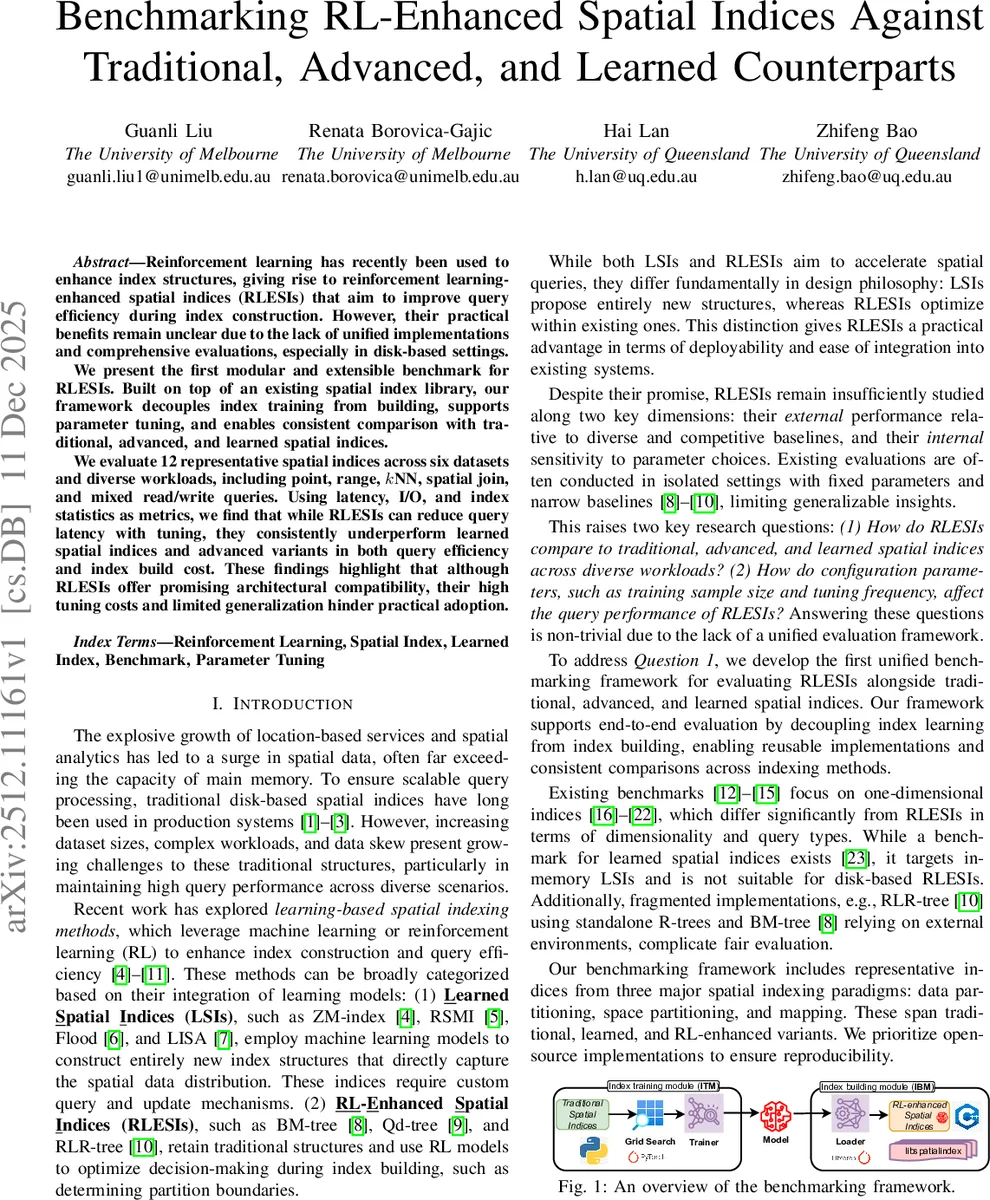
This paper addresses the emerging class of reinforcement‑learning‑enhanced spatial indices (RLESIs), which aim to improve query performance by learning better construction decisions for traditional index structures. Existing evaluations of RLESIs are fragmented, often limited to in‑memory settings, and lack unified baselines. To fill this gap, the authors design a modular benchmark framework built on top of the open‑source disk‑based library libspatialindex. The framework separates the learning phase (Index Training Module, ITM) from the building phase (Index Building Module, IBM). ITM provides a standardized PyTorch training environment, including a grid‑search tuner that explores hyper‑parameters such as training sample size, reward weighting, and tuning frequency. IBM extends libspatialindex with a C++ loader that injects the trained RL policy into traditional index constructors, enabling seamless integration without redesigning the underlying data structures.
The benchmark includes twelve representative indices spanning three design families—data‑partitioning, space‑partitioning, and mapping—each represented by a traditional version, an advanced variant, a learned (non‑RL) version, and an RL‑enhanced version. The data‑partitioning family covers R‑tree, R*‑tree, AI+R‑tree, RLR‑tree, and BM‑tree; the space‑partitioning family includes KD‑tree, Quad‑tree, Grid‑File, KDB‑tree, GKD‑tree, Qd‑tree, and LMSFC; the mapping family comprises Z‑curve, Hilbert‑curve, rank‑space, ZM‑index, ML‑Index, and RSMI. Six publicly available datasets of varying size (hundreds of thousands to millions of points), dimensionality (2–5), and distribution (uniform, clustered, skewed) are used. Workloads consist of point queries, range queries, k‑nearest‑neighbor (kNN) queries, spatial joins, and mixed read/write mixes. Performance metrics include P50 and P99 latency, I/O count, index node statistics (size, depth), storage overhead, and total time spent on index construction and RL model training.
Key findings are organized into twenty‑two observations (O1‑O22). First, RLESIs achieve modest latency reductions (≈10–30 %) over pure traditional indices but consistently lag behind advanced variants (R*‑tree, KDB‑tree) and learned indices (ZM‑index, RSMI) by 5–20 %. Second, without careful hyper‑parameter tuning, RLESIs exhibit high latency variance, especially for range and kNN queries; RLR‑tree and Qd‑tree show sharp spikes in the high‑percentile tail. Third, insertion latency is significantly higher for RLESIs (2–3× traditional) because each insert may trigger model‑guided subtree selection or split prediction; BM‑tree is the worst offender. Fourth, the learning phase dominates index build cost, accounting for 30–45 % of total construction time, and data‑partitioning indices incur additional disk I/O during build. Fifth, scalability tests reveal linear degradation for most methods, yet RLESIs can suffer abrupt performance drops when the learned policy overfits to a particular data distribution. Sixth, systematic grid‑search tuning can reduce query latency by up to 120×, but the tuning process itself consumes 20–35 % of overall experiment time, highlighting a trade‑off between performance gains and tuning overhead. Finally, modest reward‑function redesign and meta‑learning reduce training time by ~27 % for BM‑tree without harming query speed, indicating that more efficient learning schemes can partially alleviate the cost barrier.
Overall, the study demonstrates that while RLESIs enjoy architectural compatibility with existing disk‑based systems, their practical adoption is hindered by high training and tuning costs and limited generalization across workloads. The authors suggest future directions: (1) meta‑learning to transfer tuned policies across datasets, (2) lightweight, cost‑aware reward designs, (3) online or incremental learning to amortize training overhead, and (4) hybrid pipelines that combine RL‑guided decisions with traditional heuristics to balance build cost and query performance. The benchmark, code, and datasets are released as open source, providing a foundation for continued research on learned spatial indexing.
Comments & Academic Discussion
Loading comments...
Leave a Comment