Bulk-Edge Correspondence for Finite Two-dimensional Ergodic Disordered Systems
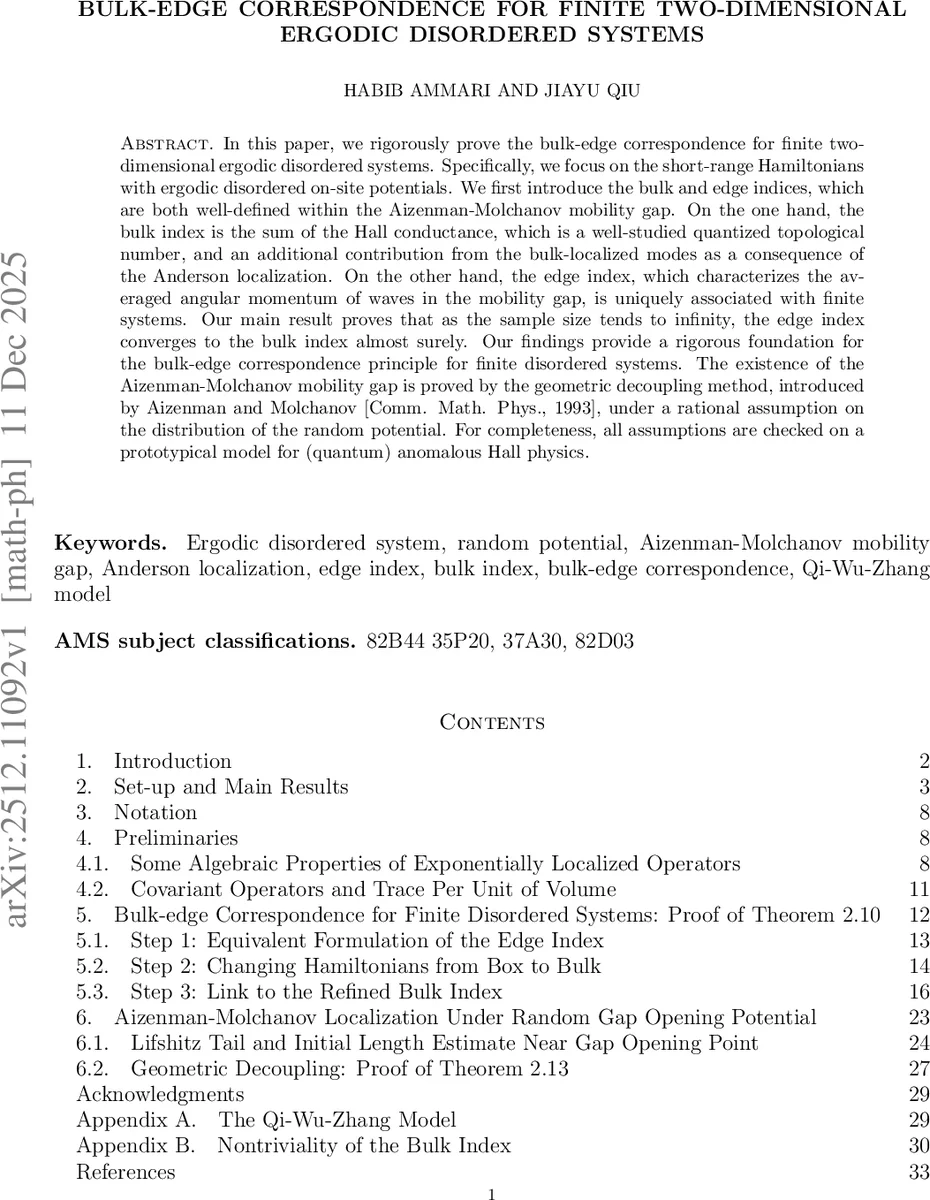
In this paper, we rigorously prove the bulk-edge correspondence for finite two-dimensional ergodic disordered systems. Specifically, we focus on the short-range Hamiltonians with ergodic disordered on-site potentials. We first introduce the bulk and edge indices, which are both well-defined within the Aizenman-Molchanov mobility gap. On the one hand, the bulk index is the sum of the Hall conductance, which is a well-studied quantized topological number, and an additional contribution from the bulk-localized modes as a consequence of the Anderson localization. On the other hand, the edge index, which characterizes the averaged angular momentum of waves in the mobility gap, is uniquely associated with finite systems. Our main result proves that as the sample size tends to infinity, the edge index converges to the bulk index almost surely. Our findings provide a rigorous foundation for the bulk-edge correspondence principle for finite disordered systems. The existence of the Aizenman-Molchanov mobility gap is proved by the geometric decoupling method, introduced by Aizenman and Molchanov [Comm. Math. Phys., 1993], under a rational assumption on the distribution of the random potential. For completeness, all assumptions are checked on a prototypical model for (quantum) anomalous Hall physics.
💡 Research Summary
The presented paper provides a rigorous mathematical proof of the bulk-edge correspondence (BEC) principle within the context of finite two-dimensional ergodic disordered systems. The bulk-edge correspondence is a fundamental pillar of topological physics, asserting that the topological invariants characterizing the bulk of a material dictate the existence and properties of protected edge states. While this principle is well-established for clean, infinite systems, its validity in the presence of disorder and within finite-sized geometries—where Anderson localization plays a critical role—has required more stringent mathematical verification.
The authors focus on short-range Hamiltonians characterized by ergodic disordered on-site potentials. A significant challenge in disordered systems is the emergence of localized states within the energy spectrum due to Anderson localization, which complicates the traditional definition of topological invariants. To address this, the paper introduces a redefined “bulk index” and an “edge index.” The bulk index is not merely the quantized Hall conductance but is explicitly defined as the sum of the Hall conductance and an additional contribution arising from bulk-localized modes. Conversely, the edge index, which is uniquely applicable to finite systems, is defined through the averaged angular momentum of waves residing within the Aizenman-Molchanov mobility gap.
The central achievement of this research is the proof that as the system size tends toward infinity, the edge index converges almost surely to the bulk index. This convergence demonstrates that the topological information encoded in the boundary of a finite, disordered system is consistent with the integrated topological properties of the bulk, even when accounting for the complexities introduced by localization.
To establish the existence of the Aizenman-Molchanov mobility gap, the authors employ the geometric decoupling method, a sophisticated technique originally introduced by Aizenman and Molchanov in 1993. By applying this method under rational assumptions regarding the distribution of the random potential, the authors ensure the mathematical stability of their findings. For practical relevance, the paper validates these theoretical assumptions using a prototypical model for quantum anomalous Hall (QAH) physics.
In conclusion, this work provides a robust mathematical foundation for the bulk-edge correspondence in realistic, disordered, and finite-sized 2D systems. By proving that the edge-localized angular momentum converges to the bulk topological charge, the paper bridges the gap between idealized mathematical models and the physical reality of disordered topological materials, offering critical insights for the development of topological quantum devices.
Comments & Academic Discussion
Loading comments...
Leave a Comment