Curved Odd Elasticity
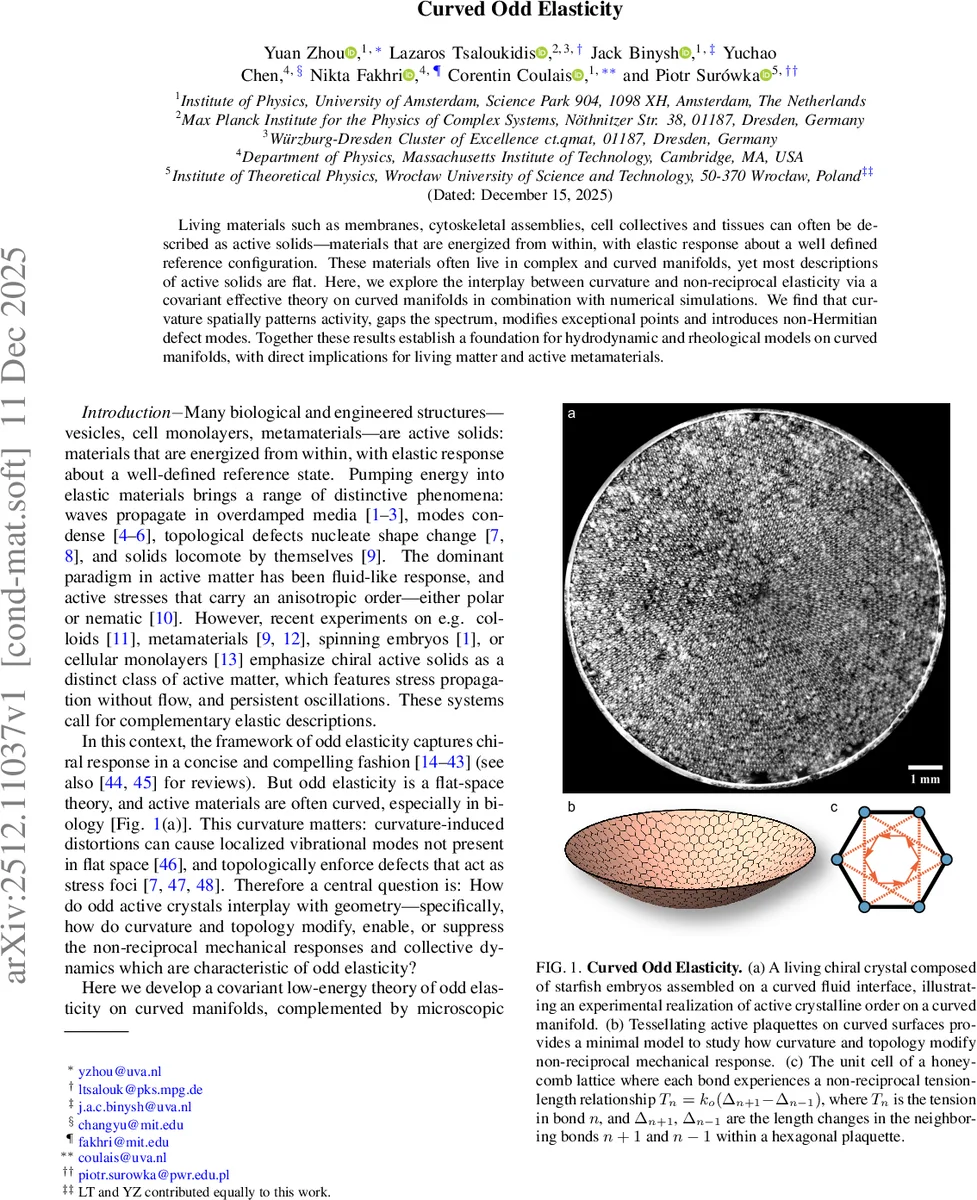
Living materials such as membranes, cytoskeletal assemblies, cell collectives and tissues can often be described as active solids – materials that are energized from within, with elastic response about a well defined reference configuration. These materials often live in complex and curved manifolds, yet most descriptions of active solids are flat. Here, we explore the interplay between curvature and non-reciprocal elasticity via a covariant effective theory on curved manifolds in combination with numerical simulations. We find that curvature spatially patterns activity, gaps the spectrum, modifies exceptional points and introduces non-Hermitian defect modes. Together these results establish a foundation for hydrodynamic and rheological models on curved manifolds, with direct implications for living matter and active metamaterials.
💡 Research Summary
The authors develop a covariant theory of odd elasticity that extends the flat‑space description of non‑reciprocal (odd) elastic response to curved manifolds. By introducing a reference metric (\bar g_{ij}) and a dynamical metric (g_{ij}), they define the symmetric strain (u_{ij}= \frac12(g_{ij}-\bar g_{ij})) and construct an elasticity tensor that includes a purely odd contribution
\
Comments & Academic Discussion
Loading comments...
Leave a Comment