A vision for ground-based astronomy beyond the 2030s: How to build ESO's next big telescope sustainably
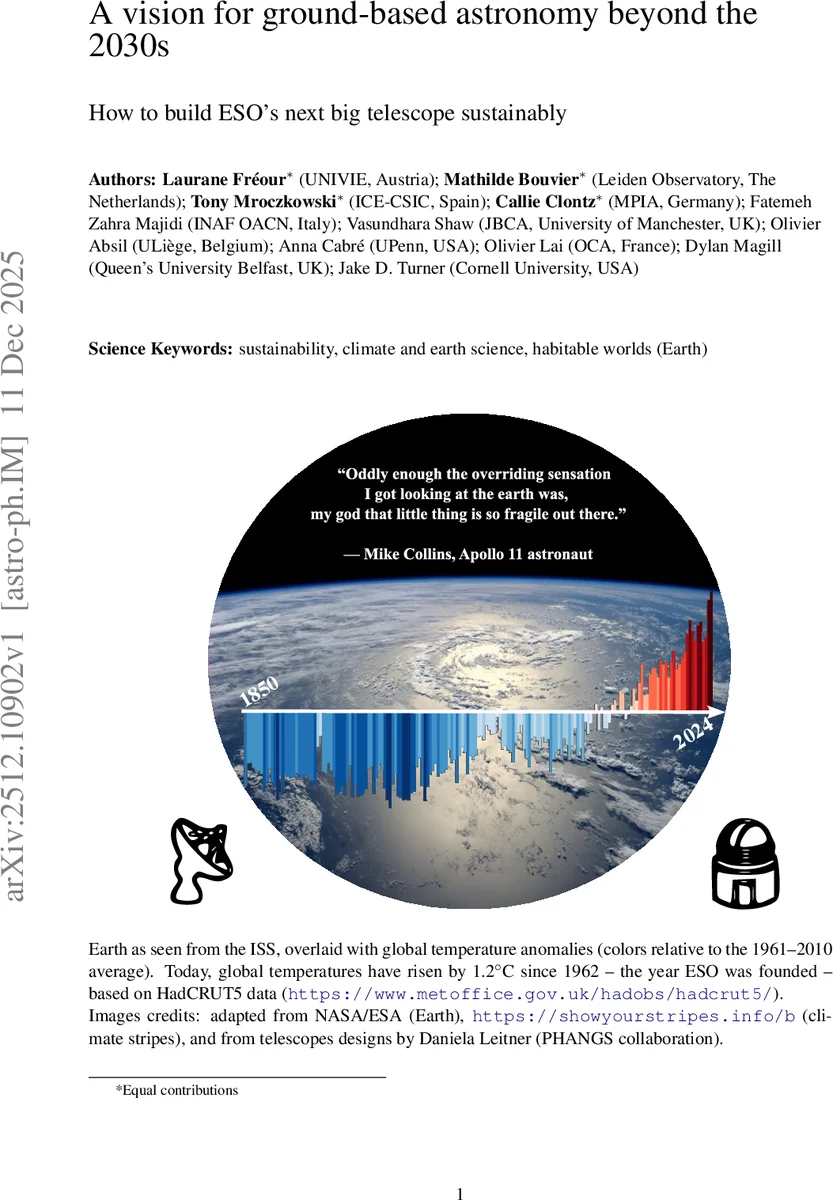
Astronomy is the study of the Universe and all the objects that it comprises. Our attention is therefore usually focused beyond Earth, home to the only form of life known today. However, how can we continue to explore the secrets of the Universe, if we stand by and watch our only home burn? We know that there is no Planet B. It is therefore urgent that, as astronomers, we collectively work to protect the Earth, allowing future generations the opportunity to continue to uncover the secrets of the cosmos. As astronomical facilities account for the majority of our community’s carbon footprint, we propose guidelines that we hold crucial for the European Southern Observatory (ESO) to consider in the context of the Expanding Horizons programme as it plans a next-generation, transformational facility.
💡 Research Summary
**
The paper entitled “A vision for ground‑based astronomy beyond the 2030s: How to build ESO’s next big telescope sustainably” presents a comprehensive set of recommendations for the European Southern Observatory (ESO) as it plans its next‑generation, transformational ground‑based facility under the Expanding Horizons programme. The authors begin by framing sustainability in the context of the United Nations’ Brundtland definition and the planetary‑boundary framework, noting that seven of nine safe operating limits have already been exceeded. They argue that astronomy contributes significantly to climate change through greenhouse‑gas (GHG) emissions, water use, aerosol release, and energy consumption, while simultaneously being vulnerable to climate‑driven extreme weather and atmospheric changes that can degrade observing conditions.
Quantitatively, the paper cites an annual emission of roughly 1.2 Mt CO₂e from astronomical observatories (2019 data). It highlights successful mitigation steps already taken by ESO, such as photovoltaic installations at Paranal and La Silla that cut electricity‑related GHG emissions by about 50 % between 2016 and 2022. Similar renewable‑energy transitions are noted at the Simons Observatory, NOIRLab’s Cerro Pachón sites, and the W. M. Keck Observatory. However, the authors warn that the Extremely Large Telescope (ELT) threatens to reverse these gains because its power demand will exceed the current baseline, leading to higher electricity consumption in 2030 than in 2016.
The paper then shifts focus to the emerging data‑intensive nature of 2040s astronomy. Global data‑centre energy use is projected to reach 1 000 TWh by 2030—equivalent to more than a third of EU household electricity consumption in 2022—and water withdrawal could match that of half the United Kingdom by 2027. Medium‑scale data centres already consume megawatts of power, comparable to a small town. If such facilities are powered by conventional energy mixes, they could emit tens of thousands of tonnes of CO₂ annually, potentially dwarfing the telescope’s own carbon footprint. Consequently, sustainability must be embedded not only in the telescope’s hardware but throughout its computational ecosystem.
To address these challenges, the authors propose a series of technical and managerial guidelines:
-
Life‑Cycle Assessment (LCA) Integration – Conduct iterative LCAs from raw‑material extraction through de‑commissioning, using them to steer material choices (e.g., low‑carbon or carbon‑capture‑enabled components) and design decisions. Existing ESO facilities have already begun such assessments, providing a template.
-
Multidimensional Sustainability – Incorporate biodiversity and social considerations by involving ecologists in site selection and engaging local communities in energy‑infrastructure planning. Renewable‑energy projects can deliver co‑benefits to nearby populations, strengthening social licence.
-
Transparent Reporting – Publish full environmental metrics (CO₂, electricity, water, heat, travel, logistics, data‑transport, storage, and processing) on a regular basis. This aligns with ESO’s open‑science ethos and combats climate‑disinformation by fostering trust.
-
FAIR Data Practices – Embed Findable, Accessible, Interoperable, and Reusable principles into instrument pipelines, metadata standards, and archive policies. Structured naming, version control, open formats, persistent identifiers, and rich machine‑actionable metadata reduce redundant storage and processing, directly lowering energy use.
-
Renewable Energy and Efficient Computing – Power observatories and associated data centres with solar, wind, hydro, or geothermal sources. Deploy energy‑recovery systems (e.g., braking energy recovery), low‑power AI accelerators, high‑density storage, liquid‑immersion or free‑air cooling, and algorithmic optimisations (model compression, pipeline pruning) to minimise resource consumption.
-
Long‑Term Sustainability Targets – Define explicit, time‑bound environmental goals and monitor progress throughout the project’s lifecycle. Include equity, diversity, and inclusion (EDI) metrics to ensure social sustainability.
The authors conclude that embedding these principles from the conceptual design phase onward will enable ESO’s next flagship telescope to be both scientifically revolutionary and environmentally responsible. By doing so, ESO can set a global benchmark for large‑scale scientific infrastructure, demonstrating that ambitious astrophysical discovery and planetary stewardship are mutually reinforcing rather than mutually exclusive pursuits.
Comments & Academic Discussion
Loading comments...
Leave a Comment