An equivalent condition for q-holonomicity
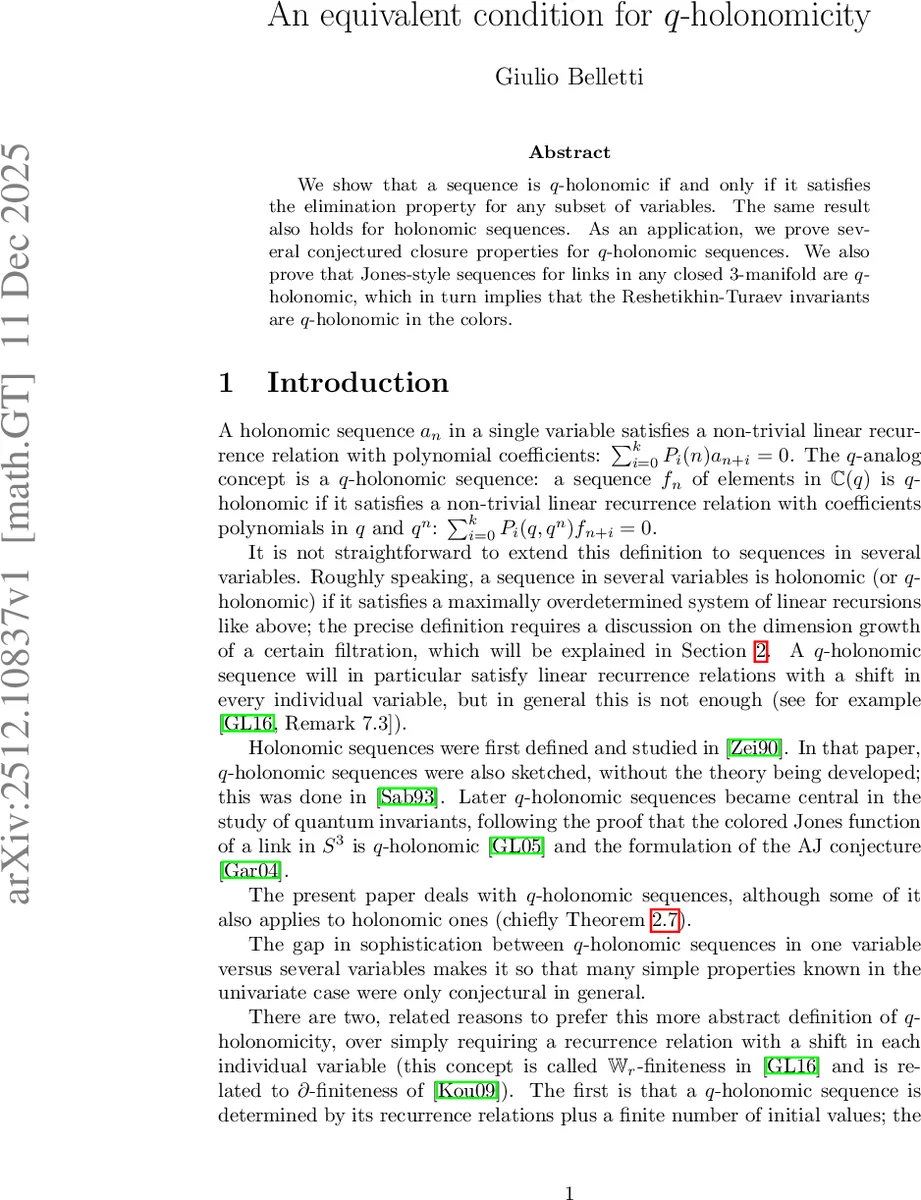
We show that a sequence is q-holonomic if and only if it satisfies the elimination property for any subset of variables. The same result also holds for holonomic sequences. As an application, we prove several conjectured closure properties for q-holonomic sequences. We also prove that Jones-style sequences for links in any closed $3$-manifold are q-holonomic, which in turn implies that the Reshetikhin-Turaev invariants are q-holonomic in the colors.
💡 Research Summary
This paper establishes a fundamental equivalence in the theory of multivariate q-holonomic sequences and derives significant applications in closure properties and quantum topology.
The core contribution is Theorem 2.7, which proves that a sequence is q-holonomic if and only if it is “strongly W_r-finite.” A q-holonomic sequence, abstractly defined via the dimension growth of a filtration on modules over the quantum Weyl algebra W_r, satisfies a maximally overdetermined system of linear q-difference equations. Strong W_r-finiteness (also known as the elimination property) is a more concrete, computational condition: for any subset of the 2r generators {L_i, M_i} of size exactly r+1, there exists a non-trivial recurrence relation for the sequence using only operators from that subset. Prior to this work, it was known that q-holonomicity implied strong W_r-finiteness, but the converse was only conjectural. The proof constructs a filtration argument (Lemma 2.8) showing that the dimension of the space F_N W_{r,+} · f grows at most polynomially like O(N^r) if f is strongly W_r-finite, which matches the definition of q-holonomicity. Corollary 2.9 extends this equivalence to a third related condition: strong W_r-finiteness with multiplicities. An analogous equivalence (Theorem 2.13) is also shown for classical holonomic sequences and the Weyl algebra A_r.
This equivalence bridges a gap between abstract theory and practical computation. The elimination property is crucial for guaranteeing the termination of algorithms like creative telescoping, used in automated proof of identities. Therefore, the theorem confirms that the class of q-holonomic sequences is well-suited for such algorithmic treatments.
The second major part of the paper (Section 3) applies Theorem 2.7 to prove several conjectured closure properties for multivariate q-holonomic sequences, answering open questions from earlier literature. Specifically, Proposition 3.1 shows that if f(q) is q-holonomic and ω is a root of unity, then f(ωq) is q-holonomic. Proposition 3.2 shows that f(q^α) for α ∈ Q is q-holonomic. Proposition 3.3 proves that the q-derivative D_q f is q-holonomic. Finally, Proposition 3.4 establishes that evaluating a q-holonomic sequence at a root of unity ω yields a classical holonomic sequence f(ω). The proofs leverage the strong W_r-finiteness condition, making them more straightforward generalizations of the univariate cases.
The final application pertains to quantum topology. Using the main theorem, the author proves that “Jones-style” sequences for framed links in any closed, oriented 3-manifold are q-holonomic in the color parameters. This generalizes the celebrated result that the colored Jones function of a link in S^3 is q-holonomic. A corollary is that the Reshetikhin-Turaev invariants for such manifolds are also q-holonomic in the colors. This extends the reach of q-holonomic methods in quantum invariant theory beyond the familiar setting of S^3.
In summary, this paper provides a unifying characterization of q-holonomicity, resolves conjectures about the stability of this class under natural operations, and expands the scope of known q-holonomic sequences in topology, strengthening the bridge between algebraic properties of sequences and their topological significance.
Comments & Academic Discussion
Loading comments...
Leave a Comment