Learning Controllable and Diverse Player Behaviors in Multi-Agent Environments
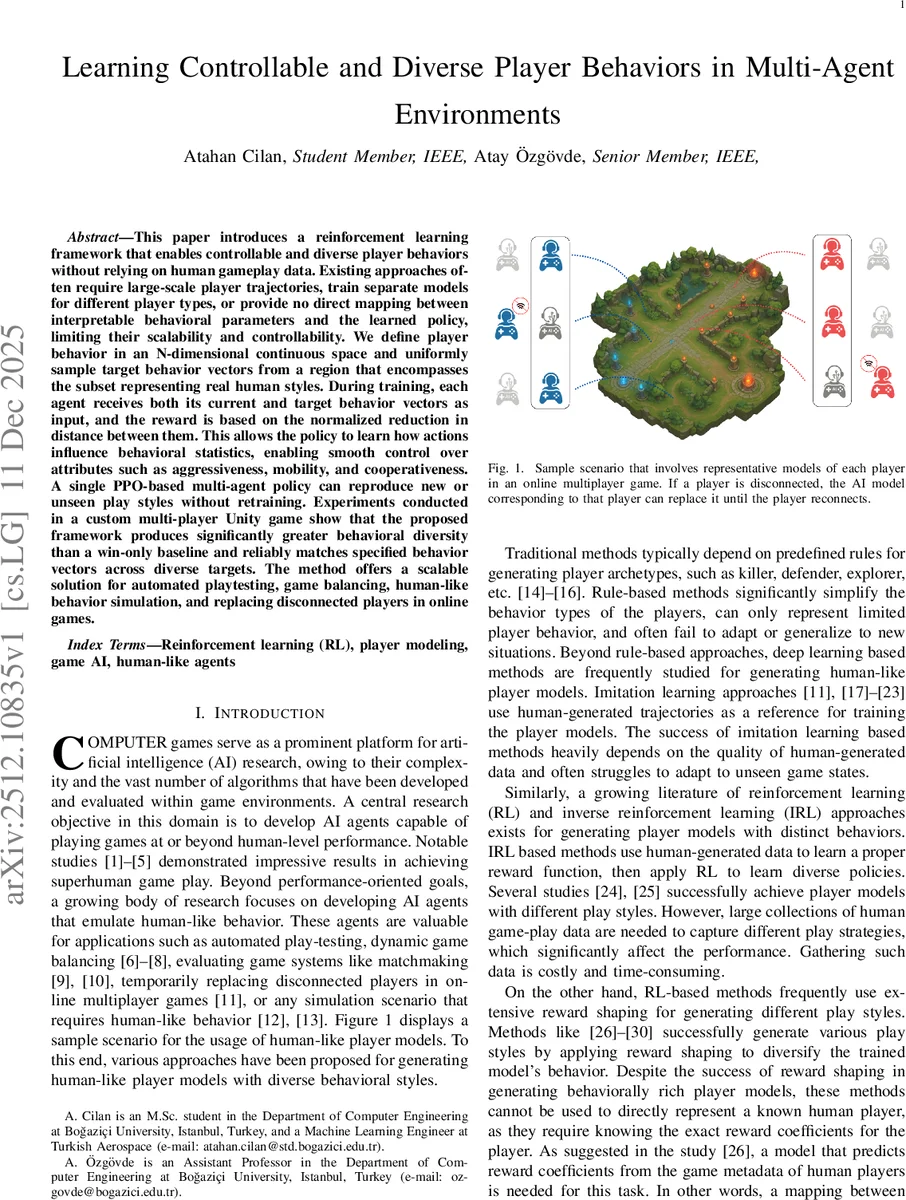
This paper introduces a reinforcement learning framework that enables controllable and diverse player behaviors without relying on human gameplay data. Existing approaches often require large-scale player trajectories, train separate models for different player types, or provide no direct mapping between interpretable behavioral parameters and the learned policy, limiting their scalability and controllability. We define player behavior in an N-dimensional continuous space and uniformly sample target behavior vectors from a region that encompasses the subset representing real human styles. During training, each agent receives both its current and target behavior vectors as input, and the reward is based on the normalized reduction in distance between them. This allows the policy to learn how actions influence behavioral statistics, enabling smooth control over attributes such as aggressiveness, mobility, and cooperativeness. A single PPO-based multi-agent policy can reproduce new or unseen play styles without retraining. Experiments conducted in a custom multi-player Unity game show that the proposed framework produces significantly greater behavioral diversity than a win-only baseline and reliably matches specified behavior vectors across diverse targets. The method offers a scalable solution for automated playtesting, game balancing, human-like behavior simulation, and replacing disconnected players in online games.
💡 Research Summary
The paper introduces Uniform Behavior Conditioned Learning (UBCL), a reinforcement‑learning framework that enables controllable and diverse player behaviors without any human gameplay data. Existing approaches either rely on handcrafted rules, large collections of human trajectories for imitation or inverse reinforcement learning, or on extensive reward shaping that lacks a direct mapping to interpretable behavioral parameters. Consequently, they suffer from poor scalability, limited controllability, and the need to retrain for each new play style.
UBCL addresses these issues by defining a player’s “behavior vector” – an N‑dimensional continuous representation where each dimension encodes a measurable trait such as aggressiveness, cooperativeness, mobility, risk‑taking, etc. During training, each agent samples a target behavior vector uniformly from a bounded region that encloses the subset of realistic human styles. At every timestep the agent receives (i) the current game state, (ii) its current behavior vector (computed from in‑game statistics), and (iii) the sampled target vector. The reward is the normalized reduction in Euclidean distance between the current and target vectors:
r_t = (‖b_t^curr – b_t^tgt‖ – ‖b_{t+1}^curr – b_t^tgt‖) / ‖b_t^curr – b_t^tgt‖
This formulation incentivizes actions that move the agent’s statistics toward the desired profile while giving zero reward once the target is reached, thus preventing overshooting. Because the target vectors span the entire behavior space, the policy learns a general mapping from actions to statistical outcomes, enabling it to reproduce any vector—including previously unseen human‑like styles—without additional training.
The authors implement UBCL in a custom 2‑vs‑2 team‑based Unity game using the Unity ML‑Agents toolkit. The environment features point‑collecting objects and combat; agents are conditioned on a six‑dimensional behavior vector (aggressiveness, cooperativeness, competitiveness, mobility, risk‑taking, etc.). Proximal Policy Optimization (PPO) is used as the underlying multi‑agent RL algorithm, with a single shared policy network for all agents. For comparison, a baseline “win‑only” policy is trained using a reward that only encourages victory.
Experimental results show that UBCL dramatically expands behavioral coverage. Dimensionality‑reduction visualizations (t‑SNE) reveal that the UBCL policy occupies a broad, continuous region of the behavior space, whereas the win‑only policy clusters in a narrow subset. Radar‑chart analyses and quantitative distance metrics demonstrate that UBCL agents match their target vectors with an average Euclidean error below 0.08, while the baseline fails to align with the specified traits. Moreover, UBCL agents achieve comparable win rates, indicating that diversity does not come at the expense of competence.
Key advantages of UBCL are: (1) data‑efficiency – no human demonstrations are required; (2) a single policy can generate an unbounded number of distinct play styles simply by changing the input vector; (3) the behavior vector is interpretable, allowing game designers to directly specify desired player personas; (4) the method can be used for automated play‑testing, dynamic matchmaking evaluation, and seamless replacement of disconnected players in online sessions. Limitations include the need to hand‑craft meaningful behavior dimensions for each game genre and potential sample inefficiency as the dimensionality of the vector grows. The authors suggest constraining the sampling region to the empirically observed human sub‑space or adding penalties for unrealistic targets to mitigate these issues.
In summary, UBCL provides an explicit “target behavior → policy” mapping that overcomes the opacity of reward‑shaping approaches and the data‑dependency of imitation/IRL methods. By conditioning a PPO‑based multi‑agent policy on uniformly sampled behavior vectors, the framework achieves both high behavioral diversity and fine‑grained controllability, making it a practical tool for modern game AI development and research.
Comments & Academic Discussion
Loading comments...
Leave a Comment