Blood Pressure Prediction for Coronary Artery Disease Diagnosis using Coronary Computed Tomography Angiography
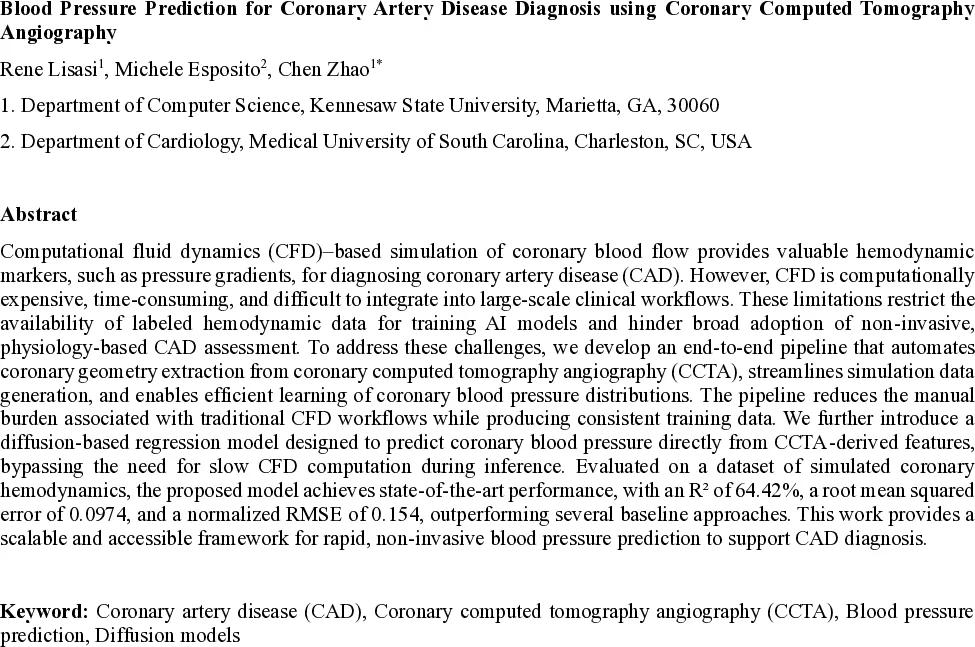
Computational fluid dynamics (CFD) based simulation of coronary blood flow provides valuable hemodynamic markers, such as pressure gradients, for diagnosing coronary artery disease (CAD). However, CFD is computationally expensive, time-consuming, and difficult to integrate into large-scale clinical workflows. These limitations restrict the availability of labeled hemodynamic data for training AI models and hinder broad adoption of non-invasive, physiology based CAD assessment. To address these challenges, we develop an end to end pipeline that automates coronary geometry extraction from coronary computed tomography angiography (CCTA), streamlines simulation data generation, and enables efficient learning of coronary blood pressure distributions. The pipeline reduces the manual burden associated with traditional CFD workflows while producing consistent training data. We further introduce a diffusion-based regression model designed to predict coronary blood pressure directly from CCTA derived features, bypassing the need for slow CFD computation during inference. Evaluated on a dataset of simulated coronary hemodynamics, the proposed model achieves state of the art performance, with an R2 of 64.42%, a root mean squared error of 0.0974, and a normalized RMSE of 0.154, outperforming several baseline approaches. This work provides a scalable and accessible framework for rapid, non-invasive blood pressure prediction to support CAD diagnosis.
💡 Research Summary
This paper addresses the long‑standing challenge of providing rapid, non‑invasive hemodynamic assessment for coronary artery disease (CAD) by replacing computational fluid dynamics (CFD) with a deep learning approach that can predict blood pressure (or fractional flow reserve, FFR) directly from coronary computed tomography angiography (CCTA) images. The authors propose a two‑stage framework: (1) an automated data‑generation pipeline that extracts three‑dimensional coronary geometry from CCTA, runs CFD simulations to obtain pressure fields, and constructs a training set of paired image patches and centerline pressure values; and (2) an Inverted Conditional Diffusion (ICD) model that treats the pressure values as the diffusion variable and the image patches as conditioning information, thereby performing continuous regression through a reverse‑diffusion process.
Automated Pipeline (Patch‑Based Dataset Pipeline, PBDP)
The pipeline begins with raw CCTA scans and corresponding segmentation masks, which are imported into 3D Slicer. Using the Vascular Modeling Toolkit (VMTK), the coronary arteries are segmented, clipped at inlet and outlet, and a centerline is extracted. The authors then convert all volumes from the standard Right‑Anterior‑Superior (RAS) coordinate system to a unified Left‑Posterior‑Superior (LPS) system, ensuring that geometry, centerline, and pressure data share a common reference frame. The clipped artery model is imported into SimVascular, where surface cleaning, hole filling, and capping are performed. A mesh is generated automatically, and CFD simulations are run with MPI parallelism (10 cores) using physiologically realistic boundary conditions (inlet pressure 133 300 Pa, resistance 1333 Pa·s/cm³, wall thickness 0.2 mm, elastic modulus 4 × 10⁶ Pa). The simulation produces time‑resolved pressure fields over 150 timesteps (Δt = 0.001 s).
To reduce dimensionality and focus on clinically relevant measurements, the authors extract a 28 × 28 × 28 voxel 3D patch centered at each point along the centerline. The average pressure within a small radius around the centerline point is assigned as the target label. All coordinates are transformed into a local frame relative to the artery’s centerline, guaranteeing spatial consistency across patients. This results in a dataset of image‑patch/pressure pairs that mimics the invasive FFR wire measurement, but without any catheter insertion.
Inverted Conditional Diffusion (ICD) Model
Traditional diffusion models generate data by denoising a noisy sample conditioned on a label. The ICD model inverts this relationship: the pressure values are progressively corrupted with Gaussian noise over T diffusion steps (the forward process), while the CCTA patches serve as conditioning information. The reverse process is learned by a neural network that, at each step, receives the current noisy pressure estimate and the corresponding image patch, and predicts the mean of the Gaussian distribution for the next less‑noisy step. Training minimizes a weighted mean‑squared error between the predicted and true denoised pressures, with a schedule that balances early‑stage large‑noise corrections and later‑stage fine adjustments.
This formulation offers several advantages over conventional regression architectures. First, the multi‑step denoising trajectory yields smooth, continuous pressure predictions, avoiding the “stepwise” errors often seen in sequence models such as Bi‑LSTM. Second, by conditioning on local 3D image patches, the model can exploit rich spatial context that simple fully‑connected or 1‑D convolutional networks cannot capture. Third, the diffusion framework is inherently permutation‑invariant with respect to the order of centerline points, eliminating the need for careful ordering of input sequences.
Experimental Evaluation
The authors evaluate the ICD model on a simulated dataset comprising multiple patients and coronary trees. Using a 5‑fold cross‑validation, the ICD achieves an R² of 64.42 %, a root‑mean‑square error (RMSE) of 0.0974, and a normalized RMSE of 0.154. These results surpass baseline methods: a ResNet‑based feature extractor followed by an MLP (R² ≈ 52 %), a plain MLP (R² ≈ 48 %), and Bi‑LSTM (R² ≈ 55 %). Inference time on an NVIDIA A100 GPU is under 5 minutes per case, compared with 12–24 hours for a full CFD run, representing a speedup of two to three orders of magnitude.
Discussion and Limitations
While the performance gains are compelling, the study relies entirely on CFD‑generated synthetic data. Consequently, the model’s ability to generalize to real‑world CCTA scans and invasive FFR measurements remains untested. The pressure fields are derived from a single set of CFD parameters (boundary conditions, wall properties), so the model may be sensitive to variations in patient‑specific physiology not captured in the training set. Moreover, the current implementation predicts only static average pressures; it does not model the temporal dynamics of the cardiac cycle or integrate global hemodynamic variables such as cardiac output.
Future work should focus on (i) validating the approach against a clinical dataset with measured FFR, (ii) incorporating domain adaptation techniques to bridge the gap between simulated and real data, (iii) extending the diffusion framework to handle time‑dependent pressure waveforms, and (iv) exploring transfer learning to reduce the amount of labeled data required for new scanner models or patient populations.
Conclusion
The paper presents a fully automated pipeline that converts CCTA scans into high‑quality CFD‑derived pressure labels and a novel diffusion‑based regression model that can predict those pressures directly from image patches. The combination yields accurate, fast, and scalable blood‑pressure estimation, potentially enabling real‑time functional assessment of coronary lesions without invasive procedures or costly CFD simulations. If validated on clinical data, this framework could become a cornerstone of non‑invasive CAD diagnostics, improving patient safety, reducing costs, and accelerating decision‑making in cardiology practice.
Comments & Academic Discussion
Loading comments...
Leave a Comment