Non-Stable $K_1$-Functors of Discrete Valuation Rings Containing a Field
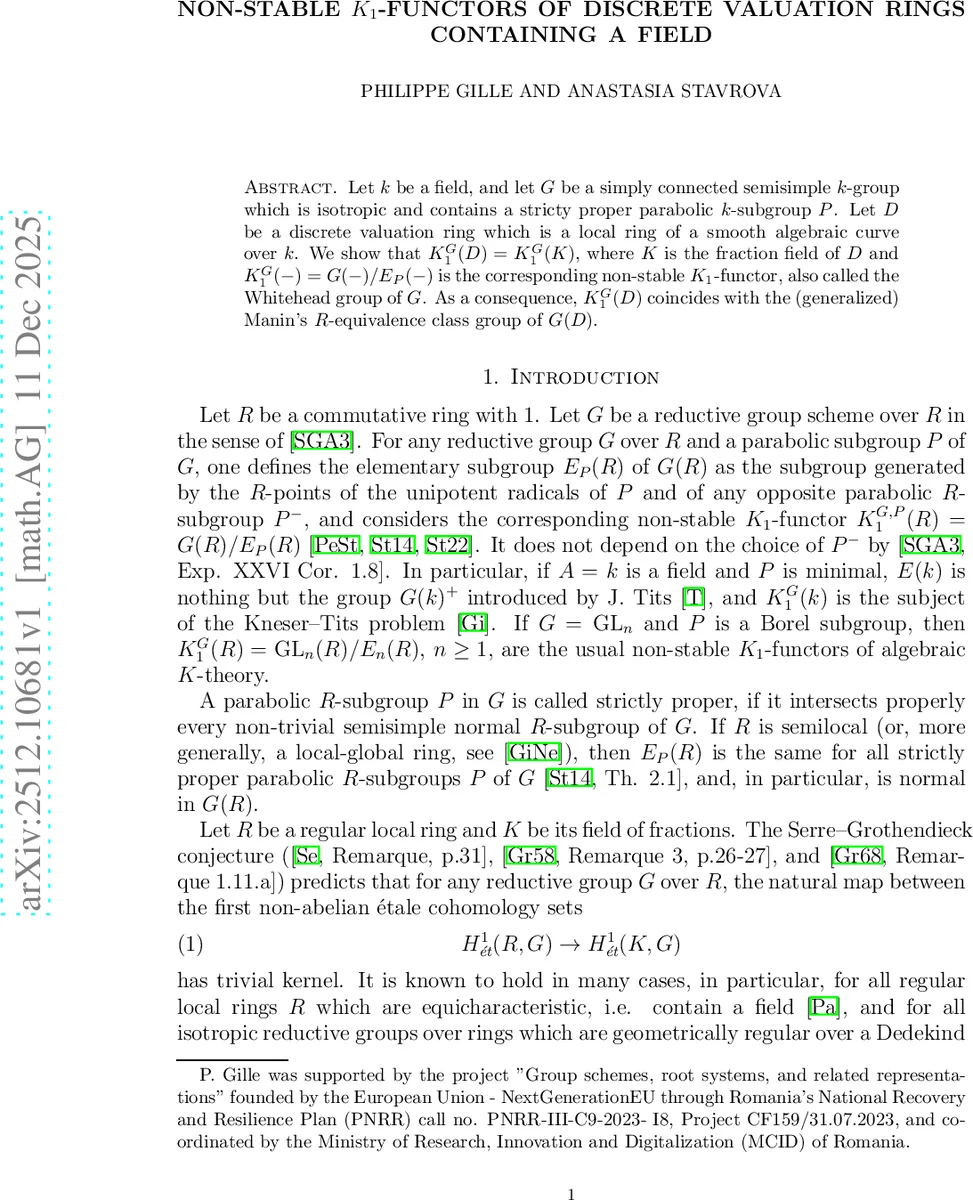
Let $k$ be a field, and let $G$ be a simply connected semisimple k-group which is isotropic and contains a strictly proper parabolic $k$-subgroup $P$. Let $D$ be a discrete valuation ring which is a local ring of a smooth algebraic curve over $k$. Let $K$ be the fraction field of $D$. We show that the corresponding non-stable $K_1$-functor (for $G$ and $P$, also called the Whitehead group of $G$) coincide over $D$ and $K$. As a consequence, $K^G_1 (D)$ coincides with the (generalized) Manin’s $R$-equivalence class group of $G(D)$.
💡 Research Summary
This paper investigates the behavior of non-stable K1-functors for reductive group schemes over discrete valuation rings (DVRs) containing a field. The central object of study is the functor K1^G,P(R) = G(R)/E_P(R), defined for a reductive group scheme G over a commutative ring R with a strictly proper parabolic subgroup scheme P. Here, E_P(R) is the elementary subgroup generated by the R-points of the unipotent radicals of P and an opposite parabolic subgroup P-. This functor generalizes both the group G(k)+ introduced by Tits (when R=k is a field and P is minimal) and the classical non-stable K1-functors for GL_n (when P is a Borel subgroup).
The main problem addressed is the injectivity (and surjectivity) of the natural map K1^G,P(R) → K1^G,P(K), where R is a regular local ring and K is its field of fractions. This question is viewed as a non-commutative, non-abelian analogue of the local-global principle for étale cohomology (the Serre-Grothendieck conjecture). Previous work by Stavrova (2022) established injectivity for groups of isotropic rank ≥2 over equicharacteristic regular local rings. However, the case of isotropic rank 1 (e.g., SL2) remained open, as known counterexamples for related maps over polynomial rings indicated the limitations of prior methods.
The paper’s primary achievements are the following theorems:
- Theorem 1.1: Let k be a field, G a simply connected, isotropic, semisimple k-group with a strictly proper parabolic k-subgroup P. Let D be a DVR which is the local ring at a closed point of a smooth algebraic curve over k, and let K be its fraction field. Then the natural map K1^G,P(D) → K1^G,P(K) is injective.
- Corollary 1.3: Under the same hypotheses, if G is simply connected and semisimple, then K1^G,P(D) is isomorphic to the (generalized) Manin R-equivalence class group G(D)/R.
- Theorem 1.4: For any DVR D with fraction field K, and any simply connected semisimple group scheme G over D with a strictly proper parabolic D-subgroup scheme P, the map K1^G,P(D) → K1^G,P(K) is surjective. Consequently, for such groups over any DVR, this map is an isomorphism.
The proofs rely on a series of intricate lemmas that dissect the structure of the elementary subgroups E_P. Lemma 2.1 proves a factorization property for the unipotent radical U_P over rings that are sums of two subalgebras. Lemma 2.2 shows that under certain conditions (satisfied for Dedekind domains and polynomial rings), the elementary subgroup behaves well under localization: G(D_S) = E_P(D) · P(D_S). Lemma 2.3 provides a key gluing technique: if B ⊆ A are rings sharing a non-zero divisor h with B/hB ≅ A/hA, and if E_P(B_h) is generated by E_P(B) and its intersection with P(B_h) (or P-(B_h)), then E_P(A_h) = E_P(A)E_P(B_h).
These tools are applied in several corollaries. Corollary 2.4 establishes that for coprime polynomials f, g ∈ k
Comments & Academic Discussion
Loading comments...
Leave a Comment