A Proof of Success and Reward Distribution Protocol for Multi-bridge Architecture in Cross-chain Communication
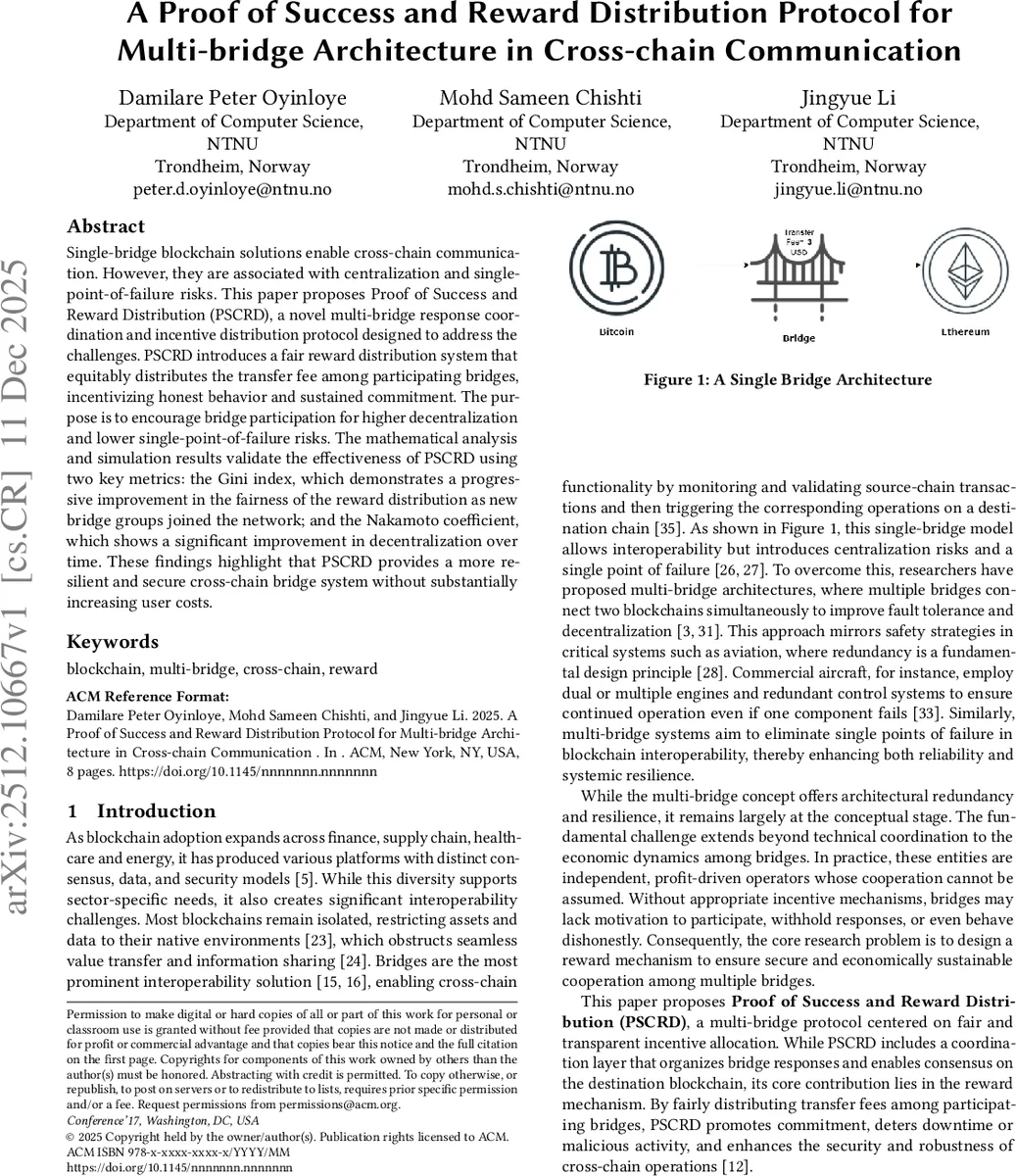
Single-bridge blockchain solutions enable cross-chain communication. However, they are associated with centralization and single-point-of-failure risks. This paper proposes Proof of Success and Reward Distribution (PSCRD), a novel multi-bridge response coordination and incentive distribution protocol designed to address the challenges. PSCRD introduces a fair reward distribution system that equitably distributes the transfer fee among participating bridges, incentivizing honest behavior and sustained commitment. The purpose is to encourage bridge participation for higher decentralization and lower single-point-of-failure risks. The mathematical analysis and simulation results validate the effectiveness of PSCRD using two key metrics: the Gini index, which demonstrates a progressive improvement in the fairness of the reward distribution as new bridge groups joined the network; and the Nakamoto coefficient, which shows a significant improvement in decentralization over time. These findings highlight that PSCRD provides a more resilient and secure cross-chain bridge system without substantially increasing user costs.
💡 Research Summary
The rapid expansion of the blockchain ecosystem has heightened the demand for efficient cross-chain communication. However, the prevailing reliance on single-bridge architectures presents significant vulnerabilities, most notably the “Single Point of Failure” (SPOF) and the risks associated with centralization. If a single bridge is compromised through a hack or operational failure, the entire cross-chain asset flow is jeopardized. To address these critical security and centralization challenges, this paper introduces the Proof of Success and Reward Distribution (PSCRD) protocol, a novel multi-bridge response coordination and incentive distribution framework.
The core innovation of PSCRly lies in its transition from a single-bridge model to a multi-bridge architecture. The proposed protocol is designed to coordinate multiple bridges working in unison to facilitate cross-chain transfers. The PSCRD protocol integrates two fundamental components: a “Proof of Success” mechanism to verify the integrity of cross-chain transactions, and a “Reward Distribution” mechanism to equitably allocate transaction fees among the participating bridges. By implementing a fair reward system, the protocol incentivizes bridge operators to maintain honest behavior and sustained commitment to the network, thereby fostering a more decentralized and resilient ecosystem.
To validate the effectiveness of the PSCRD protocol, the researchers employed rigorous mathematical analysis and simulations, focusing on two vital metrics: the Gini Index and the Nakamoto Coefficient. The Gini Index analysis was utilized to measure the fairness of the reward distribution. The results demonstrated a progressive decrease in the Gini Index as new bridge groups joined the network, indicating that the protocol successfully prevents the concentration of wealth among a few participants and promotes an equitable distribution of fees. This is crucial for the long-term sustainability of the multi-bridge network.
The Nakamoto Coefficient analysis was conducted to quantify the level of decentralization within the system. The findings revealed a significant and continuous increase in the Nakamoto Coefficient over time. A higher Nakamoto Coefficient implies that a larger number of entities would need to collude to compromise the network, thereby proving that the PSCRD protocol effectively enhances the network’s resistance to centralized attacks and strengthens its overall security posture.
In conclusion, the PSCRD protocol provides a robust solution for building a more secure and decentralized cross-chain infrastructure. The study demonstrates that it is possible to significantly improve the resilience and decentralization of cross-chain communication without imposing substantial additional costs on the end-users. This breakthrough offers a scalable and economically viable blueprint for the future of interoperable blockchain networks, ensuring that the multi-chain landscape remains secure against the evolving threats of the digital age.
Comments & Academic Discussion
Loading comments...
Leave a Comment