Codeshare agreements between airlines: literature review with the aid of artificial intelligence
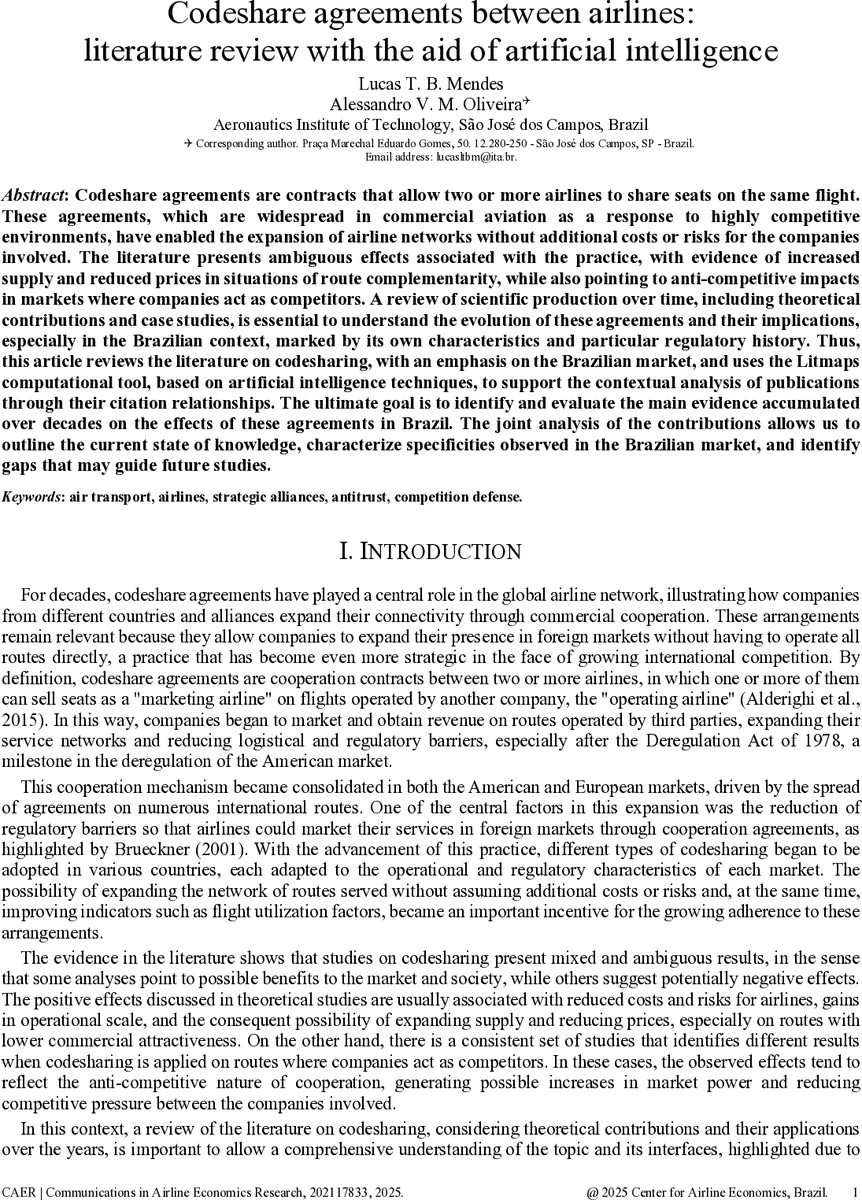
Codeshare agreements are contracts that allow two or more airlines to share seats on the same flight. These agreements, which are widespread in commercial aviation as a response to highly competitive environments, have enabled the expansion of airline networks without additional costs or risks for the companies involved. The literature presents ambiguous effects associated with the practice, with evidence of increased supply and reduced prices in situations of route complementarity, while also pointing to anti-competitive impacts in markets where companies act as competitors. A review of scientific production over time, including theoretical contributions and case studies, is essential to understand the evolution of these agreements and their implications, especially in the Brazilian context, marked by its own characteristics and particular regulatory history. Thus, this article reviews the literature on codesharing, with an emphasis on the Brazilian market, and uses the Litmaps computational tool, based on artificial intelligence techniques, to support the contextual analysis of publications through their citation relationships. The ultimate goal is to identify and evaluate the main evidence accumulated over decades on the effects of these agreements in Brazil. The joint analysis of the contributions allows us to outline the current state of knowledge, characterize specificities observed in the Brazilian market, and identify gaps that may guide future studies.
💡 Research Summary
This paper conducts a comprehensive literature review of airline codeshare agreements, employing the artificial‑intelligence‑driven mapping platform Litmaps to visualize citation networks and thematic clusters. The authors begin by outlining the historical evolution of codesharing, noting its rapid expansion after the U.S. Airline Deregulation Act of 1978 and its subsequent adoption in Europe and other mature markets. They summarize the dual nature of codeshare effects reported in the literature: on the one hand, codesharing can increase route supply, reduce marginal costs, and generate economies of scale, especially on complementary or low‑traffic routes; on the other hand, when competing airlines share the same route, the practice may raise market power, lead to higher fares, and diminish competitive pressure.
Methodologically, the study searches major databases (CAPES Journal, Elsevier, Google Scholar, Web of Science) using keywords such as “codeshare,” “airline alliance,” and “Brazil.” Approximately 1,200 abstracts are imported into Litmaps, which plots each article by publication year (X‑axis) and relevance (Y‑axis) while scaling node size by citation count and drawing lines to represent citation links. This AI‑assisted visualization quickly identifies seminal works (e.g., Alderighi et al., 2015; Sampaio & Urdanoz, 2022) and reveals the chronological development of research themes. The authors acknowledge methodological constraints: Litmaps analyses are limited to abstracts, potentially misclassifying articles; the database selection favors high‑impact international journals, thereby excluding regional journals, conference papers, theses, and other grey literature that may be especially relevant for emerging markets like Brazil.
The literature review is divided into three parts. First, the global perspective highlights how codesharing became a strategic response to deregulation in the United States, facilitating hub‑spoke networks while sometimes dampening price competition on overlapping routes. Second, the European experience shows similar patterns, with codeshare used to improve connectivity on marginal international routes. Third, the Brazilian focus examines the country’s unique regulatory trajectory. After a brief period of deregulation in the late 1990s, the Brazilian government re‑tightened market controls in 2003 to curb excess capacity and encouraged a flagship codeshare between TAM and Varig. Subsequent agreements—both domestic (e.g., Azul‑Gol) and international (e.g., LATAM‑Air France)—demonstrate the same mixed outcomes: network expansion and brand synergy coexist with antitrust concerns and occasional fare increases.
Pattern analysis of the Litmaps‑generated clusters reveals that early studies were predominantly theoretical, emphasizing cost‑benefit models, while more recent work incorporates econometric analyses of real‑world data. Brazilian publications tend to be case‑oriented and integrate policy discussion, but many treat codeshare as a sub‑component of broader strategic alliances, making it difficult to isolate its independent impact. The authors also note that most research relies on citation‑based relevance, which may overlook newer or less‑cited studies that could offer fresh insights.
In conclusion, the paper asserts that codeshare agreements are a double‑edged sword: they improve operational efficiency and market reach, yet they can also facilitate anti‑competitive behavior depending on market structure and regulatory oversight. The Brazilian experience illustrates how government policy can both stimulate cooperation and unintentionally reinforce market concentration. The authors recommend future research directions: (1) micro‑level price and demand data analyses to quantify welfare effects; (2) simulation of regulatory scenarios to assess optimal antitrust interventions; and (3) inclusion of non‑journal sources to capture a fuller picture of codeshare dynamics in emerging markets. Such work would help policymakers balance the benefits of network integration with the need to preserve competition and consumer welfare.
Comments & Academic Discussion
Loading comments...
Leave a Comment