Design and Implementation of a High-Precision Wind-Estimation UAV with Onboard Sensors
Accurate real-time wind vector estimation is essential for enhancing the safety, navigation accuracy, and energy efficiency of unmanned aerial vehicles (UAVs). Traditional approaches rely on external sensors or simplify vehicle dynamics, which limits their applicability during agile flight or in resource-constrained platforms. This paper proposes a real-time wind estimation method based solely on onboard sensors. The approach first estimates external aerodynamic forces using a disturbance observer (DOB), and then maps these forces to wind vectors using a thin-plate spline (TPS) model. A custom-designed wind barrel mounted on the UAV enhances aerodynamic sensitivity, further improving estimation accuracy. The system is validated through comprehensive experiments in wind tunnels, indoor and outdoor flights. Experimental results demonstrate that the proposed method achieves consistently high-accuracy wind estimation across controlled and real-world conditions, with speed RMSEs as low as \SI{0.06}{m/s} in wind tunnel tests, \SI{0.22}{m/s} during outdoor hover, and below \SI{0.38}{m/s} in indoor and outdoor dynamic flights, and direction RMSEs under \ang{7.3} across all scenarios, outperforming existing baselines. Moreover, the method provides vertical wind estimates – unavailable in baselines – with RMSEs below \SI{0.17}{m/s} even during fast indoor translations.
💡 Research Summary
This paper presents a novel method for high-precision, real-time 3D wind vector estimation using only the onboard sensors of an Unmanned Aerial Vehicle (UAV). The research addresses the limitations of existing approaches, which either rely on bulky external anemometers or oversimplify vehicle dynamics, making them unsuitable for agile flight or resource-constrained platforms.
The core innovation is a two-stage estimation pipeline. In Stage I, a Disturbance Observer (DOB) estimates the external aerodynamic forces (primarily drag) acting on the UAV in real-time. The DOB utilizes measurements of thrust (derived from motor RPM), acceleration, and attitude, allowing it to function without quasi-static assumptions and thus remain effective during dynamic maneuvers. To enhance the signal-to-noise ratio, especially at low wind speeds, a custom-designed cylindrical “wind barrel” is mounted beneath the UAV. This passive structure increases aerodynamic drag, amplifying the measurable force signal for a given wind condition.
Stage II maps the estimated forces to wind velocity vectors. This mapping is learned from a dataset collected in a wind tunnel. For the horizontal wind speed and direction, a Thin-Plate Spline (TPS) regression model is employed. The TPS model provides a smooth and accurate interpolation over a wide range of force inputs due to its minimum bending energy property. The vertical wind speed is estimated using a simpler polynomial regression model applied to the vertical force component. The final true wind vector is obtained by subtracting the UAV’s ground velocity from the estimated relative air velocity.
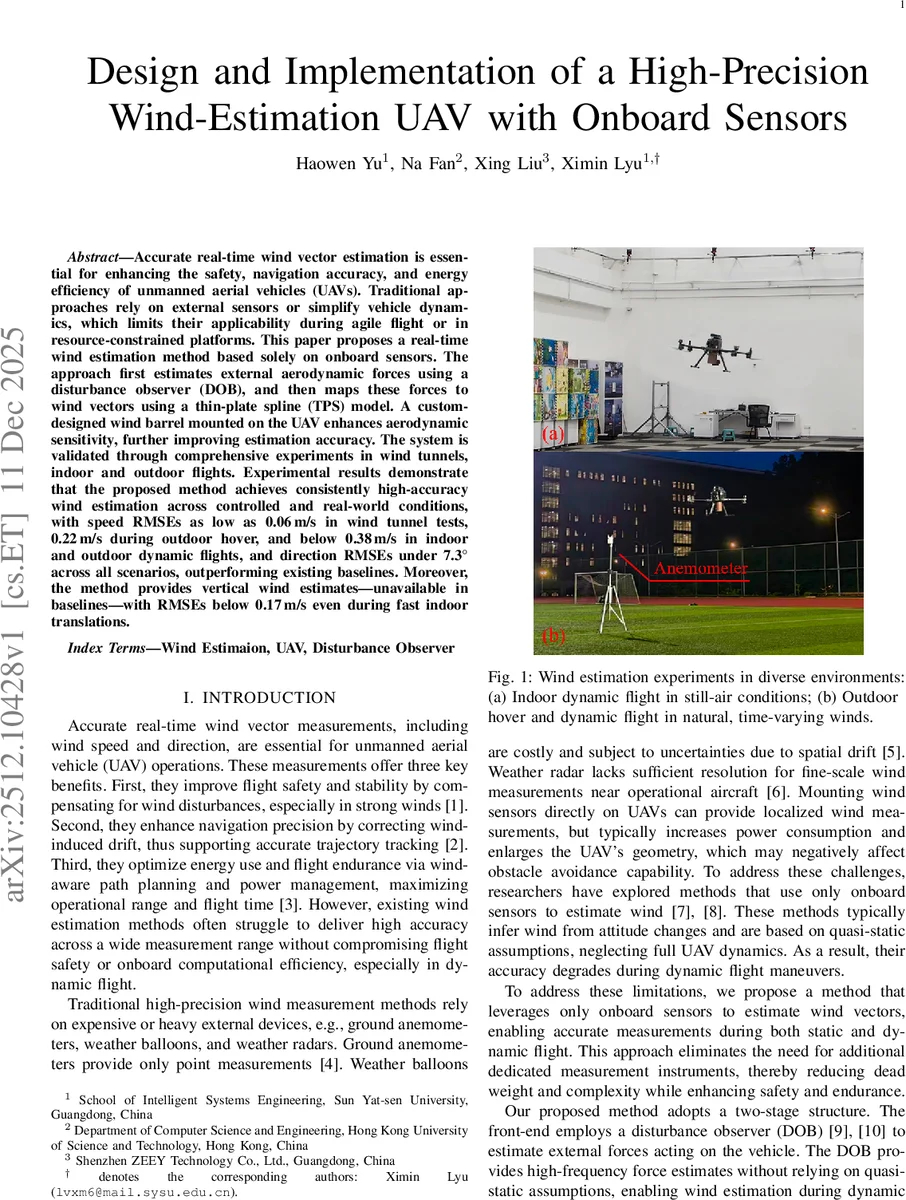
The proposed system was rigorously validated through a series of experiments: controlled wind tunnel tests, indoor dynamic flights in still air, and outdoor flights involving both hovering and dynamic trajectories in natural, time-varying wind. The results demonstrate consistently superior performance compared to baseline methods across all scenarios. In wind tunnel tests, the method achieved remarkable accuracy with speed RMSE as low as 0.06 m/s and direction RMSE of 3.6°. During outdoor hovering in natural wind, it maintained a speed RMSE of 0.22 m/s and direction RMSE of 3.3°, showing strong correlation (r > 0.9) with ground truth. For dynamic flights—both indoor and outdoor—the horizontal speed RMSE remained below 0.38 m/s and direction RMSE below 7.3°. A significant breakthrough is the method’s ability to estimate the vertical wind component, which is unavailable in most baselines. It achieved a vertical wind speed RMSE below 0.17 m/s even during fast indoor translational flights.
In summary, this work successfully demonstrates a practical, self-contained solution for high-precision 3D wind estimation on UAVs. By synergistically combining a model-based DOB for robust force estimation, a data-driven TPS model for accurate mapping, and a simple aerodynamic modification for enhanced sensitivity, the method unlocks reliable wind sensing during agile flight without the need for external, power-hungry sensors. This advancement has strong implications for applications in aerial meteorology, wind-aware navigation, and energy-efficient flight planning.
Comments & Academic Discussion
Loading comments...
Leave a Comment