Evaluating covalency using RIXS spectral weights: Silver fluorides vs. cuprates
We investigate the electronic structure of AgF2, AgFBF4, AgF and Ag2O using X-ray absorption spectroscopy (XAS) and resonant inelastic X-ray scattering (RIXS) at the Ag L3 edge. XAS results were compared with density functional theory computations of the spectra, allowing an identification of main features and an assessment of the theoretical approximations. Our RIXS measurements reveal that AgF2 exhibits charge transfer excitations and dd excitations, analogous to those observed in La2CuO4. We propose to use the ratio of dd to CT spectral weight as a measure of the covalence of the compounds and provide explicit equations for the weights as a function of the scattering geometry for crystals and powders. The measurements at the metal site L3 edge and previous measurements at the ligand K edge reveal a striking similarity between the fluorides and cuprates materials, with fluorides somewhat more covalent than cuprates. These findings support the hypothesis that silver fluorides are an excellent platform to mimic the physics of cuprates, providing a promising avenue for exploring high-Tc superconductivity and exotic magnetism in quasi-two-dimensional (AgF2) and quasi-one-dimensional (AgFBF4) materials.
💡 Research Summary
This paper presents a comprehensive comparative study of the electronic structures of silver fluoride compounds (AgF2, AgFBF4) and their potential analogues, cuprate superconductors, using advanced X-ray spectroscopy techniques. The primary motivation is to evaluate silver fluorides as alternative platforms for exploring high-temperature superconductivity and exotic magnetism, given the chemical similarity between copper and silver.
The research employs X-ray Absorption Spectroscopy (XAS) and Resonant Inelastic X-ray Scattering (RIXS) at the Ag L3-edge (around 3350 eV). A significant experimental achievement is the successful acquisition of RIXS spectra at this “tender X-ray” edge using the Tender X-ray Emission Spectrometer (TEXS) at the ESRF, despite the technical challenges compared to more common L-edge measurements for 3d or 5d transition metals. Measurements were performed on polycrystalline samples of AgF2, AgFBF4, AgF, and Ag2O at 15 K. The experimental results are complemented and validated by Density Functional Theory (DFT) calculations, including the supercell core-hole (SCH) method for simulating XAS spectra.
The XAS results for the d9 compounds (AgF2, AgFBF4) show distinct pre-edge “white line” features, confirming transitions to empty 4d states and enabling subsequent RIXS processes. The RIXS maps reveal rich inelastic spectra for AgF2 and AgFBF4, dominated by two main features: d-d excitations around 2 eV and charge-transfer (CT) excitations above 3 eV. In stark contrast, the d10 compounds (AgF, Ag2O) show essentially only fluorescence lines. The spectral line shape of AgF2, particularly the presence and relative strength of these d-d and CT excitations, bears a striking resemblance to the well-known RIXS spectrum of the parent cuprate La2CuO4 measured at the Cu L3-edge.
A key theoretical contribution of the work is the proposal of a quantitative metric for covalency based on these RIXS spectra. The authors argue that the ratio of the spectral weights of the d-d excitations (W_dd) to the charge-transfer excitations (W_CT) serves as a direct measure of the metal-ligand orbital mixing, i.e., covalency. They provide explicit formulas to calculate these weights as a function of scattering geometry for both single crystals and, crucially, for powder-averaged samples (detailed in an appendix). Applying this analysis, they find that while the spectra of silver fluorides and cuprates are remarkably similar, the W_dd/W_CT ratio is larger for AgF2, indicating that “fluorides are somewhat more covalent than cuprates.”
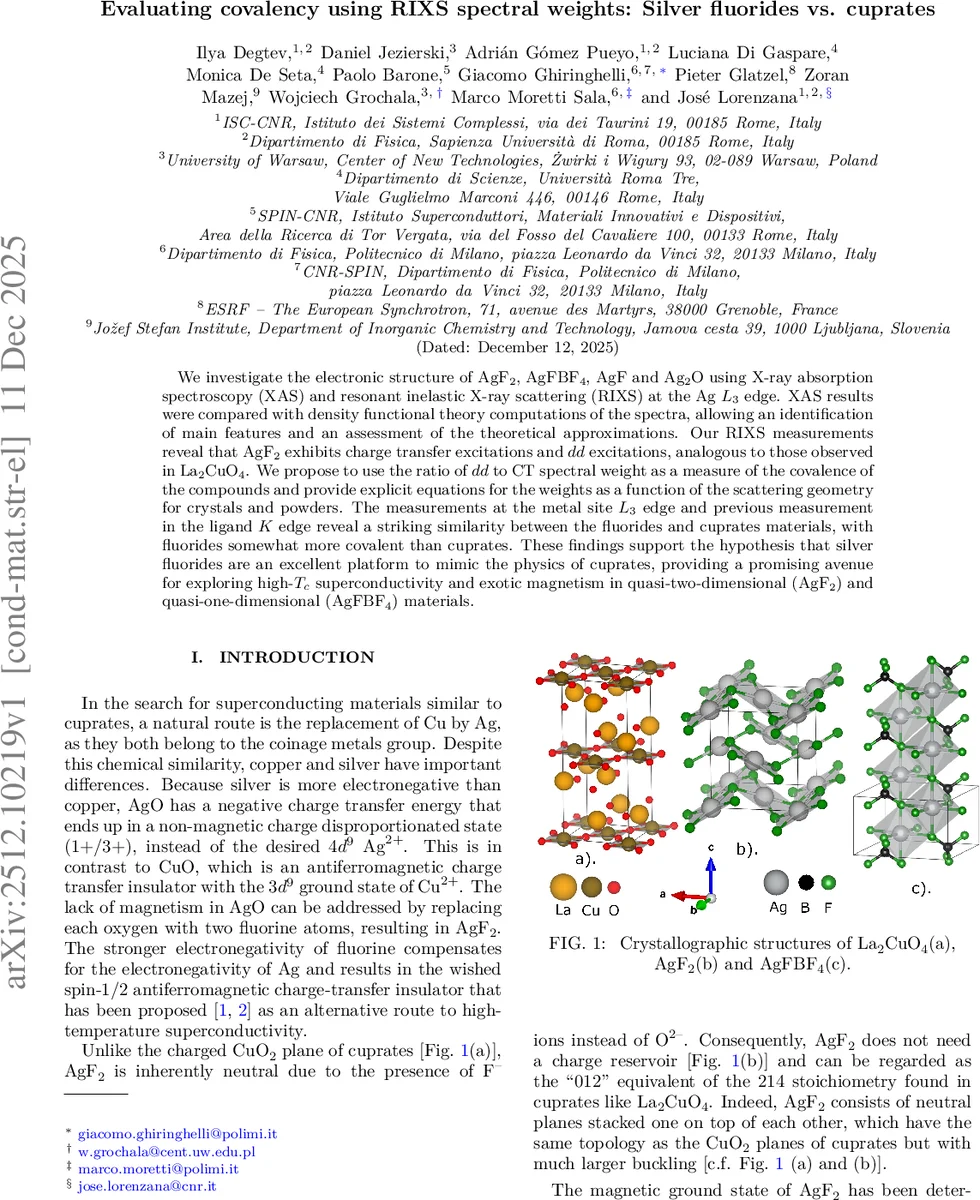
This finding strongly supports the hypothesis that silver fluorides are excellent electronic analogues of cuprates. AgF2 forms neutral layers isostructural to the charged CuO2 planes in cuprates but without the need for charge reservoir layers. The demonstrated covalent, charge-transfer insulator character of AgF2 validates it as a promising starting point for doping studies aimed at inducing superconductivity. Furthermore, the study of AgFBF4 reveals intense d-d excitations consistent with its proposed role as a quasi-one-dimensional Heisenberg magnet with a very large superexchange interaction (J ~ 300 meV), opening avenues for research into exotic magnetic phases.
In conclusion, this work successfully bridges materials synthesis, cutting-edge spectroscopy at a challenging energy range, and theoretical modeling. It provides compelling spectroscopic evidence for the cuprate-like physics in silver fluorides and establishes a novel analytical framework (the d-d/CT weight ratio) for quantifying covalency, thereby paving the way for future exploration of high-Tc superconductivity and quantum magnetism in these alternative material systems.
Comments & Academic Discussion
Loading comments...
Leave a Comment