Clumpy, dense gas in the outflow of NGC 1266
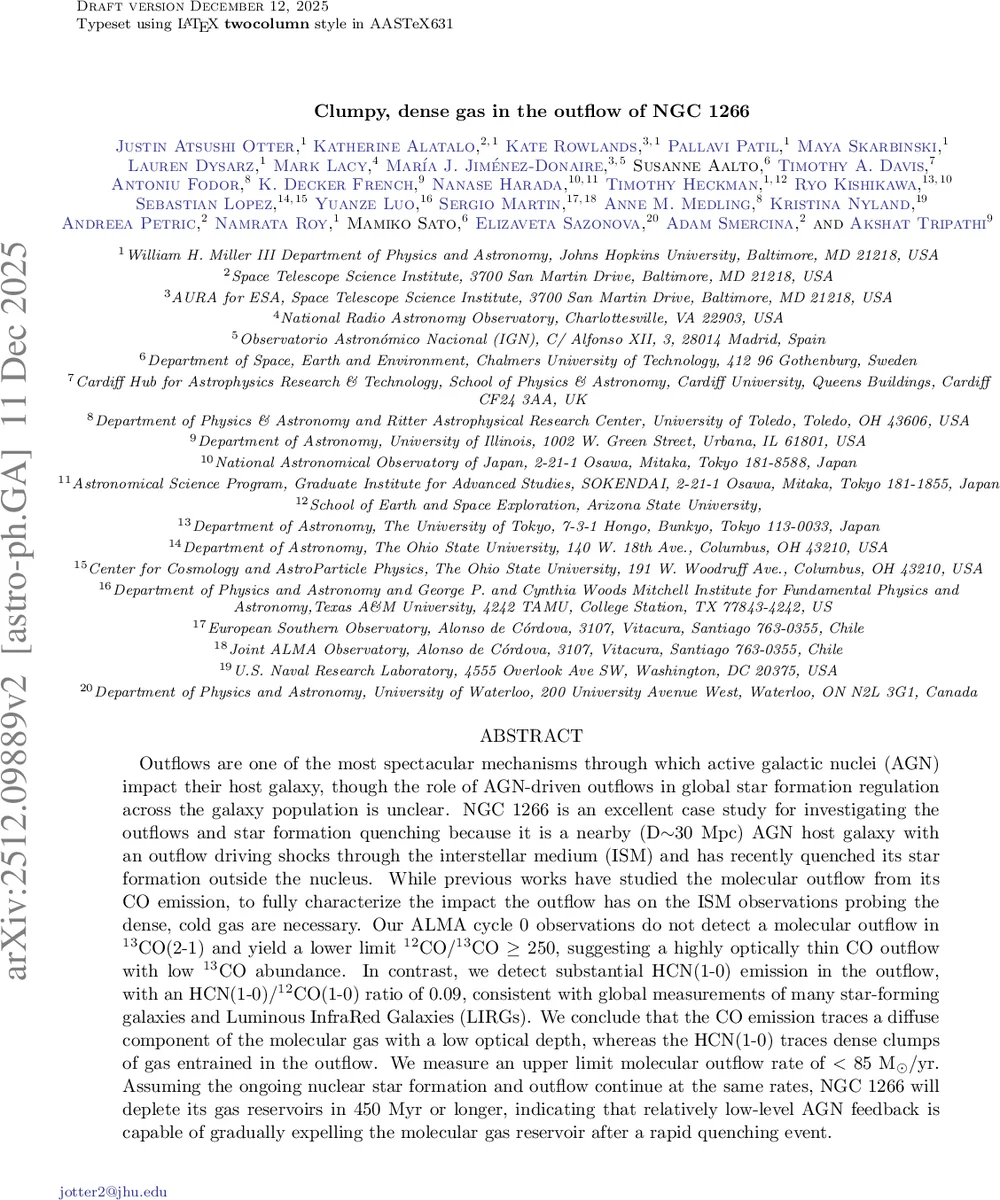
Outflows are one of the most spectacular mechanisms through which active galactic nuclei (AGN) impact their host galaxy, though the role of AGN-driven outflows in global star formation regulation across the galaxy population is unclear. NGC 1266 is an excellent case study for investigating the outflows and star formation quenching because it is a nearby (D\sim30 Mpc) AGN host galaxy with an outflow driving shocks through the interstellar medium (ISM) and has recently quenched its star formation outside the nucleus. While previous works have studied the molecular outflow from its CO emission, to fully characterize the impact the outflow has on the ISM observations probing the dense, cold gas are necessary. Our ALMA cycle 0 observations do not detect a molecular outflow in 13CO(2-1) and yield a lower limit 12CO/13CO \geq 250, suggesting a highly optically thin CO outflow with low 13CO abundance. In contrast, we detect substantial HCN(1-0) emission in the outflow, with an HCN(1-0)/12CO(1-0) ratio of 0.09, consistent with global measurements of many star-forming galaxies and Luminous InfraRed Galaxies (LIRGs). We conclude that the CO emission traces a diffuse component of the molecular gas with a low optical depth, whereas the HCN(1-0) traces dense clumps of gas entrained in the outflow. We measure an upper limit molecular outflow rate of < 85 Msun/yr. Assuming the ongoing nuclear star formation and outflow continue at the same rates, NGC 1266 will deplete its gas reservoirs in 450 Myr or longer, indicating that relatively low-level AGN feedback is capable of gradually expelling the molecular gas reservoir after a rapid quenching event.
💡 Research Summary
This paper presents a detailed study of the molecular outflow in the nearby active galactic nucleus (AGN) host galaxy NGC 1266, utilizing archival ALMA Cycle 0 observations. The focus is on probing the dense, cold phase of the gas within the outflow using the HCN(1-0) line and investigating gas conditions via the 13CO(2-1) line, providing a more complete picture than previous CO-only studies.
NGC 1266 is a key target for understanding AGN feedback and star formation quenching. It is an early-type galaxy at a distance of ~30 Mpc that has recently quenched its star formation outside the nucleus and hosts a prominent molecular outflow likely driven by its AGN. The central question is how this outflow impacts the interstellar medium and contributes to quenching.
The ALMA data in Band 3 (covering HCN(1-0)) and Band 6 (covering 13CO(2-1)) were calibrated and imaged using CASA. To maximize signal-to-noise for spectral analysis, the data were imaged with natural weighting and uv-tapering. The resulting beams were 3.9"x3.3" (~560 pc) for HCN(1-0) and 2.0"x1.9" (~300 pc) for 13CO(2-1).
Spatially, the 13CO(2-1) emission is resolved, extending over about 600 pc, similar to the central concentration of previous 12CO(2-1) maps, but it does not detect the extended southwestern outflow component seen in 12CO. The HCN(1-0) emission remains spatially unresolved within the beam.
The core finding comes from spectral analysis. The integrated spectra of HCN(1-0) and 13CO(2-1) were extracted and fitted with Gaussian models. The HCN(1-0) spectrum is well-described by two components: a narrow component (σ ~50 km/s) and a broad component (σ ~145 km/s). This broad component’s width matches the previously identified outflow component in 12CO lines. In stark contrast, the 13CO(2-1) spectrum shows no detectable broad component; it is fitted only with narrow components (σ < 50 km/s). This non-detection in 13CO implies a lower limit for the 12CO/13CO ratio of ≥250 in the outflow, indicating that the CO-emitting gas in the outflow is highly optically thin and has a very low abundance of the 13C isotope.
A critical ratio was measured for the outflowing gas: HCN(1-0)/12CO(1-0) ≈ 0.09. This ratio is consistent with global values found in many star-forming galaxies and Luminous Infrared Galaxies (LIRGs), suggesting the presence of gas at densities conducive to star formation (n > 10^4 cm^-3) within the outflow itself.
The authors synthesize these results into a coherent picture. They conclude that the molecular outflow in NGC 1266 has a two-phase structure. The 12CO emission traces a diffuse, low optical depth component of molecular gas. Conversely, the HCN(1-0) emission traces dense clumps of gas that have been entrained in the AGN-driven outflow. This represents direct evidence for “clumpy” dense gas within a large-scale galactic outflow.
From the derived properties, the study places an upper limit on the molecular mass outflow rate of < 85 M⊙/yr. By considering the current nuclear star formation rate (~0.7 M⊙/yr) and this outflow rate, the authors estimate that NGC 1266 will deplete its molecular gas reservoir in approximately 450 Myr or longer, assuming these processes continue. This demonstrates that even a relatively low-level AGN, if sustained, can gradually expel a galaxy’s gas following an initial rapid quenching event.
In summary, this work highlights the complexity of AGN-driven outflows, showing they can contain not just diffuse gas but also dense molecular clumps. It underscores the importance of using multiple tracers like HCN and 13CO, beyond common 12CO observations, to fully characterize the physical and chemical state of outflowing material and its ultimate impact on galaxy evolution.
Comments & Academic Discussion
Loading comments...
Leave a Comment