A dynamical order parameter for the transition to nonergodic dynamics in the discrete nonlinear Schrödinger equation
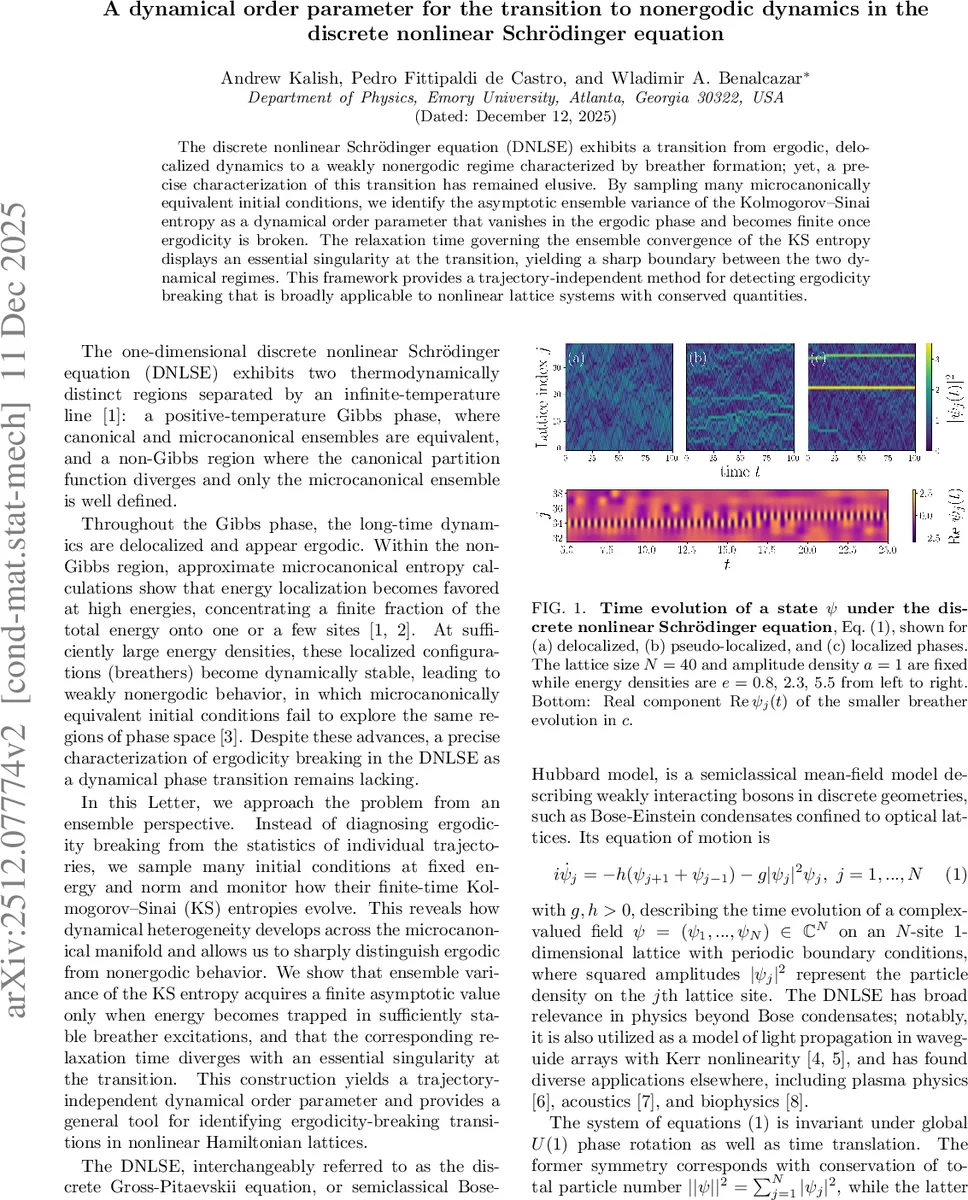
The discrete nonlinear Schrödinger equation (DNLSE) exhibits a transition from ergodic, delocalized dynamics to a weakly nonergodic regime characterized by breather formation; yet, a precise characterization of this transition has remained elusive. By sampling many microcanonically equivalent initial conditions, we identify the asymptotic ensemble variance of the Kolmogorov-Sinai entropy as a dynamical order parameter that vanishes in the ergodic phase and becomes finite once ergodicity is broken. The relaxation time governing the ensemble convergence of the KS entropy displays an essential singularity at the transition, yielding a sharp boundary between the two dynamical regimes. This framework provides a trajectory-independent method for detecting ergodicity breaking that is broadly applicable to nonlinear lattice systems with conserved quantities.
💡 Research Summary
This paper presents a significant breakthrough in characterizing the dynamical phase transition within the Discrete Nonlinear Schrödinger Equation (DNLSE), specifically focusing on the transition from ergodic to nonergodic regimes. In nonlinear lattice systems, the transition from delocalized, ergodic dynamics to a regime dominated by the formation of localized structures known as “breathers” has long been a subject of intense study, yet defining a precise boundary for this transition has proven difficult due to the complexity of nonlinear interactions.
The researchers propose a novel “dynamical order parameter” based on the asymptotic ensemble variance of the Kolmogorov-Sinai (KS) entropy. By sampling a large number of microcanonically equivalent initial conditions, the study demonstrates that the variance of the KS entropy serves as a definitive indicator of ergodicity breaking. In the ergodic phase, where energy is distributed across the lattice, this ensemble variance vanishes as the system explores the phase space uniformly. Conversely, in the nonergodic phase, the emergence of breathers breaks this uniformity, causing the variance to remain finite.
A key technical highlight of this work is the analysis of the relaxation time required for the ensemble to converge. The authors discovered that the relaxation time exhibits an “essential singularity” at the transition point. This mathematical feature provides rigorous evidence of a sharp, well-defined boundary between the two dynamical regimes, rather than a gradual or ambiguous crossover. This discovery is crucial because it elevates the characterization of the transition from a qualitative observation to a precise, quantifiable physical phenomenon.
Furthermore, the methodology introduced here is “trajectory-independent.” Unlike previous approaches that relied on analyzing individual, potentially misleading trajectories, this framework utilizes the statistical properties of an ensemble. This makes the method much more robust and less susceptible to the fluctuations inherent in single-trajectory dynamics. The implications of this research extend far beyond the DNLSE; the proposed framework is broadly applicable to any nonlinear lattice system governed by conserved quantities. This provides a powerful new tool for the physics community to detect and study ergodicity breaking and energy localization in a wide array of complex, many-body nonlinear systems.
Comments & Academic Discussion
Loading comments...
Leave a Comment