Finite groups and arc-transitive maps of square-free Euler characteristic
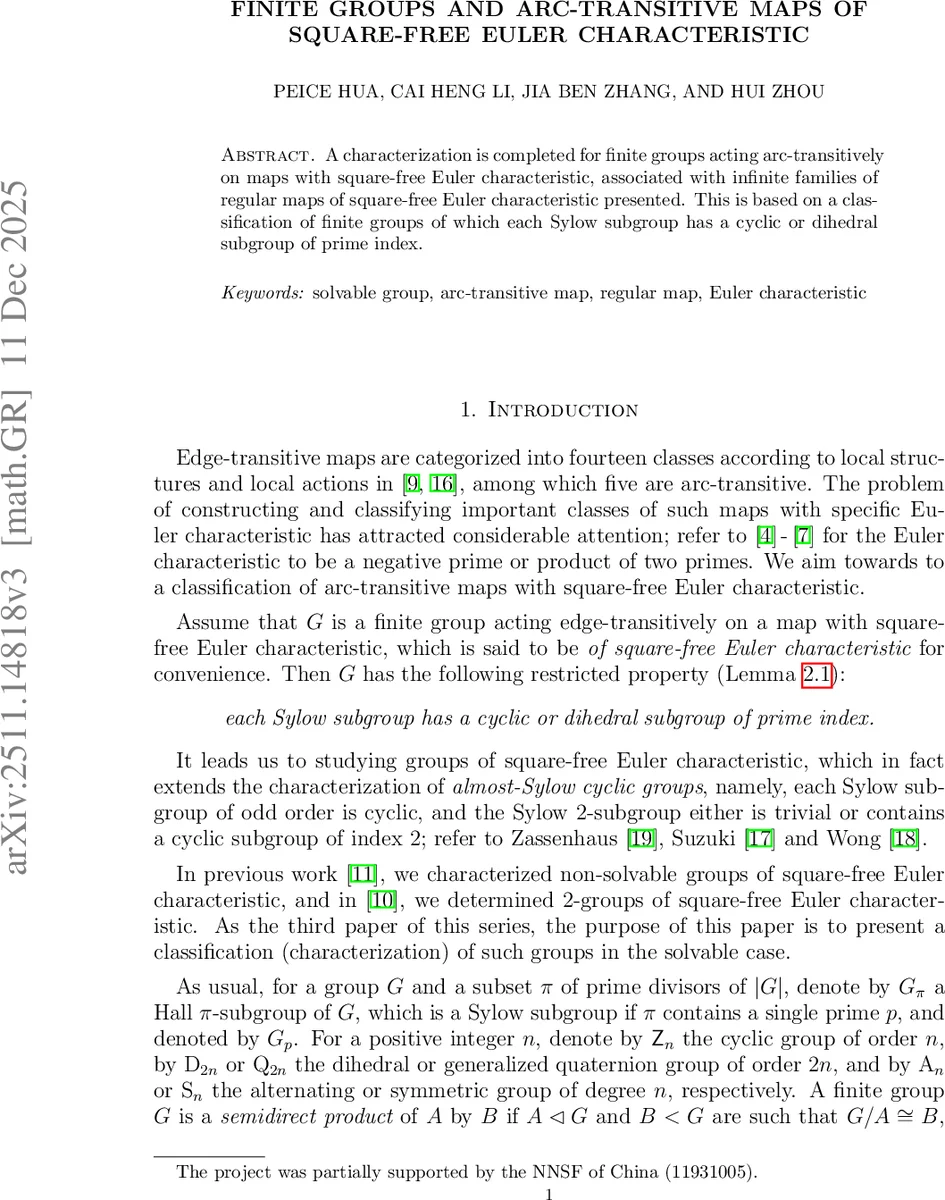
A characterization is completed for finite groups acting arc-transitively on maps with square-free Euler characteristic, associated with infinite families of regular maps of square-free Euler characteristic presented. This is based on a classification of finite groups of which each Sylow subgroup has a cyclic or dihedral subgroup of prime index.
💡 Research Summary
This paper completes the classification of finite solvable groups that act arc-transitively on maps whose Euler characteristic is square-free (i.e., contains no squared prime factors). The work is part of a series aiming to classify important classes of edge-transitive maps with specific Euler characteristics.
The foundation is Lemma 2.1, which establishes a crucial group-theoretic constraint: if a map M has square-free Euler characteristic χ(M), then every Sylow subgroup of its automorphism group Aut(M) contains a cyclic or dihedral subgroup of prime index. This leads the authors to study the broader class of finite groups satisfying Hypothesis 2.2: each Sylow subgroup has a cyclic or dihedral subgroup of prime index. They focus on the solvable case in this paper.
The first main result, Theorem 1.1, provides a complete characterization of finite solvable groups G satisfying Hypothesis 2.2. It states that such a group decomposes as G = H : K. Here, H is the largest normal Hall subgroup of odd order, which itself has the structure A : B, where A is abelian, B is nilpotent, and A ∩ Z(H) = 1. The subgroup K, which involves the Sylow 2-subgroup and potentially Sylow subgroups for primes 3 and 7, is classified into four families: (i) K is trivial or equal to the Sylow 2-subgroup G₂; (ii) K is a Hall {2,3}- or {2,7}-subgroup from a specific list of small groups; (iii) K is a Hall {2,3}-subgroup isomorphic to one of the infinite families X, Y, or W detailed in Table 1 (these involve semidirect and central products of dihedral, quaternion, and cyclic groups); (iv) K is a Hall {2,3,7}-subgroup of the form Z₃² : (G₇ : G₃). The structures of the Sylow 2-subgroups (Proposition 4.1) and odd-order p-subgroups (Lemma 4.3) under Hypothesis 2.2 are determined as prerequisites.
The second main result, Theorem 1.2, refines this classification for groups that are actually arc-transitive automorphism groups of maps with square-free Euler characteristic. It describes the structure G = (A : B) : K, where A, B are as in Theorem 1.1, and then lists the permissible groups K corresponding to the five types of arc-transitive maps: G-arc-transitive (type 1), G-regular (type 1), G-vertex-reversing (types 2* or 2P), and G-vertex-rotary (types 2*ex or 2Pex). For each type, the possible groups K are subsets of those listed in Theorem 1.1, with further restrictions imposed by the algebraic models of these maps (regular triples, reversing triples, rotary pairs).
Beyond classification, the paper constructs infinite families of regular maps with square-free Euler characteristic, proving Theorem 1.3. Section 3 presents three explicit constructions (Constructions 3.1, 3.3, 3.5) based on groups related to D_{2n} ≀ S₂. These yield regular maps M_n whose Euler characteristic is of the form -n(n-3) or -n(n-2). Lemmas 3.2, 3.4, and 3.6 then employ number-theoretic results (e.g., by Erdős and Chen) to demonstrate that for infinitely many values of n (including infinitely many primes in the -n(n-2) case), these values are square-free. The underlying graphs of these example maps are multiple cycles C_n^(n) or Cartesian products C_n □ C_n.
In summary, this paper successfully bridges combinatorial topology and finite group theory. It derives strong algebraic constraints from a topological invariant (square-free Euler characteristic), classifies all solvable groups meeting those constraints, identifies which of those groups can act as arc-transitive automorphisms on maps, and finally provides concrete infinite families of such maps, thereby establishing both the theoretical framework and explicit existence for this class of geometric objects.
Comments & Academic Discussion
Loading comments...
Leave a Comment