Dynamical Masses and Radiative Transfer Modeling of HD 698: a Be Binary in Evolutionary Transition
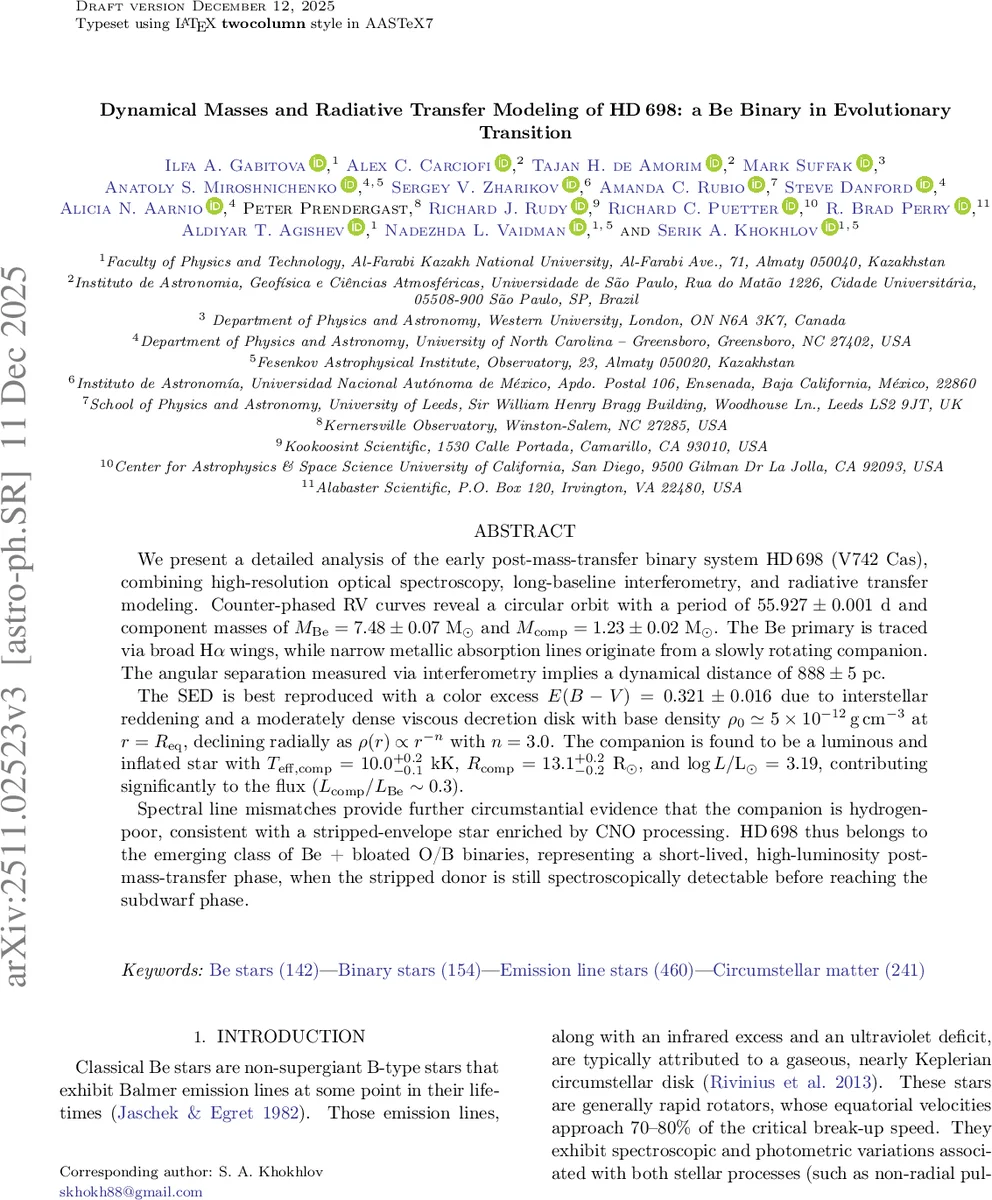
We present a detailed analysis of the early post-mass-transfer binary HD 698 (V742 Cas) combining high-resolution optical spectroscopy, long-baseline interferometry, and radiative-transfer modeling. Counter-phased radial-velocity curves yield a circular orbit with P=55.927+/-0.001 d and component masses M_Be=7.48+/-0.07 M_sun and M_comp=1.23+/-0.02 M_sun. The Be primary is traced by broad H alpha wings, while narrow metallic absorption lines arise from a slowly rotating companion. The interferometric separation implies a dynamical distance of 888+/-5 pc. The spectral energy distribution is reproduced with E(B-V)=0.321+/-0.016 and a viscous decretion disk of base density rho_0~5x10^-12 g cm^-3 at r=R_eq, declining radially as rho(r)r^-n with n=3.0. The companion is luminous and inflated, with T_eff=10.0(+0.2,-0.1) kK, R_comp=13.1+/-0.2 R_sun, and log(L/L_sun)=3.19, contributing significantly to the flux (L_comp/L_Be0.3). Spectral line mismatches further suggest a hydrogen-poor, CNO-processed atmosphere, consistent with a stripped-envelope star. HD 698 thus adds to the emerging class of Be+bloated OB binaries, capturing a brief post-mass-transfer phase when the donor remains spectroscopically detectable prior to the subdwarf stage.
💡 Research Summary
This paper presents a comprehensive study of the early post‑mass‑transfer binary system HD 698 (V742 Cas), combining high‑resolution optical spectroscopy, long‑baseline interferometry, and detailed radiative‑transfer modeling. Historically, HD 698 was a puzzling object with conflicting mass estimates and an unseen companion that led to speculation about a massive compact object. Recent interferometric work resolved the binary, revealing a classical Be star and a luminous, inflated companion. Building on these results, the authors obtained 78 high‑resolution spectra (R ≈ 12 000) spanning 2014–2025, measured metallic line radial velocities, and derived a projected rotational velocity v sin i ≈ 28 ± 5 km s⁻¹ for the narrow‑line component. The low rotation speed, together with the interferometric inclination (i ≈ 119.44°), implies an equatorial rotation of only ~32 km s⁻¹, confirming that the high‑amplitude RV curve belongs to the low‑mass companion rather than the Be primary.
Interferometric observations with the CHARA Array in the H‑band measured a projected separation of 0.663 mas. Combining this angular separation with the orbital solution yields a dynamical distance of 888 ± 5 pc, substantially larger than the Gaia DR3 parallax distance (≈ 703 pc) and consistent with the elevated RUWE indicating unresolved orbital motion in the Gaia solution.
The authors assembled a broad spectral energy distribution from UV (IUE), optical (ground‑based photometry), and near‑IR (NIRIS) data. Radiative‑transfer modeling of a viscous decretion disk around the Be star, with a base density ρ₀ ≈ 5 × 10⁻¹² g cm⁻³ and a radial density exponent n = 3.0, reproduces the infrared excess. An interstellar reddening of E(B–V) = 0.321 ± 0.016 is required. The SED fit indicates that the Be star contributes ~70 % of the total luminosity, while the companion supplies the remaining ~30 %.
Spectral analysis of the companion shows a hydrogen‑deficient atmosphere enriched in CNO‑processed material, with narrow metal lines and a low projected rotation. Atmospheric modeling yields T_eff = 10.0 (+0.2/‑0.1) kK, radius R = 13.1 ± 0.2 R☉, and log L/L☉ = 3.19. These parameters place the companion in the “bloated stripped‑envelope” regime, i.e., a post‑mass‑transfer star that has not yet contracted to a hot subdwarf (sdO/B). The derived masses from the combined RV and interferometric solution are M_Be = 7.48 ± 0.07 M☉ for the Be primary and M_comp = 1.23 ± 0.02 M☉ for the stripped companion, with a circular orbit (e ≈ 0) and period P = 55.927 ± 0.001 days.
The paper situates HD 698 within the emerging class of Be + bloated OB binaries (e.g., LB‑1, HR 6819, HIP 15429) that represent a brief evolutionary phase (∼10⁵ yr) after mass transfer, when the donor star is still luminous enough to be detected spectroscopically before it evolves into a compact subdwarf. The authors discuss how the observed V/R variations in Balmer emission lines, locked in phase with the companion’s RV curve, indicate a tidally perturbed, non‑axisymmetric disk, consistent with theoretical expectations for Be stars in close binaries.
In conclusion, the study delivers the most precise dynamical masses and orbital parameters for HD 698 to date, confirms the presence of a viscous decretion disk around the Be star, and characterizes the companion as a hydrogen‑poor, CNO‑enriched, inflated stripped star. These results provide a valuable benchmark for binary evolution models involving mass transfer, angular‑momentum accretion, and the formation of Be stars, and they highlight HD 698 as a prime target for future UV and X‑ray spectroscopy to probe the remaining envelope and the eventual transition to a subdwarf phase.
Comments & Academic Discussion
Loading comments...
Leave a Comment