Assessing the Effects of Monetary Shocks on Macroeconomic Stars: A SMUC-IV Framework
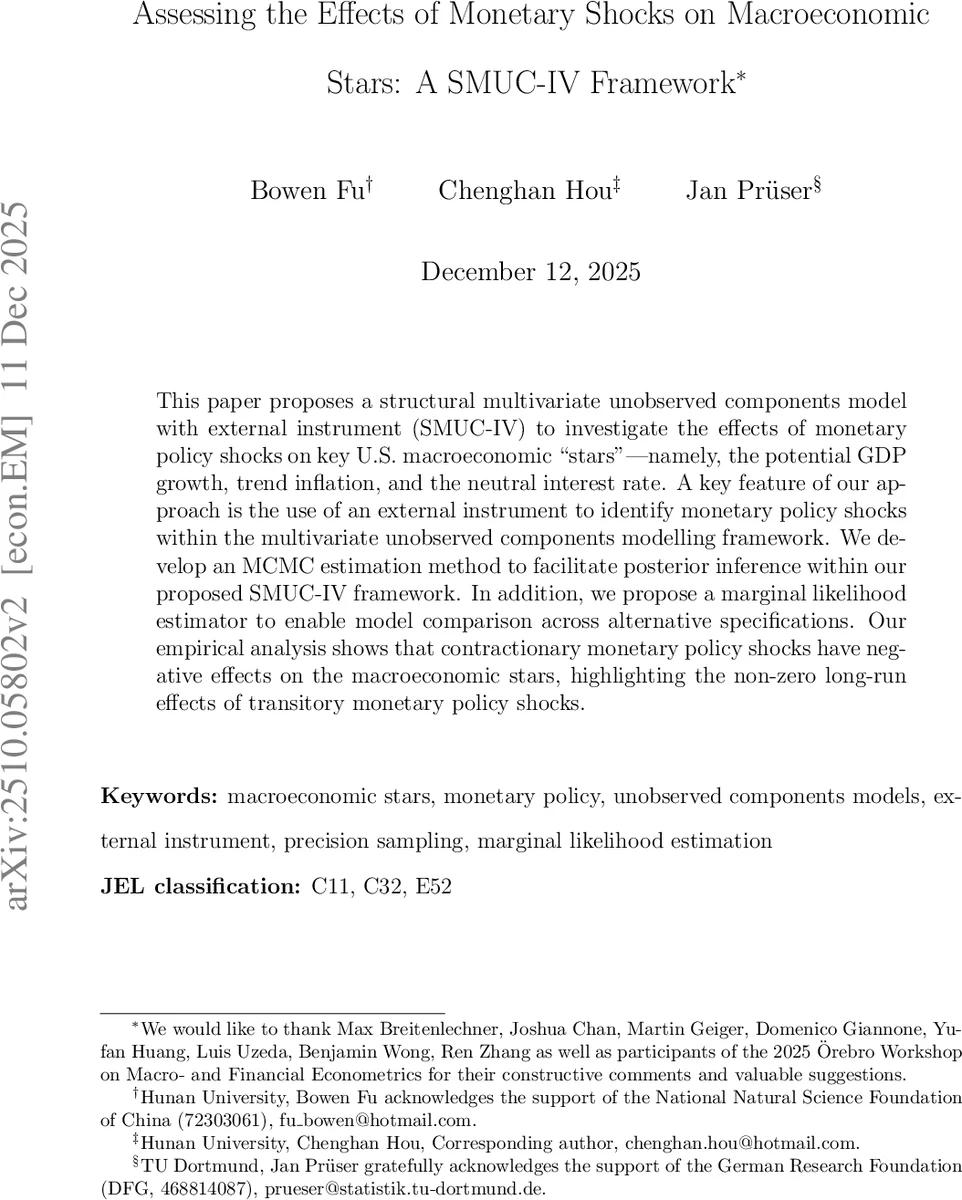
This paper proposes a structural multivariate unobserved components model with external instrument (SMUC-IV) to investigate the effects of monetary policy shocks on key U.S. macroeconomic “stars”-namely, the level of potential output, the growth rate of potential output, trend inflation, and the neutral interest rate. A key feature of our approach is the use of an external instrument to identify monetary policy shocks within the multivariate unobserved components modeling framework. We develop an MCMC estimation method to facilitate posterior inference within our proposed SMUC-IV framework. In addition, we propose an marginal likelihood estimator to enable model comparison across alternative specifications. Our empirical analysis shows that contractionary monetary policy shocks have significant negative effects on the macroeconomic stars, highlighting the nonzero long-run effects of transitory monetary policy shocks.
💡 Research Summary
This paper proposes a novel econometric framework, the Structural Multivariate Unobserved Components model with external Instrumental Variable (SMUC-IV), to assess the long-run effects of monetary policy shocks on key U.S. macroeconomic “stars”: potential GDP growth, trend inflation, and the neutral interest rate. The authors bridge the gap between unobserved components (UC) models, adept at estimating these latent trends, and the external instrument identification strategy prevalent in structural VAR literature.
The core methodology involves decomposing observed real GDP growth, inflation, and the nominal interest rate into permanent trend components (the stars) and transitory cycle components. The trends follow random walks, while the cycles evolve as a VAR(p) process. The key innovation is the identification of a structural monetary policy shock within this UC framework. This is achieved by incorporating an external instrument—specifically, the orthogonalized high-frequency financial market surprise series from Bauer and Swanson (2023)—which is correlated only with the monetary policy shock. This imposes zero restrictions on the contemporaneous impact matrix, allowing for the clean isolation of the policy shock’s effects. The model flexibly allows for correlations among the innovations of all trend and cycle components, contrasting with the common independence assumption in standard UC models.
For estimation, the authors develop an efficient MCMC algorithm based on precision sampling for Gaussian state space models, exploiting the joint Gaussianity between data and states to simplify posterior inference. They also propose an improved modified harmonic mean estimator for the marginal likelihood, enhanced via a conditional Monte Carlo method, to enable rigorous Bayesian model comparison between alternative specifications (e.g., with and without innovation correlations).
The empirical analysis yields two main findings. First, a contractionary monetary policy shock leads to significant and persistent declines in all three macroeconomic stars. Potential GDP growth and the neutral rate fall, consistent with a “supply-demand doom loop” where tighter policy dampens investment and innovation, thereby reducing productivity. Trend inflation also declines, aligning with a re-anchoring of long-term inflation expectations. Second, counterfactual historical decomposition analysis shows that in the absence of major historical contractionary shocks, the levels of these stars would have been notably higher. These results are robust across various alternative model specifications.
The paper concludes that monetary policy can have non-neutral long-run effects on the economy’s supply side and inflation expectations. This creates a potential policy dilemma: disinflation may come at the cost of lower potential growth and a lower neutral rate. The findings suggest a possible role for complementary fiscal policies that support productive capacity during disinflationary periods. The proposed SMUC-IV framework is presented as a unified tool for jointly estimating macroeconomic stars and analyzing their responses to structural shocks, with applicability extending beyond monetary policy.
Comments & Academic Discussion
Loading comments...
Leave a Comment