Aligning Humans and Robots via Reinforcement Learning from Implicit Human Feedback
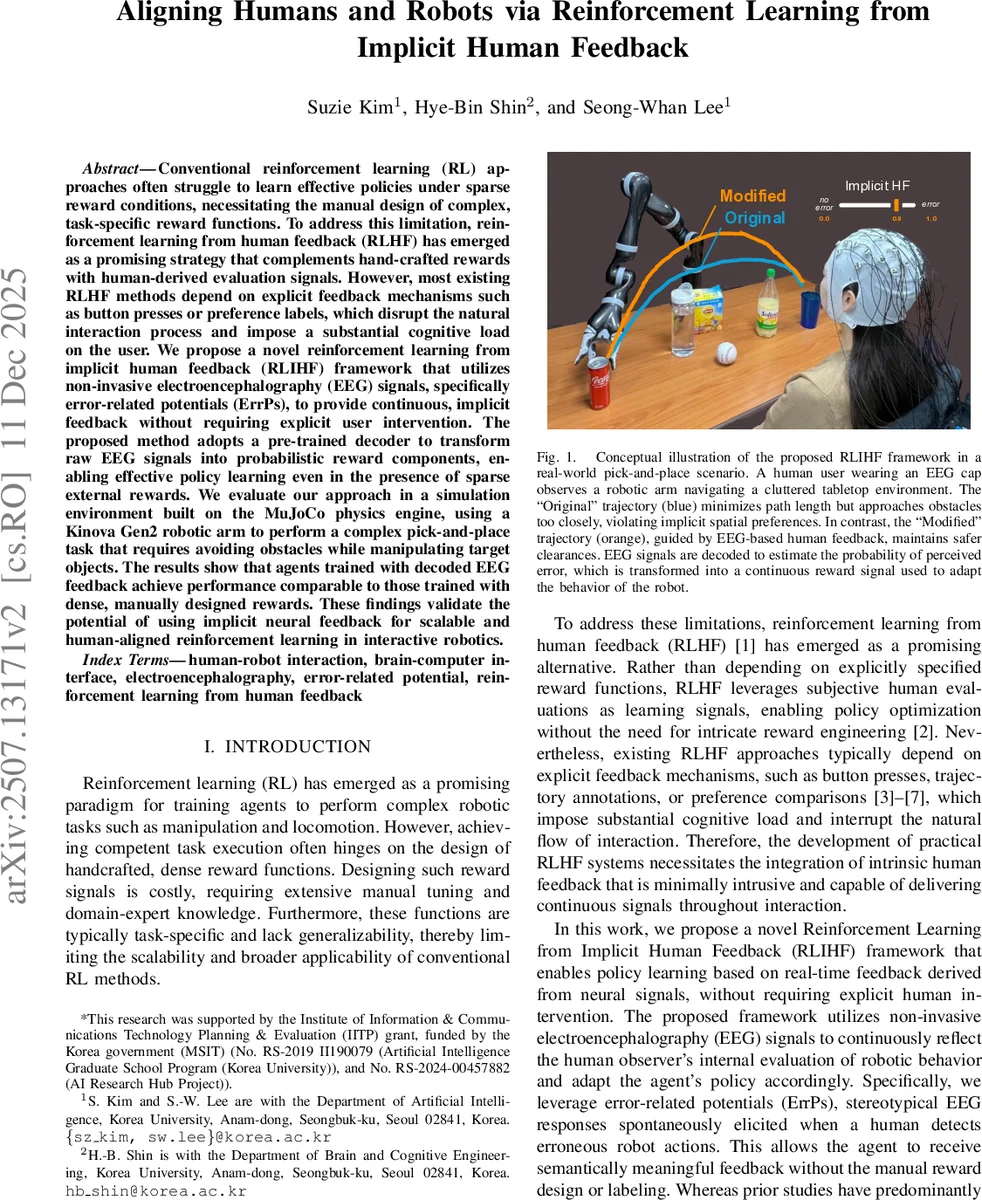
Conventional reinforcement learning (RL) ap proaches often struggle to learn effective policies under sparse reward conditions, necessitating the manual design of complex, task-specific reward functions. To address this limitation, rein forcement learning from human feedback (RLHF) has emerged as a promising strategy that complements hand-crafted rewards with human-derived evaluation signals. However, most existing RLHF methods depend on explicit feedback mechanisms such as button presses or preference labels, which disrupt the natural interaction process and impose a substantial cognitive load on the user. We propose a novel reinforcement learning from implicit human feedback (RLIHF) framework that utilizes non-invasive electroencephalography (EEG) signals, specifically error-related potentials (ErrPs), to provide continuous, implicit feedback without requiring explicit user intervention. The proposed method adopts a pre-trained decoder to transform raw EEG signals into probabilistic reward components, en abling effective policy learning even in the presence of sparse external rewards. We evaluate our approach in a simulation environment built on the MuJoCo physics engine, using a Kinova Gen2 robotic arm to perform a complex pick-and-place task that requires avoiding obstacles while manipulating target objects. The results show that agents trained with decoded EEG feedback achieve performance comparable to those trained with dense, manually designed rewards. These findings validate the potential of using implicit neural feedback for scalable and human-aligned reinforcement learning in interactive robotics.
💡 Research Summary
The paper “Aligning Humans and Robots via Reinforcement Learning from Implicit Human Feedback” introduces a novel framework called Reinforcement Learning from Implicit Human Feedback (RLIHF) to address a core challenge in robotics and reinforcement learning (RL): the dependency on manually engineered, task-specific reward functions. Traditional RL struggles in sparse-reward environments, while existing Reinforcement Learning from Human Feedback (RLHF) methods often rely on explicit, disruptive feedback mechanisms like button presses or preference labels, which impose a cognitive burden on users.
The proposed RLIHF framework circumvents these issues by leveraging implicit, naturally occurring physiological signals. Specifically, it utilizes non-invasive electroencephalography (EEG) to capture a human observer’s internal evaluative state in real-time. The key neural marker employed is the Error-Related Potential (ErrP), a stereotypical brainwave pattern that is spontaneously elicited when a person perceives an error or violation of expectation in a robot’s action.
The technical pipeline of RLIHF operates as follows: A human observer, wearing an EEG cap, watches a robot perform a task. A pre-trained decoder, based on the lightweight EEGNet convolutional neural network, processes streaming EEG data and outputs a probabilistic estimate (p_ErrP) of whether the observer perceived an error at that moment. This probability is transformed into a scalar reward signal using the formula r_ErrP = 1 - p_ErrP, where a high error likelihood results in low reward. This neural-derived reward is then combined with any available sparse environmental rewards (e.g., for task success or collision avoidance). The composite reward signal is fed into the Soft Actor-Critic (SAC) algorithm, an off-policy RL method chosen for its sample efficiency and robustness to noise, to update the robot’s control policy.
The framework was evaluated in a simulated pick-and-place task using a Kinova Gen2 robotic arm within a MuJoCo/robosuite environment. The workspace was cluttered with obstacles, requiring the robot not only to avoid collisions but also to learn implicit human spatial preferences, such as maintaining comfortable clearance margins—a nuance difficult to encode in traditional reward functions. Training was conducted under three conditions: a sparse-reward baseline, a dense-reward baseline with handcrafted shaping, and the proposed RLIHF condition. EEG feedback for RLIHF was simulated using a publicly available dataset (HRI-ErrP) from 12 subjects, with decoders trained in a leave-one-subject-out manner.
The results demonstrated that agents trained with RLIHF consistently and significantly outperformed those trained with only sparse rewards. Crucially, RLIHF agents achieved performance levels comparable to those trained with fully engineered dense rewards, across metrics like episodic return, success rate, and path efficiency. This success was observed despite variability in individual decoder accuracy, indicating a degree of robustness to imperfections in the neural signal decoding process.
In conclusion, the study validates the feasibility of using implicit neural feedback as a continuous, unobtrusive teaching signal for robotic policy learning. By directly translating human internal evaluations into reward signals, RLIHF offers a promising path toward scalable and human-aligned reinforcement learning, with potential applications in collaborative robotics, personalized assistive technologies, and brain-computer interfaces where seamless, natural interaction is paramount.
Comments & Academic Discussion
Loading comments...
Leave a Comment