FE-MCFormer: An interpretable fault diagnosis framework for rotating machinery under strong noise based on time-frequency fusion transformer
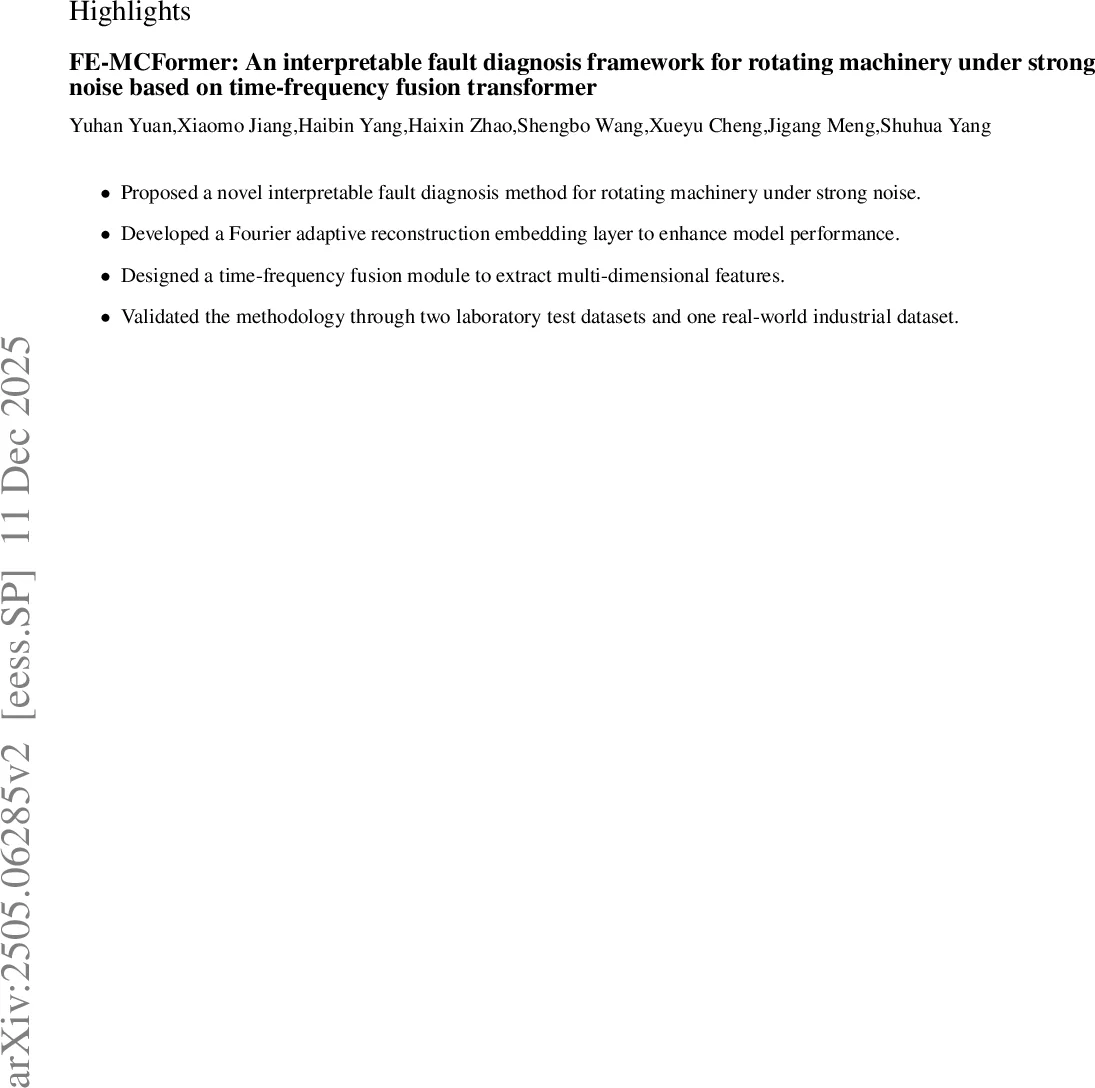
Many fault diagnosis methods of rotating machines are based on discriminative features extracted from signals collected from the key components such as bearings. However, under complex operating conditions, periodic impulsive characteristics in the signal related to weak fault information are often obscured by noise interference. Consequently, existing approaches struggle to learn interpretable fault-related features in such scenarios. This paper proposes a novel transformer framework (FE-MCFormer) to extract interpretable time-frequency features, with the aim of improving the fault detection accuracy and intrepretability of rotating machines under strong noise. First, a Fourier adaptive reconstruction embedding layer is introduced as a global information encoder in the model. Subsequently, a time-frequency fusion module is designed, further improve the model robustness and interpretability. The effectiveness of FE-MCFormer in machine fault diagnosis is validated through three case studies.
💡 Research Summary
This paper proposes a novel deep learning framework named FE-MCFormer for interpretable fault diagnosis of rotating machinery operating under strong noise interference. The core challenge addressed is that weak, periodic fault impulses in vibration signals are often buried under overwhelming noise in industrial environments, making accurate and trustworthy diagnosis difficult for existing methods.
The architecture of FE-MCFormer is designed to synergistically combine the strengths of multiscale convolutional neural networks (MSCNNs) and transformers. It begins with a Fourier Adaptive Reconstruction Embedding Layer (FAREL). This innovative layer acts as a global encoder and adaptive filter. It transforms the input time-series signal into the frequency domain via FFT, applies learnable complex-valued weights to adaptively reconstruct the spectrum (emphasizing or suppressing specific frequency components), and then transforms it back to the time domain via inverse FFT. This process allows the model to inherently highlight fault-related frequency characteristics (like bearing defect frequencies) while suppressing broadband noise, enhancing both robustness and interpretability from the very first layer.
The processed features then pass through a series of Multiscale Time-Frequency Fusion (MSTFF) modules. Each MSTFF module contains two key sub-components:
- Multiscale Convolutional Attention Layer (MSCAL): This layer replaces the standard Multi-Head Self-Attention (MHSA) in transformers. It uses parallel convolutional branches with different kernel sizes (e.g., 1x3, 1x5) to efficiently extract multi-scale local temporal features from the signal, which are crucial for identifying impulse shapes and intervals. It is computationally more efficient than MHSA and better suited for local pattern recognition in signals.
- Time-Frequency Fusion Network (TFFN): This is an enhanced feed-forward network that incorporates a frequency-domain reconstruction operation similar to FAREL. It allows for deep fusion of the local temporal features from the MSCAL with global frequency-domain context, strengthening the model’s nonlinear modeling capacity and global dependency awareness.
Distillation layers are placed between MSTFF modules to prioritize the most salient features. Finally, the refined features are classified via a fully connected layer and softmax activation.
The authors validate FE-MCFormer through three comprehensive case studies using two widely recognized public bearing datasets (CWRU and PU) and one real-world industrial fan dataset. Experimental results demonstrate that FE-MCFormer achieves superior fault classification accuracy compared to state-of-the-art CNN and transformer-based models, particularly under strong additive white Gaussian noise conditions. Furthermore, the interpretability of the model is showcased by visualizing the learned frequency weights in the FAREL, which clearly show amplified responses at known fault characteristic frequencies. Ablation studies confirm the contribution of each proposed component (FAREL, MSCAL, TFFN) to the overall performance.
In conclusion, FE-MCFormer presents a significant step forward by offering a robust, accurate, and interpretable fault diagnosis solution that effectively handles the pervasive challenge of strong noise in industrial rotating machinery monitoring.
Comments & Academic Discussion
Loading comments...
Leave a Comment