📝 Original Info
- Title: LabelFusion: Learning to Fuse LLMs and Transformer Classifiers for Robust Text Classification
- ArXiv ID: 2512.10793
- Date: 2025-12-11
- Authors: Researchers from original ArXiv paper
📝 Abstract
LabelFusion is a fusion ensemble for text classification that learns to combine a traditional transformerbased classifier (e.g., RoBERTa) with one or more Large Language Models (LLMs such as OpenAI GPT, Google Gemini, or DeepSeek) to deliver accurate and cost-aware predictions across multi-class and multi-label tasks. The package provides a simple high-level interface (AutoFusionClassifier) that trains the full pipeline end-to-end with minimal configuration, and a flexible API for advanced users. Under the hood, LabelFusion integrates vector signals from both sources by concatenating the ML backbone's embeddings with the LLM-derived per-class scores-obtained through structured prompt-engineering strategies-and feeds this joint representation into a compact multi-layer perceptron (FusionMLP) that produces the final prediction. This learned fusion approach captures complementary strengths of LLM reasoning and traditional transformer-based classifiers, yielding robust performance across domains-achieving 92.4% accuracy on AG News and 92.3% on 10-class Reuters 21578 topic classification-while enabling practical trade-offs between accuracy, latency, and cost.
💡 Deep Analysis
Deep Dive into LabelFusion: Learning to Fuse LLMs and Transformer Classifiers for Robust Text Classification.
LabelFusion is a fusion ensemble for text classification that learns to combine a traditional transformerbased classifier (e.g., RoBERTa) with one or more Large Language Models (LLMs such as OpenAI GPT, Google Gemini, or DeepSeek) to deliver accurate and cost-aware predictions across multi-class and multi-label tasks. The package provides a simple high-level interface (AutoFusionClassifier) that trains the full pipeline end-to-end with minimal configuration, and a flexible API for advanced users. Under the hood, LabelFusion integrates vector signals from both sources by concatenating the ML backbone’s embeddings with the LLM-derived per-class scores-obtained through structured prompt-engineering strategies-and feeds this joint representation into a compact multi-layer perceptron (FusionMLP) that produces the final prediction. This learned fusion approach captures complementary strengths of LLM reasoning and traditional transformer-based classifiers, yielding robust performance across d
📄 Full Content
LABELFUSION: LEARNING TO FUSE LLMS AND TRANSFORMER
CLASSIFIERS FOR ROBUST TEXT CLASSIFICATION
Michael Schlee
Centre for Statistics
Georg-August-Universität Göttingen
Germany
Christoph Weisser
Centre for Statistics
Georg-August-Universität Göttingen
Germany
Timo Kivimäki
Department of Politics and International Studies
University of Bath
Bath, UK
Melchizedek Mashiku
Tanaq Management Services LLC
Contracting Agency to the Division of Viral Diseases
Centers for Disease Control and Prevention
Chamblee, Georgia, USA
Benjamin Saefken
Institute of Mathematics
Clausthal University of Technology
Clausthal-Zellerfeld, Germany
December 12, 2025
ABSTRACT
LabelFusion is a fusion ensemble for text classification that learns to combine a traditional transformer-
based classifier (e.g., RoBERTa) with one or more Large Language Models (LLMs such as OpenAI
GPT, Google Gemini, or DeepSeek) to deliver accurate and cost-aware predictions across multi-class
and multi-label tasks. The package provides a simple high-level interface (AutoFusionClassifier)
that trains the full pipeline end-to-end with minimal configuration, and a flexible API for advanced
users. Under the hood, LabelFusion integrates vector signals from both sources by concatenating
the ML backbone’s embeddings with the LLM-derived per-class scores—obtained through struc-
tured prompt-engineering strategies—and feeds this joint representation into a compact multi-layer
perceptron (FusionMLP) that produces the final prediction. This learned fusion approach captures
complementary strengths of LLM reasoning and traditional transformer-based classifiers, yielding
robust performance across domains—achieving 92.4% accuracy on AG News and 92.3% on 10-class
Reuters 21578 topic classification—while enabling practical trade-offs between accuracy, latency,
and cost.
Keywords Natural Language Processing · Text Classification · Large Language Models · Ensemble Learning ·
Multi-class · Multi-label
arXiv:2512.10793v1 [cs.CL] 11 Dec 2025
A PREPRINT - DECEMBER 12, 2025
1
Introduction
Modern text classification spans diverse scenarios, from sentiment analysis [1, 2, 3] to complex topic tagging [4, 5, 6, 7],
often under constraints that vary per deployment (throughput, cost ceilings, data privacy). While transformer classifiers
such as BERT/RoBERTa achieve strong supervised performance [8, 9], frontier LLMs can excel in low-data, ambiguous,
or cross-domain settings [10]. No single model family is typically uniformly best: LLMs are powerful, but comparatively
costly, whereas fine-tuned transformers are efficient but may struggle with out-of-distribution cases or extremely limited
training examples.
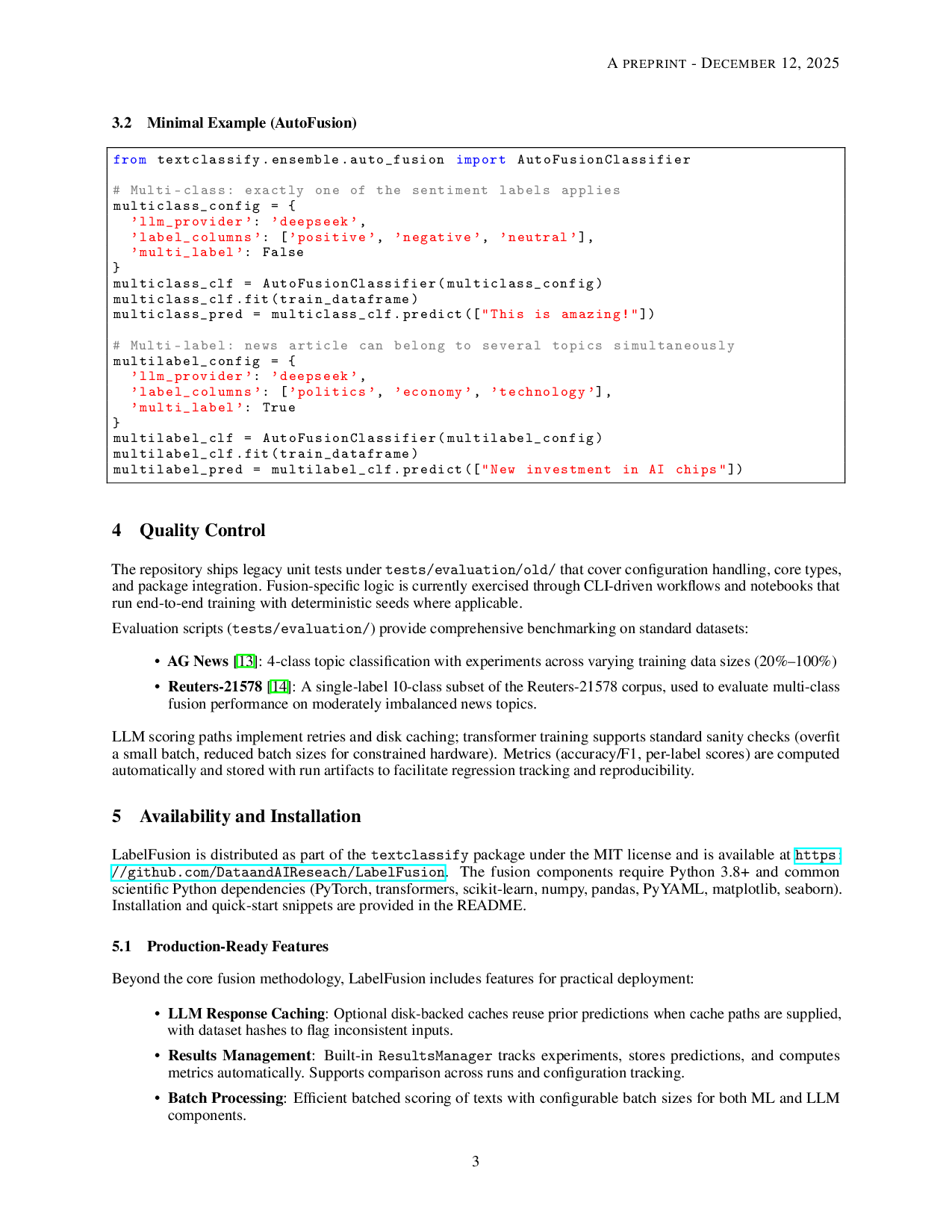
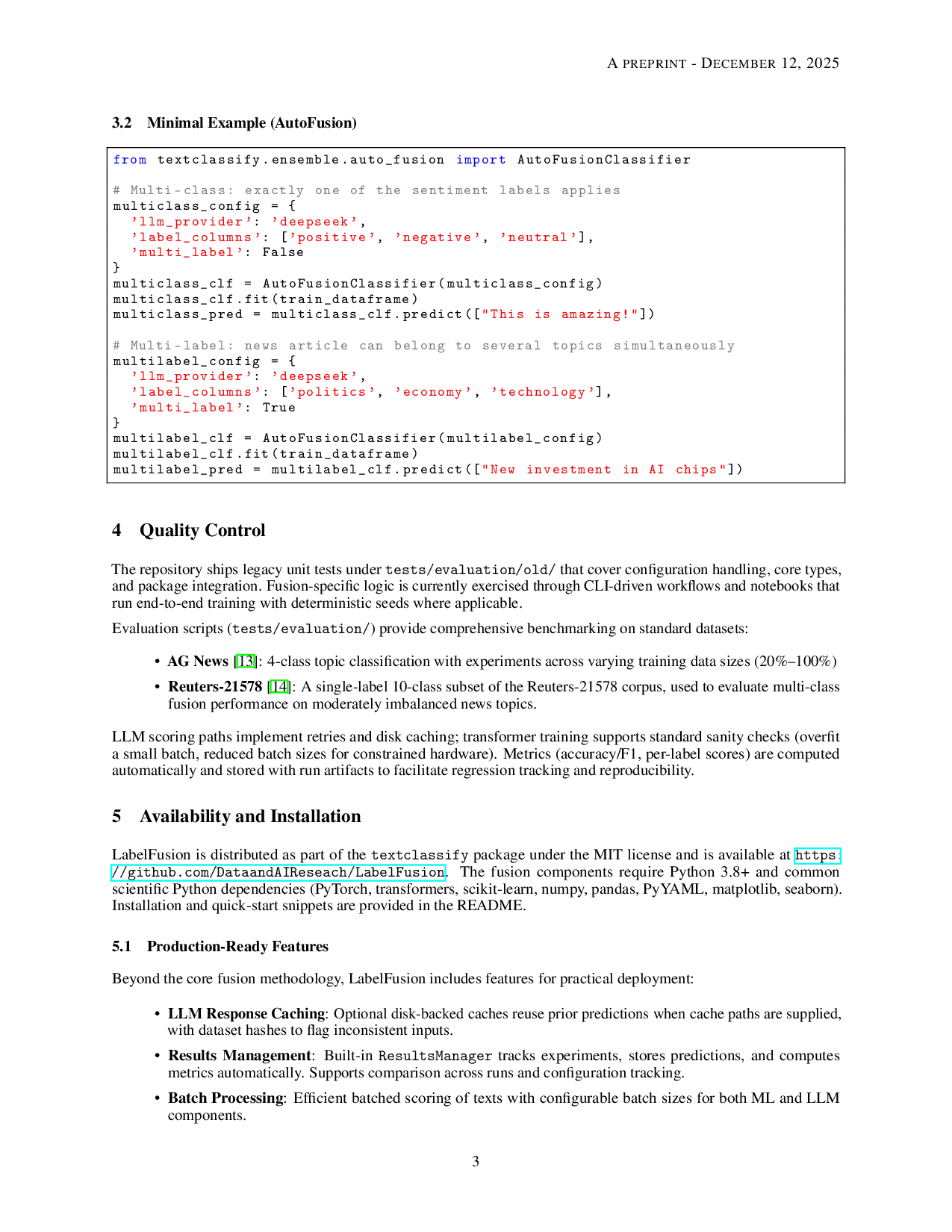
LabelFusion addresses this gap by: (1) exposing a minimal “AutoFusion” interface that trains a learned combination of
an ML backbone and one or more LLMs; (2) supporting both multi-class and multi-label classification; (3) providing
a lightweight fusion learner that directly fits on LLM scores and ML embeddings; and (4) integrating cleanly with
existing ensemble utilities. Researchers and practitioners can therefore leverage LLMs where they add value while
retaining the speed and determinism of transformer models.
2
State of the Field
In applied NLP, common tools such as scikit-learn [11] and Hugging Face Transformers [12] offer strong baselines but do
not provide a learned fusion of LLMs with supervised transformers. Orchestration frameworks (e.g., LangChain) focus
on tool use rather than classification ensembles. LabelFusion contributes a focused, production-minded implementation
of a small learned combiner that operates on per-class signals from both model families.
3
Functionality and Design
LabelFusion consists of three layers:
• ML component: a RoBERTa-style classifier produces per-class logits for input texts.
• LLM component(s): provider-specific classifiers (OpenAI, Gemini, DeepSeek) return per-class scores. Scores
can be cached to minimize API calls when cache locations are provided.
• Fusion component: a compact MLP concatenates information rich ML embeddings and LLM scores and
outputs fused logits. The ML backbone is trained/fine-tuned with a small learning rate; the fusion MLP uses a
higher rate, enabling rapid adaptation without destabilizing the encoder.
3.1
Key Features
• Multi-class and multi-label support with consistent data structures and unified training pipeline.
• Optional LLM response caching reuses on-disk predictions when cache paths are supplied, with dataset-hash
validation to guard against stale files.
• Batched scoring processes multiple texts efficiently with configurable batch sizes for both ML tokenization
and LLM API calls.
• Results management via ResultsManager tracks experiments, stores predictions, computes metrics, and
enables reproducible research workflows.
• Flexible interfaces: Command-line training via train_fusion.py with YAML configs for research; or
minimal AutoFusion API for quick deployment.
• Composable design: LabelFusion can serve as a st
…(Full text truncated)…
📸 Image Gallery
Reference
This content is AI-processed based on ArXiv data.